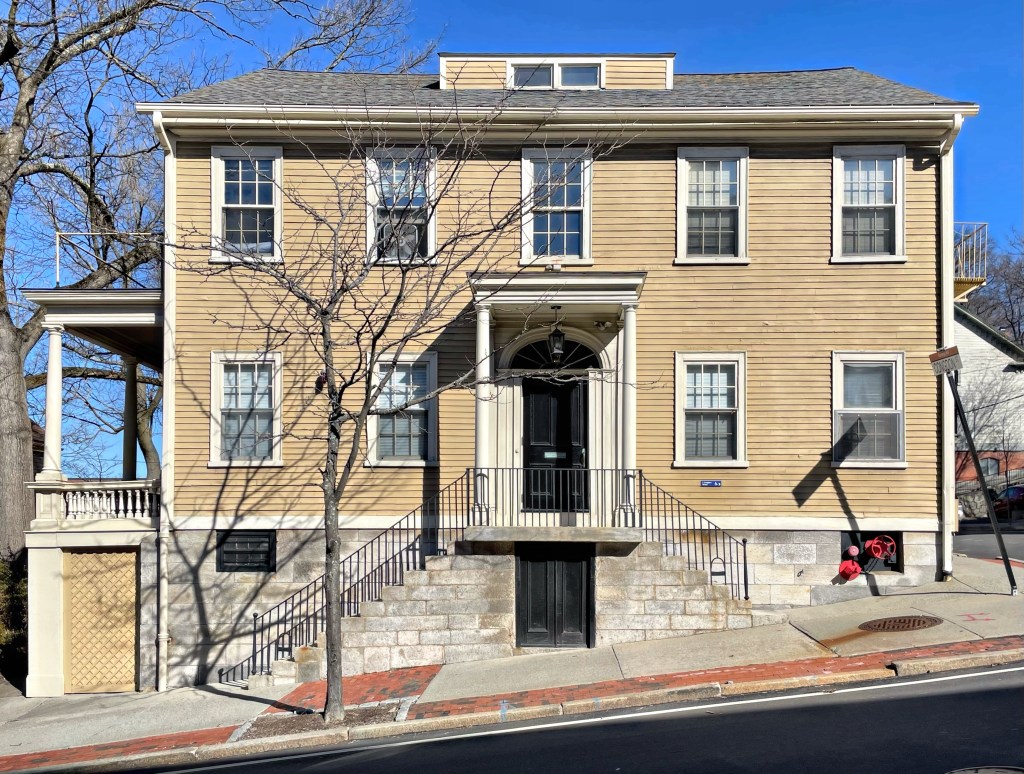
Jonathan Congdon House // 1818

Jonathan Congdon (1763-1862) worked in the hardware and iron business, following his father’s footsteps, eventually taking over the family business. Jonathan married Elizabeth Arnold and had at least nine children together. Two of their sons, Arnold and Welcome, too followed in the family business, as ironworkers and salesmen, with the new firm name, Jonathan Congdon & Sons. The company did well, and Jonathan replaced his c.1787 home on the lot (built at the time of his marriage) with the present structure. He also laid out a street on the side of the property, which was named Congdon Street. The home remained in the Congdon Family until 1937, when it was acquired by the Rhode Island School of Design (RISD).

Providence Plantation Clubhouse // 1926

This Georgian Revival brick building sits behind the Beneficent Church in Downtown Providence and is relatively well hidden off the busier streets. The structure was designed by the firm of Andrews, Jones, Briscoe & Whitmore, for the Providence Plantation Club, a women’s club. The women who gathered under this society were businesswomen, as well as women interested in the social and economic life and political life, at a moment just before they were granted the official right to vote by the US Constitution in 1920. The club was a success, starting with about 150 members and it reached more than 1300 members, just one year after its inception. As the only female architect of the society, Frances E. Henley got involved in promoting the Club in terms of its visuals and interior design. Ms. Henley was the first woman to study architecture at the Rhode Island School of Design and the first woman to independently practice architecture in Rhode Island. Henley was responsible for the interior design for multiple spaces in the building. When the club no longer needed such a building, Johnson & Wales University took it on in 1962. It is now called Wales Hall and houses a variety of offices and services.