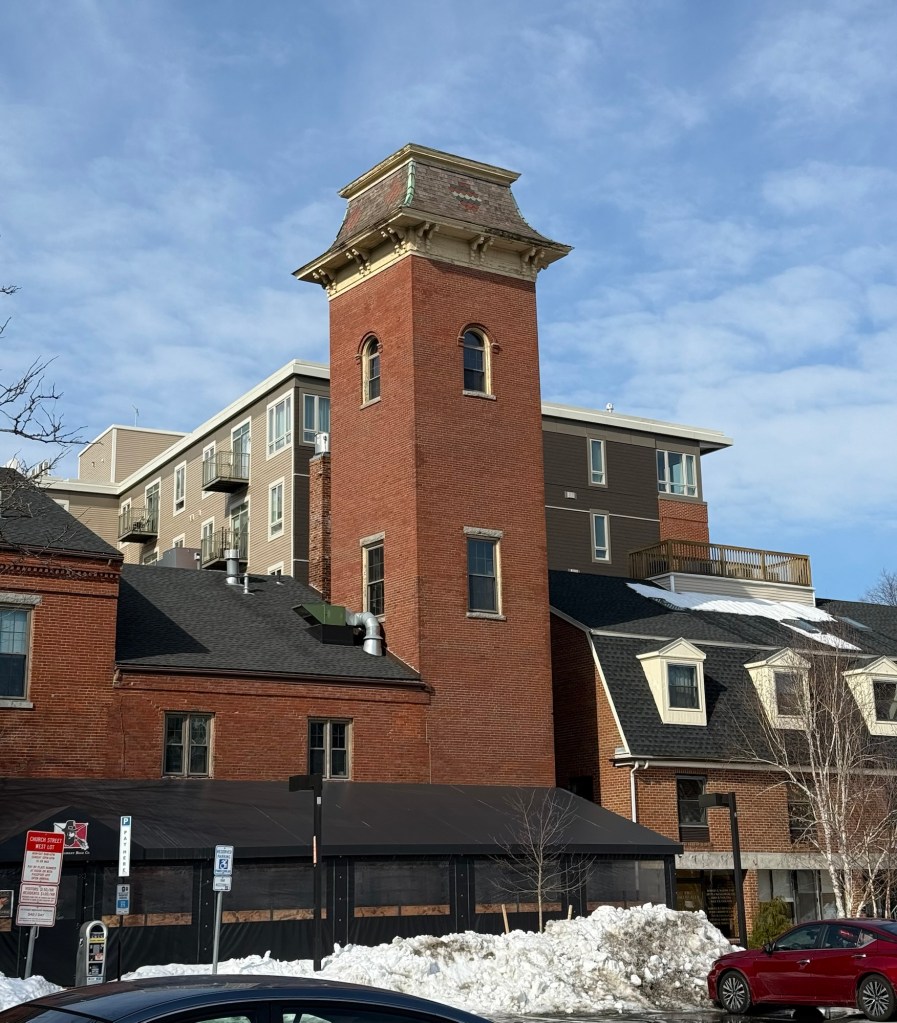
Old Salem Central Fire House // 1861

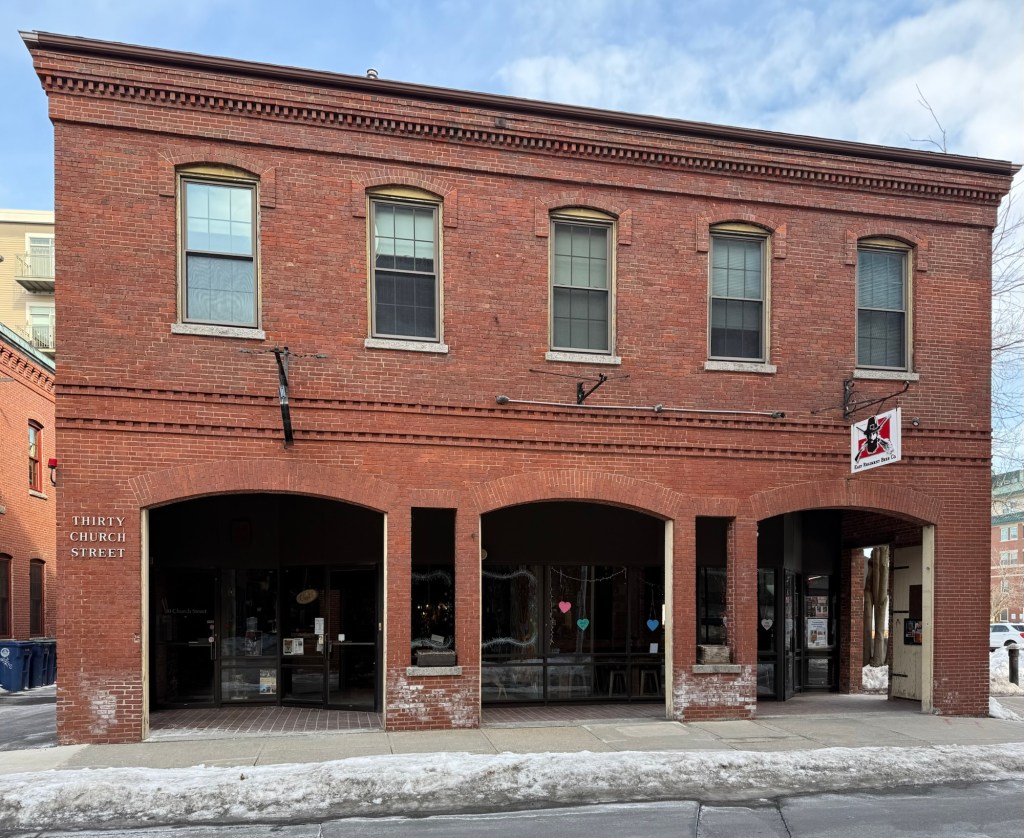
This mid-19th century brick structure on Church Street in Salem, Massachusetts, was built as the Central Fire House for the City. The Salem Fire Engine House was erected in 1861 from plans by an unidentified architect, in an eclectic style focused on function over frills. The façade is dominated by three engine bays with five windows on the second floor, surmounted by a decorative brick cornice. The hidden feature of the fire house is the three-story hose-drying tower capped by a slate mansard roof at the rear of the building. This building remained a fire house for 115 years until 1976, when due to larger fire engines and the tight constraints of the lot and surrounding streets, made use of the building a burden for fire-fighting. The City of Salem sold the building to private owners in 1976  for $24,000, and they underwent renovations to the building from designs by David Jaquith undertaken under the direction of the Salem Redevelopment Authority which sought to promote renovation of select historic buildings within the Downtown Salem Historic District. The recessed entrances through the old engine doors is a nice touch and retains the original fabric of the building. The old Salem Central Fire House is now occupied by Crazy Good Kitchen and the East Regiment Beer Company.
Salem Water Company Offices // 1879

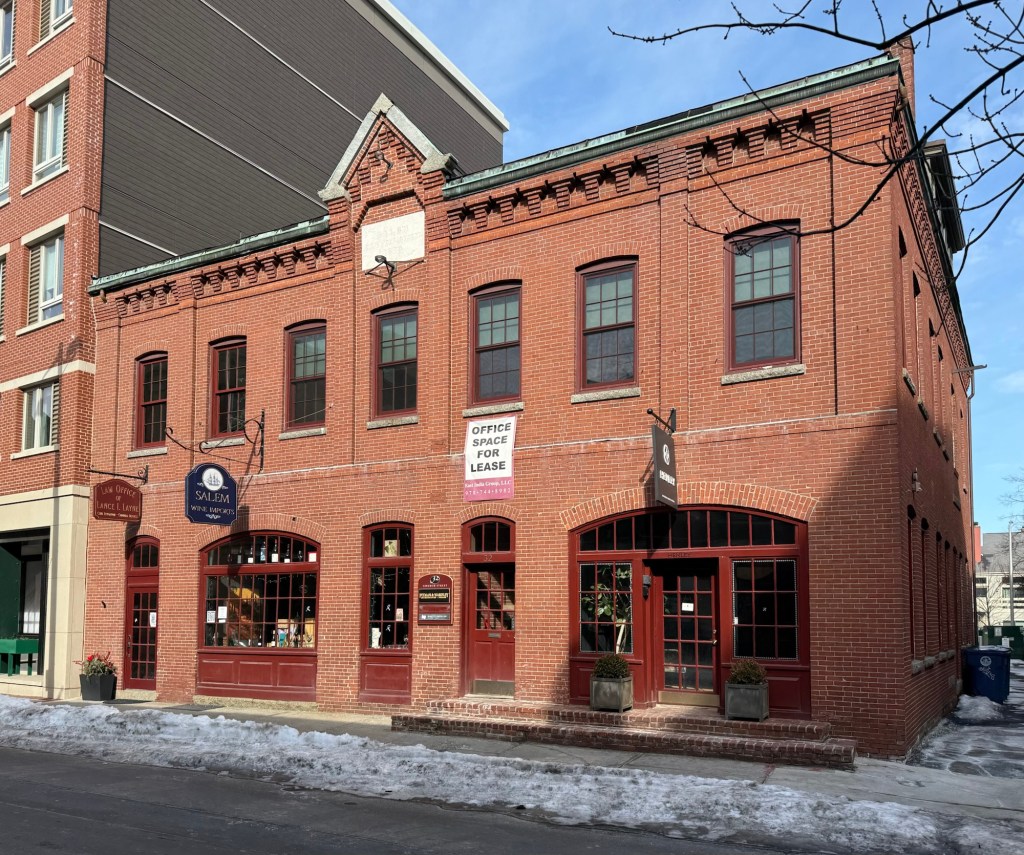
Salem, Massachusetts, was first settled by Europeans in 1626, and it would take 170 years until in 1796, an organization of citizens was established for the purpose of supplying the inhabitants generally of Salem and Danvers with pure spring water. The Salem and Danvers Aqueduct Company was incorporated in 1797  “for the purpose of conveying fresh water by subterraneous pipes into the towns of Salem & Danvers.” As Salem grew, the need for a more central water district and distribution network became a necessity for the health and prosperity of the city. A 1864 law allowed Salem to construct its own water works, and it formed a Board of Water Commissioners who designed and constructed the system. From this, funding was acquired and paid for the laying of tens of thousands of feet of subterranean water distribution pipes connecting the reservoir to buildings and hydrants in Salem. Offices of the Waterworks were scattered and obsolete until 1877, when funds for the construction of this structure at 32-34 Church Street were set aside as the new Water Department Offices. Completed by 1879, the building is a great example of a Romanesque/Italianate style masonry structure with corbelled cornice and arched openings. According to the city directories, this building continued to operate as the Salem Water Works into the late 1930s. By 1945, it was the headquarters of the United States War Price & Rationing Board. In 1964, it held a number of city offices including: Civil Defense headquarters, Fire Department headquarters, Licensing Board, Planning Board, and the City Veterans Service, before being sold by the City of Salem to private ownership in 1976.

Salem Willows Park // 1859

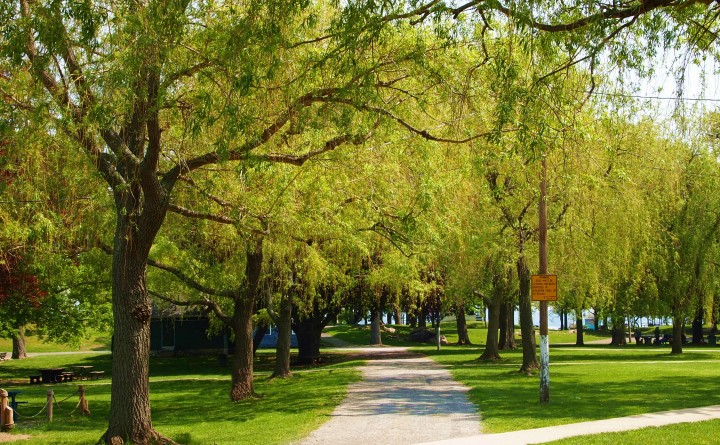
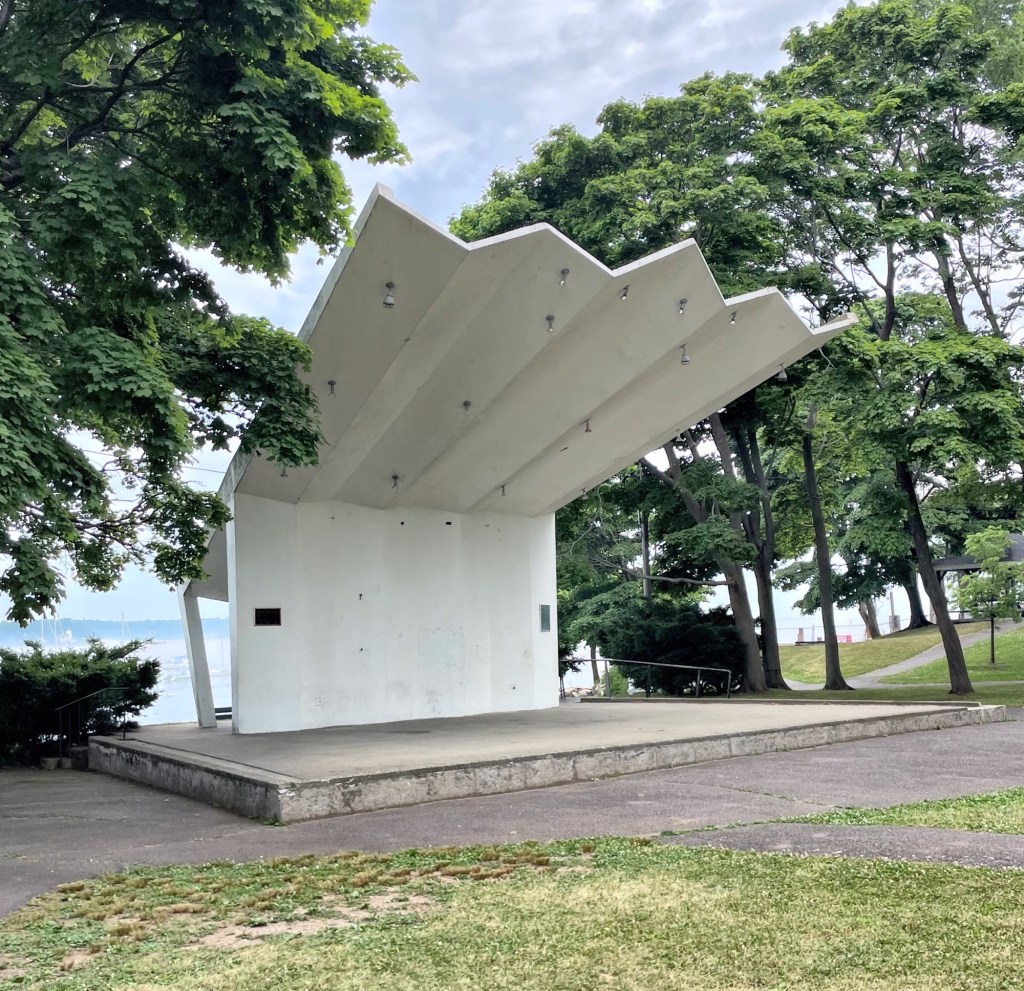
The Salem Willows neighborhood of Salem, Massachusetts sits at the extreme tip of Salem Neck, which juts out into the Atlantic Ocean. The area here was sparsely used until the 19th century, when a smallpox hospital was built here in 1800, mainly used for sailors to recover and be treated. Soon after, a man by the name of Hezekiah Williams planted rows of Willow trees for the enjoyment of patients, which would give the area (and later park) its name. The hospital burned in 1846. Part of the land on the Neck became a park, and a former farm known as the Derby Farm, was purchased and redeveloped with new streets and house lots laid out for summer cottages in the early 1870s. The neighborhood became known as Juniper Point. The Salem Willows Park was enhanced in the late 19th and early 20th centuries with bathing facilities, pavilions, and amusement and commercial buildings. The park is today well-maintained by the City of Salem and is an important protected site that documents the city’s history of the 19th and 20th centuries. I was also pleased to find the 1965 Memorial Shell Band Stand with accordion metal roof designed by the architectural firm of Robert Charles, Associates.

Ropes Mansion // c.1727

The Ropes Mansion in Salem was constructed in 1727 for merchant Samuel Barnard, a native of Deerfield who moved to Salem and made a fortune in trade. Samuel died in 1762, and the property was willed to his nephew and brother. The property was sold in 1768 to Judge Nathaniel Ropes II. Ropes’s short tenure as an associate justice on the Superior Court of Judicature, the highest court in the colony, was marked by a significant controversy over how judges were paid. Because these royal judges were effectively at the mercy of the colonists, the British proposed paying them directly, through the already-unpopular colonial taxes. This action further outraged Massachusetts patriots, who feared that the judges would become partial to the Crown over colonial interests. Due to this significant backlash from colonists and Patriots, there was significant pressure on these judges to not accept their royal salaries, including Judge Ropes, who promised that he would not accept the royal salary. Although he had refused his royal salary, he nonetheless held Loyalist views, and his position as a high-ranking judge made him a symbol of British power in the colony. According to tradition, in March 1774 an angry mob attacked the house, throwing mud, sticks, and rocks at the windows and calling for Ropes to renounce his allegiance to the Crown. However, at the time Nathaniel was in his bed, gravely ill with smallpox, and he died the following day, with the stress from the mob supposedly being a contributing factor in his death at just 47 years old. With the death of the last two unmarried Ropes sisters, Mary and Eliza, the house and grounds were bequeathed to the Essex Institute (now the PEM) by 1907 for the purpose of establishing a school of botany, as a perpetual memorial to the Ropes family. The stunning public gardens there were laid out in 1912 John Robinson.

Bertram Mansion – Salem Public Library // 1855

One of the most substantial homes in Salem, Massachusetts has to be the Bertram Mansion, built in 1855 for Captain John Bertram (1796-1882). The high-style Italianate dwelling was erected on a parcel formed from four house lots upon which several buildings
had stood (they were all either moved or demolished). Captain Bertram, who became Salem’s most wealthy citizens, was born
into a family of moderate means on the Isle of Jersey off the coast of France. He and his family came to the United States in 1807, but their language barrier and the economic fallout in Salem from the embargo of goods from the War of 1812, left the family impoverished. At the age of 16, he had begun work as a sailor aboard merchant vessels and by 28, he had become a shipmaster. His desire to be successful led him to invest his earnings on very risky investments and deals, almost all were successful. Due to this, he was able to retire from the sea in 1832, at the age of 36. Growing up in poverty, Bertram in his adulthood used his wealth to help the less fortunate. An early gift of $25,000 and a brick mansion in Salem led to the creation of the Salem Hospital in 1873. After his death, in keeping with his tradition of philanthropy, his heirs donated the family home to the City of Salem for use as a public library in 1887. The brick mansion with brownstone trim and quoins has been used as a library ever since, and is thus, one of the nicest libraries in the state!

James Braden House // 1867

One of the most stunning homes in Salem (and obviously has the best Halloween decorations every year) is the James Braden House on Federal Street. This Italianate style home was built in 1867 for James Braden, a tanner who made his fortune in manufacturing leather which coincided with Salem’s shifting from maritime trade hub to industrial center. The home he built packs a lot of architectural detail and intrigue into a typical box form. The faux ashlar wood facade and corner quoins make the house appear like stone giving it weight and a strong presence on the street, while the recessed entry with a large, highly-ornamented door hood on scroll bracket give the home the traditional Victorian flair. James Braden died in 1895, and his mansion was willed to his widow Margaret, who rented the home until her death in 1907.

Seaman’s Orphan and Children’s Friend Society // 1878

I loooooove history! I am sure you all realize that by now, but it amazes me to stumble upon a building and find such rich history behind it. When I saw this building on Carpenter Street, nextdoor to the Edwards-Machado house, I assumed it was a former apartment or tenement building, but after closer inspection of the house marker, I found that it was built as the Seaman’s Orphanage. According to the 1861 Salem Directory, the Seaman’s Orphan & Children’s Friend Society was founded “to ameliorate the condition of the fatherless and the widow”. It formed from two predecessor organizations. One was The Seamen’s Widow and Orphan Association, formed in 1833. The other was the Salem Children’s Friend Society, organized in 1839 “for the purpose of rescuing from evil and improving the condition of such children as are in indigent and suffering circumstances and not otherwise provided for”. The Seaman’s Orphan Society itself was made up of well-to-do merchants and their wives, who shared their wealth with the families of mariners who had died ashore or been lost at sea, leaving widows, fatherless children, and sometimes, orphans. These seafaring men, employed by the merchants to sail their vessels, faced dangers from storms, disease, and enemies at sea and on land. Often the sailors died in the service of the merchant, leaving little for the subsistence of their families. This is where the ship-owning merchant families stepped in, to be sure that no family in Salem would suffer from hunger or want. The new building was largely funded from families and companies and opened in 1878. The upstairs rooms were used as dormitories. The upper floors also featured a play-room, hospital, nursery, bathrooms, and rooms for matron and assistants. Downstairs were the administrative offices and a dining room. The orphanage closed here in 1949, and two years later, became the Newhall Nursing Home.

William Jelly House // 1905

Ernest Machado, the Cuban-American architect mentioned in the last post is credited with designing this massive Colonial Revival mansion on Beckford Street in Salem. The house was constructed in 1905 for William Jelly, a teller at the Salem Five Cent Savings Bank. William’s family-owned property on the street before he acquired the property, seemingly from his father. Ernest Machado was a locally significant architect who designed stately city mansions and enchanting country estates for some of Boston’s wealthiest families in the late 19th- and early 20th centuries. This home is setback off the street and faces the side, a common practice for larger homes in narrow urban lots. The house has a five bay symmetrical facade facing south, with clapboard sheathing, rusticated quoins, and a modillion cornice. It is topped by a gambrel roof, which has two large interior brick chimneys at the ridge. A Chippendale patterned balustrade stretches between three pedimented dormers which rise above the roof on main facade. Who else loves Colonial Revival houses?!

Edwards-Machado House // 1807

Tucked away on Carpenter Street, one of my favorite Salem houses, the Edwards-Machado House stands out as the only brick house on the street, for good reason! In 1803, Joseph Edwards, a carpenter, purchased this piece of land and built a three-story wooden house for his family. Just three years later, a large fire destroyed the home, the family’s belongings, and at least two neighboring homes. Undeterred, Edwards built the present house to replace the one lost in the fire in 1807, once he received his insurance, but this time, he constructed the home of fireproof brick! He sold the house not long after, and the property went through many hands in the 19th century, many owners renting the property to families. In 1877, the property was sold to John Bertram, one of Salem’s greatest benefactors who lived at 370 Essex Street which he later gave his mansion to the city for use as a public library. Bertram rented out the former Edwards home to the Machado family.

Immigrants from Cuba, the patriarch, Juan (John) was a cattle rancher in Cuba. He came to the United States in the early 1850s to escape having to take the loyalty oath to Spain, as he believed in Cuban independence. In the U.S. he entered school in Manchester-By-the Sea in order to learn English. In Massachusetts, he met his future wife, Elizabeth, and took her back to Cuba where they remained for over ten years. In 1868, just before the beginning of the Ten Years War in Cuba, Juan, his wife and their children left for the final time after he had freed his slaves and distributed his cattle to various relatives. In Salem, he worked as a spanish teacher and translator. His son, Ernest, became famous as a prominent Cuban-American architect. Ernest attended MIT and studied architecture before entering the office of Shepley, Rutan & Coolidge, the successors of the great architect H. H. Richardson. In the late 1890’s Machado opened his own architectural firm, with offices in Salem and Boston, and designed many large Colonial Revival estates for wealthy New England families. Tragically, Ernest died in New Hampshire, when his canoe capsized, drowning at 39 years old.

Orne-Derby House // 1808

It’s rare to find a house with so much potential in Salem, a town where seemingly every old house has been purchased and lovingly maintained or restored. This home on Federal Street could use some TLC to restore her to her former glory. In 1808, William Orne Jr., a housewright and his wife Polly acquired a mortgage for the lot here and he built a large, Federal style home with gambrel roof, showcasing his building skills. The property was a little more than the couple could handle financially, which was compounded by the War of 1812, and the Royal British Navy blockading maritime trade, which especially hurt Salem’s port. The Orne House was sold in 1817 to Captain John Derby III, who died just a year later, leaving his widow Sarah (Felton)
Derby all his estate. Sarah rented the home to family, but was allowed to live there until her own death in 1857. The stunning home with fanlight at the front door, historic wood windows, and pair of large brick end chimneys all could be saved with a good restoration of the home. Fingers crossed!