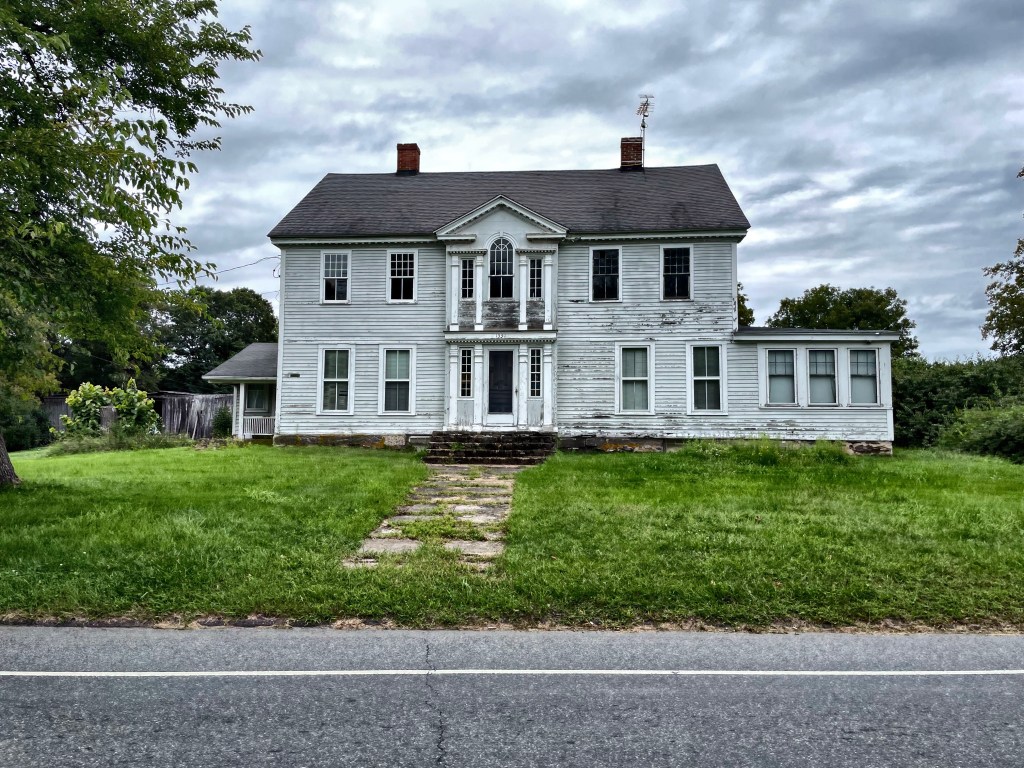
Located on Main Street in Southbury, this stately Federal style mansion stands out as one of the most unique and interesting in town! The house here was originally built in the 1760s as a more modest Georgian house by members of the Curtiss Family, one of the earliest families to settle in the area after land here was purchased from the Potatuck Native Americans. In the early 19th century, the house was modernized in the fashionable Federal style, giving the house the present appearance. The facade is dominated by an excellent doorway with a projecting Palladian portico above. The property was later owned by Benjamin Fabrique.
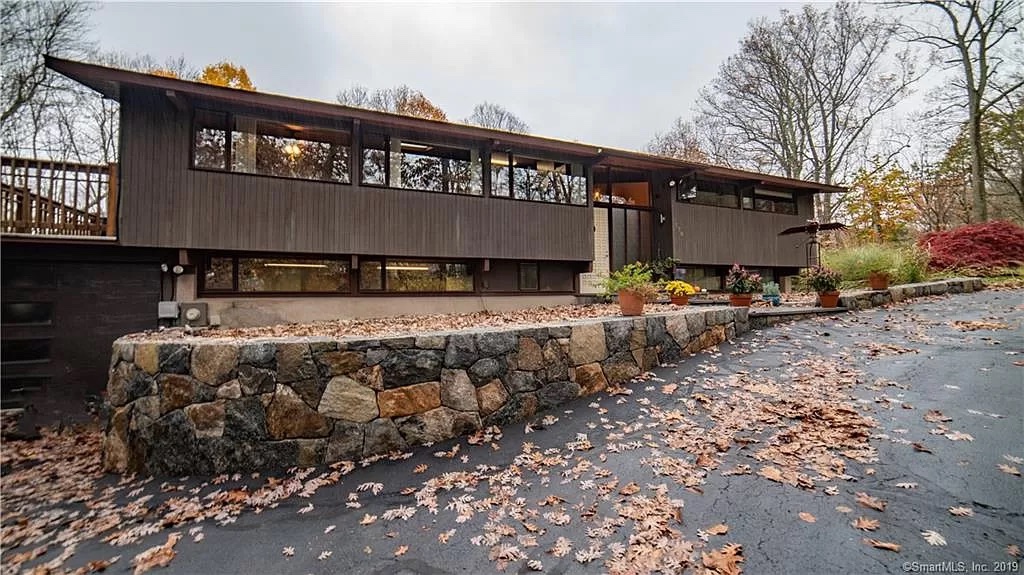
I don’t share Mid-Century buildings on here enough, mostly due to the fact that so many of the houses of the period are secluded down winding driveways and surrounded by trees! This stunning house is located in Southbury, Connecticut, and is a great example of a Deck House. The Deck House was a housing type developed by architect Carl Koch. According to At Home With Tomorrow, he began his lifelong mission to create “the good, the beautiful, and the inexpensive” in housing while at Harvard under the guidance of Walter Gropius, who is famous for the development of the Modernist Movement in architecture. After the war, he turned his focus on the housing shortage, a symptom of the Great Depression, WWII, and returning Veterans with growing families and VA mortgage loan offers. His solution was for an affordable house of pre-fabricated parts to cut costs and provide streamlined construction. In 1953, his Techbuilt house was launched, after a decade of research. William Berkes and Robert Brownell had worked with Koch at Techbuilt after graduate school, but wanted to create a design of their own. They left Techbuilt in 1959 and founded Deck House, using the same principles. The exposed Douglas fir beams, wood panel ceilings and mahogany trim and window casements are what give the deck house a lot of its signature aesthetic. A wall of glazing, open floor plan with sloping roof rafters extending beyond the walls and a low placement in seemingly untouched nature are further elements that have endeared these houses to the modern homeowner.
The Adin Wheeler House is significant as a rare house form found in this part of New England. Located in Southbury, Connecticut, the property includes the main house, a barn, and the wheelwright shop, a barn-like structure. The house is a 1-1/2-story Cape style wood-frame structure, with a front porch across the front that is sheltered by a bell-cast extension of the main roof. This type of porch roof is uncommon in Connecticut, being reminiscent of Dutch rather than English construction methods. The dwelling was built for Adin Wheeler, who owned the millworks on the nearby falls with business partner Enos Candee, a business partner (and brother-in-law) whose house also stands nearby. Theodore Wheeler, Adin’s great-grandson, built the wheelwright shop in the late 19th century, as well as the major addition to the house, which served as a tap room and public meeting space. The property is a well-preserved collection of 18th and 19th century structures.
This charming cottage shows that you do not need a stately or elaborate house to have some serious curb appeal and house envy. This is the Benjamin Osborn House, located in Southbury Connecticut. The house was built in the early 20th century for newlyweds Benjamin B. Osborn and Sarah Stiles, who married in 1808. As a gift to the couple, Sarah’s father Ephraim Stiles, who lived in a house across the street, seemingly deeded a portion of his property for his daughter and son-in-law to build their family. Tragically, Sarah died one year later, possibly during childbirth. Benjamin would marry another of Ephraim’s daughters soon after… messy. The home is a four-bay Cape, with its off-center entrance sheltered by a Colonial Revival hip-roofed portico supported by Tuscan columns.
It always amazes me that even getting lost driving the winding roads in obscure places, can reveal some of the most magical old buildings and history to uncover. This stunning Federal style mansion was built in 1806 and is located on the busy Southford Road in Southbury, Connecticut. The road was a span along a turnpike was the great thoroughfare between New Haven and Litchfield, Connecticut. Present-day Southbury was about halfway between the two, so lodging was always busy here. Knowing this, brother’s in-law, John Thompson and Benjamin Hurd had this turnpike hotel built to capitalize on the flow of weary travelers. Charles R. Oatman (1827-1904), who married Orinda T. Hurd, the daughter of Benjamin Hurd, acquired the property in 1870 and operated the hotel under his name as the Oatman Hotel. After successive owners, the name remained. It was sold in the 20th century and was converted back to single-family use, and maintains much of its original fabric, including a barn at the rear of the property. It could definitely use a new coat of paint!
The Reuben Curtiss House is a classic example of a Greek Revival farmhouse from the mid-19th century, located in Southbury, Connecticut. Local history states that a house built here by Israel Curtiss (1716-1795) who farmed the land with his large family. In 1798, Israel’s large estate was distributed among three of his sons, Joseph, Benjamin, and Reuben. This was complicated by the fact that in the same year, both Joseph and Benjamin died, leaving the entire estate to Reuben. From about 1840 and possibly until he sold the property in 1866, Reuben B. Curtiss ran an academy here, known as “Buck Hill Seminary for Boys.” It was a large operation, as suggested by the size of the addition and confirmed by the 1850 federal census. At that time there were 23 students in residence, ranging in age from 8 to 12, along with four adult supervisors. It was likely that the former farmhouse was expanded and the present 1840s Greek Revival block was added which now is the main facade.




 Buildings of New England