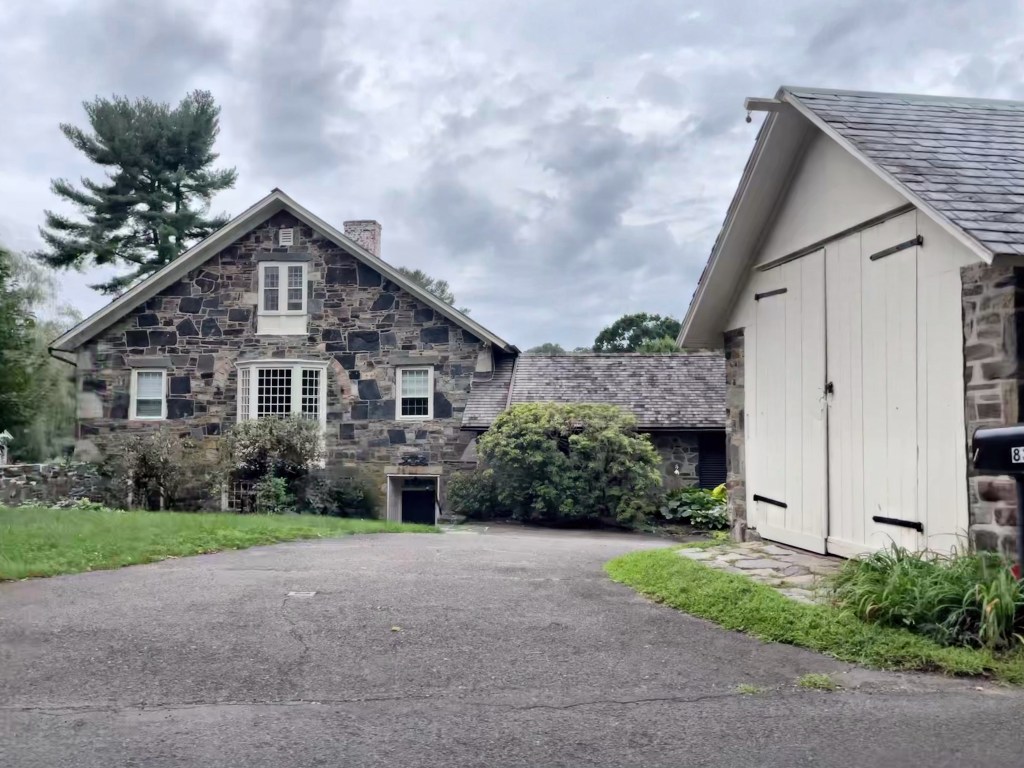
Frederic Bronson Barn // c.1895

Not many buildings in Greenfield Hill, Fairfield, Connecticut showcase the neighborhood’s transition from farming community to affluent suburb quite as well as this stone barn turned house on Hillside Road. The stone barn was constructed around c.1895 for Frederic Bronson Jr. (1851-1900) a prominent New York attorney and treasurer of the New York Life and Trust Company which was founded by his grandfather, Isaac Bronson. In about 1892, Frederic demolished his ancestral home and hired architect Richard Morris Hunt to design a new country estate for his family. The house was called Verna and is also located in Fairfield. Today Verna is known best as the Fairfield County Day School. As with many wealthy men of the Gilded Age, Frederic wanted his rural retreat to also work as a gentleman’s farm, where he could have staff farm and tend to livestock on the expansive rolling hills bounded by historic stone walls. He appears to have had this barn built for his livestock shortly after the main house, Verna was completed nearby. Bronson died in 1900 and some of the property was later sold off. This property was acquired by a Charles Stillman in 1941 and it is likely him that converted the barn into a charming residence.
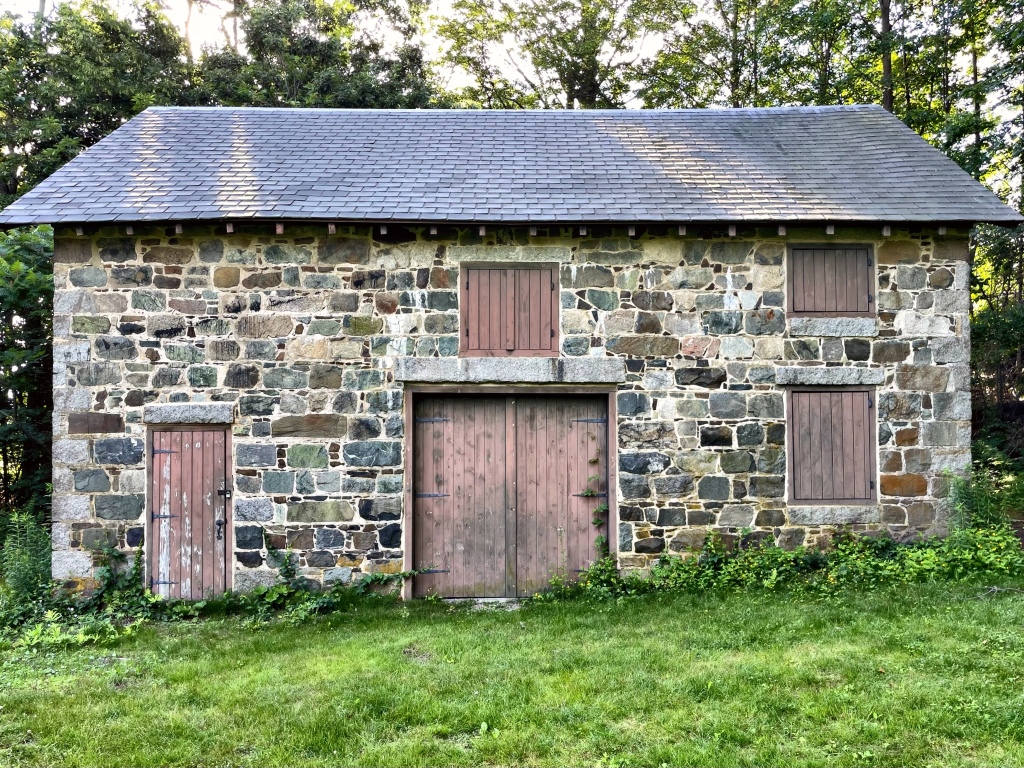
Tudor Barn // c.1845

Built in the 1840’s as a carriage barn, and once attached to a nearby mansion now gone, this barn sits near the eastern shores of Spot Pond, a major feature in the Middlesex Fells Reservation, just north of Boston. The barn sits in Stoneham, Massachusetts, and was a part of Frederic Tudor’s rural estate out in the “country”. Frederic Tudor is best known as Boston’s “Ice King”, he was the founder of the Tudor Ice Company and a pioneer of the international ice trade in the early 19th century. He made a fortune shipping ice cut from New England ponds to ports in the Caribbean, Europe, and as far away as India and Hong Kong. After the turn of the 20th century, many of the buildings surrounding Spot Pond were razed as to secure the watershed, protecting the surrounding town’s drinking water. Frederic Tudors large estate was razed, but the barn survived. Years of deferred maintenance and lack of preservation by the late 1990’s made the old barn threatened with demolition. This was exacerbated by a fire damaging the roof and in 2003, a wall collapsed. Local preservationists rallied together to acquire funding (both private and public grants) to restore the building. It remains a highlight on the walks around Spot Pond and Middlesex Fells Reservation, and is a visual link to the earlier days in what was once remote “Boston”.

Pettee Stone Barn // c.1840

Built adjacent to the stone cottage, this stone barn was also constructed in around 1840 by Otis Pettee (1795-1853) as part of his business venture. Pettee was a major mill owner in the Upper Falls Village of Newton and was a major silk manufacturer in the area. The stone barn was used as a warehouse and later as the location for raising silk worms for the silk mills down the street. As with the adjacent stone cottage/shop, Pettee likely built the barn of mostly stone on the site as a fireproof design to protect his valuable product. It is now home to Danish Country & Modern, an amazing furniture shop which sells Scandinavian furniture and accessories.