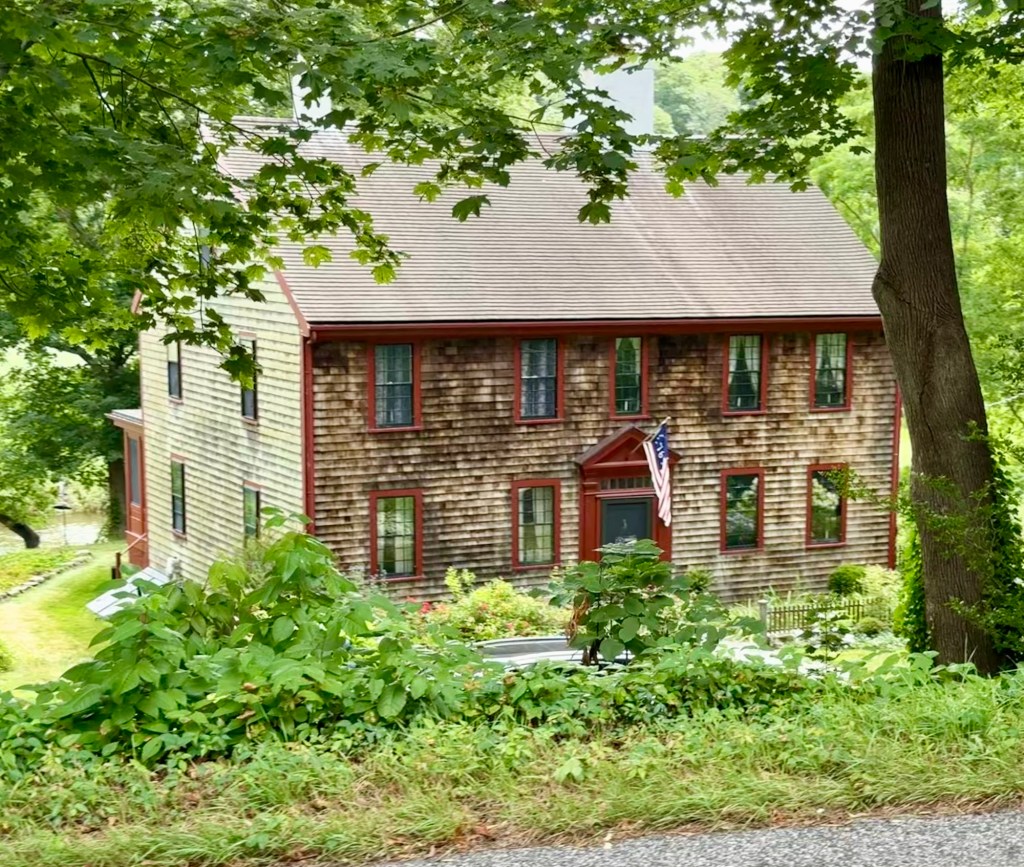
Built on the banks of the Jones River in Kingston, Massachusetts, this large residence is said to date to 1772 and was the home to a prominent ship-building family as well as to hundreds of destitute residents of the community who lived and worked here as the town’s poor house. Land (and possibly an earlier house) was acquired in 1772 by Zenas Drew (1735-1822), the son of Cornelius Drew, a wealthy shipbuilder who employed his many sons to work in the same industry, and the existing house was constructed for his family. From the house, numerous shipyards would be seen with large brigs travelling down the Jones River into Plymouth Bay and the Atlantic. After Zenas Drew’s death in 1822, the Town of Kingston acquired the property for use as the town’s almshouse or poorhouse, and likely expanded the property to its current Federal style configuration. Throughout the 19th and early 20th centuries, almshouses were a reality for society’s most vulnerable people, where these locally run institutions provided living and working conditions in a time before Social Security, Medicaid and Section 8 housing became a reality. These facilities were designed to punish people for their poverty and, hypothetically, make being poor so horrible that people would continue to work at all costs. Being poor began to carry an intense social stigma, and increasingly, poorhouses were placed outside of public view, as was the case here in Kingston outside of the town center at the banks of the river. By the 1920s and 1930s, these institutions began to close, with Kingston’s closing in 1923. The property was sold to a private owner, and has remained as a single-family residence ever since.
 Buildings of New England
Kingston Tramp House Date: ca. 1878-1896
15 Landing Road Current Use: Poor HouseDescription
This small, rectangular, shingled Tramp House has been renovated within an inch of its life. Its frame may have been assembled from used beams and it was probably an outbuilding on a neighboring farm that was moved to this site. Most importantly, private owners have attempted and succeeded in changing its appearance from the simplest of shacks to a small but high style building.
One can still see the palimpsest of the original shack: a front gable with a center door as the only opening of the façade and perhaps windows on the side. The one-room interior has an open ceiling with exposed purlins, rafters and beams. The Paris trained Boston artist Edward Willber Dean Hamilton who, with his wife, used the Poor House as a summer residence from 1923 to 1946, transformed the building. He added the portico and lovely Federal door surround he found on a house in Newburyport. We can hope that the irony of improving the utilitarian Tramp House entry with an elegant fanlight was not lost the artist. Contemporary windows and French doors make it look almost contemporary. History
In 1827 the Town of Kingston purchased the Zenus Drew house, a three-quarter house built about 1772 to use as its Poor House. It was dramatically sited directly above the narrow, winding Jones River that flows into the Kingston/Plymouth Bay. Probably about three years after its purchase the house was extended to a full five bay, center entry type. A large ell, probably of 1881, doubled the room and made the house more convenient “for those who are obliged to seek it”. It is not clear how the late nineteenth century addition related to the vagrants. [Annual Reports, 1881 p. 69]
The Overseers of the Poor recorded about 650 tramps in 1877, “not quite equal to one-half the number of inhabitants in Town” [Annual Reports, 1877, p. 23] The tramp population was reduced by 23% the following year to 498. “Probably one cause of this result may be found in the fact that the Overseers of the Poor have declined to furnish them with accommodations superior to those within reach of some of our own citizens who pay taxes, as we think has been done in previous years.” [Annual Reports, 1878, p. 28]
Possibly by 1895 the number of people at the Poor House was so small that it functionally closed. But the tramps still had to be sheltered. 1896 is the first year for which “wood for the tramps” is recorded separately. That year the Town sheltered 453 tramps “at small expense. The care of them is not agreeable, as any person may learn who undertakes it.” [Annual Reports, 1896, p. 78]
The Tramp House was first named as such in the Annual Report of 1898 so it is possible that it made its first appearance in 1897 or ’98. Their care was provided by John Drew who earned $20.00 for his efforts. He may have been a descendent of the first owners. The Overseers reported the “Tramp House has been occupied every night since September by one or more, the largest number in any one night being eleven. The expense attendant upon their support is trifling, except the destruction of beds and bed clothing and the furnishing of a few cords of wood, together with the well earned sum of money paid to the Superintendent.” [Annual Reports, 1898, p, 59] That year there were 403 tramps.
After the turn of the 20th century when the Poor House was closed, fewer tramps appeared requesting a night’s stay. In 1902 there were 82, in 1903 132 and in 1904 111. However, in `905 and ’06 the there is no mention of tramps in the Town Reports with the exception of a $50.00 payment to William O’Brian for the care of the Poor And Tramp Houses.
The Poor House was sold as a private house in 1923 but the Tramp House may well have closed earlier.
LikeLike
Thank you so much for all of this! You are the local expert on these buildings!
LikeLike