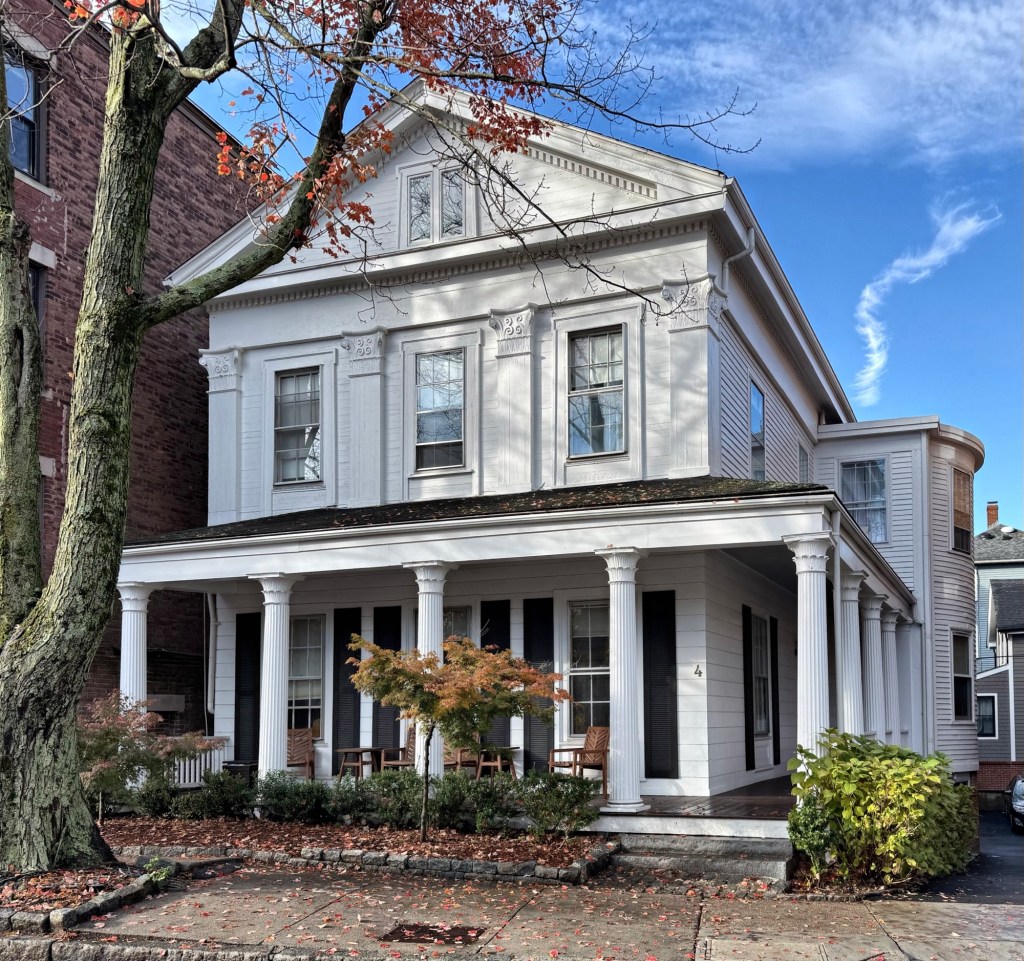
The Lindens neighborhood, located just east of the civic and commercial core of Brookline Village, was long an apple and cherry orchard known as Holden Farm. Beginning in 1843, the area became the earliest planned development in the town and was laid out as a “garden suburb” for those wishing to escape the growing congestion of Boston. As originally conceived in 1843, it reflected the latest ideals of planned residential development for a semi-rural setting on land owned by Thomas Aspinwall Davis. The streets, parks, and house lots here were laid out by civil engineer, Alexander Wadsworth, who two years earlier, laid out plans for Mount Auburn Cemetery in Cambridge, the first “Rural Cemetery” in America. Early homes were built on speculation by John F. Edwards, an architect-builder, for Davis, who was strict about high-quality designs in the Greek and Gothic revival styles in his newly laid out neighborhood. This Greek Revival style house was built in 1844 and sold in 1849 to William A. Wellman (1805-1878), the assistant collector at the United States Custom House in Boston. Wellman’s family held this property through the end of the 19th century. In 1903, as the neighborhood developed further, the property was purchased and re-oriented to face Linden Square, making room for a brick apartment building. Architecturally, the Wellman House stands out for its flushboard facade with bays divided by pilasters with elaborate capitals, and an L-shaped porch with columns capped by acanthus capitals.
 Buildings of New England