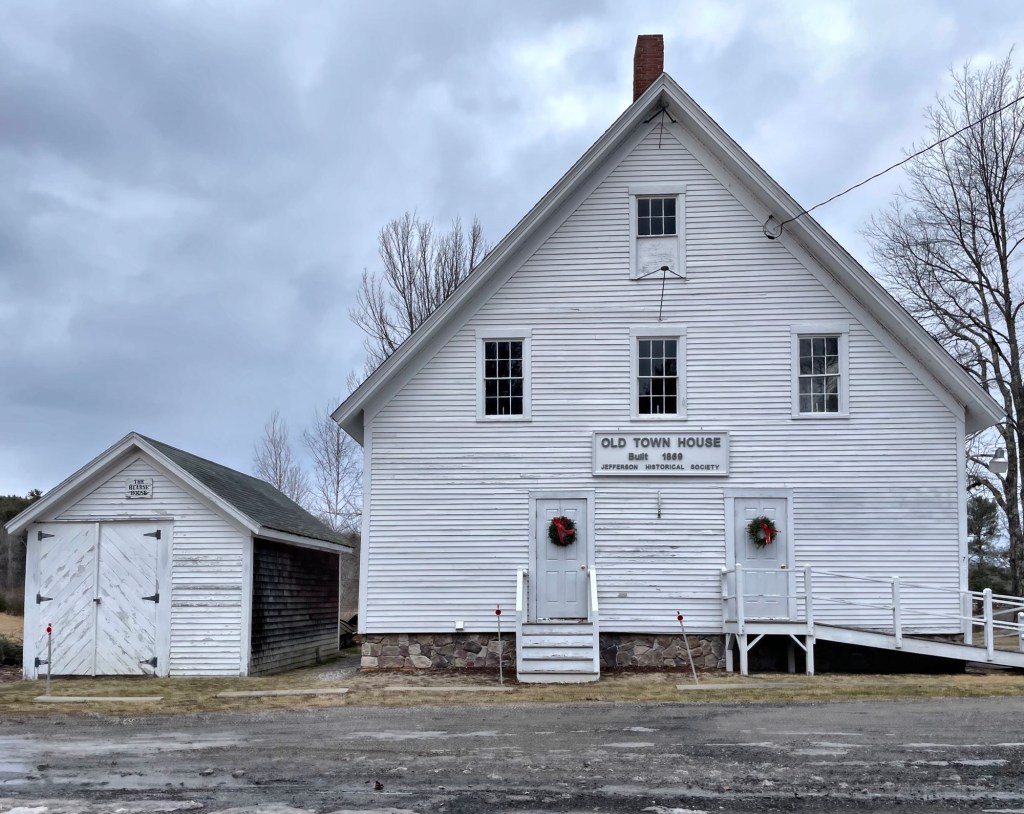
Jefferson Town House and Hearse House // 1869

Following the conclusion of the French and Indian War in 1763, much of the un-colonized land in central Maine began to see development. The Ballstown Plantation was settled in the 1760s and today includes two separate townships created from it, Jefferson and Whitefield, Maine. Jefferson was initially settled by emigrants from the coastal towns of Boothbay and Woolwich in the years just prior to the Revolution and incorporated in 1807, named after Thomas Jefferson, then President of the United States. A Town House was built in 1828 and was eventually outgrown and a new structure was funded in 1869. This is the second Jefferson Town House and like in many rural towns, it served many purposes. The building was used for town meetings, a high school, and was sometimes rented to fraternal organizations (talk about Mixed Use)! The outdated building was no longer needed by the town in the 1970s and a new building was erected closer to the center of town. This building was subsequently rented to the Jefferson Historical Society, who have restored the building, and the historic hearse house next door. The vernacular civic building will hopefully be preserved for another 150 years!

Troy Meeting House // 1840

Located in the rural town of Troy, Maine, the 1840 Troy Meeting House is a classic example of a type of meeting house or church that was built by some rural communities in the state in the decades prior to the Civil War. Built as a Union Church, without a specific denomination, the building served the members of the Troy Meeting House Society, and by extension as the only church in the town. The building features both Greek Revival and Gothic Revival stylistic details on the exterior and its design is similar to others in the surrounding towns, likely being from the same builder.

Waterbury Railroad Depot // 1875

Historic train stations are among some of my favorite types of buildings as they transport you to a different time (no pun intended). The Waterbury Railroad Depot was built in 1875 by the Central Vermont Railroad, connecting Montreal, Quebec with New London, CT and to other lines to Boston and Albany on the way. Waterbury service began in 1849, but this updated station was built later as the railway prospered and expanded. The station suffered from some deferred maintenance for decades in the mid-20th century and its fate (like many such stations) was unknown. Beginning in the late 1990s into the 2000s, Revitalizing Waterbury worked with the Great American Station Foundation, the Vermont Agency of Transportation, and Green Mountain Coffee Roasters Foundation, establishing a capital fundraising campaign meeting the goal of $1,200,000 through donations from the private sector and community members. These funds helped restore the building in phases, beginning when Keurig Green Mountain, Inc. agreed to lease the station from Revitalizing Waterbury, and created a visitor center and cafe (now Black Cap Coffee and Bakery) that has become a first-class attraction and provided an economic boost to the downtown.