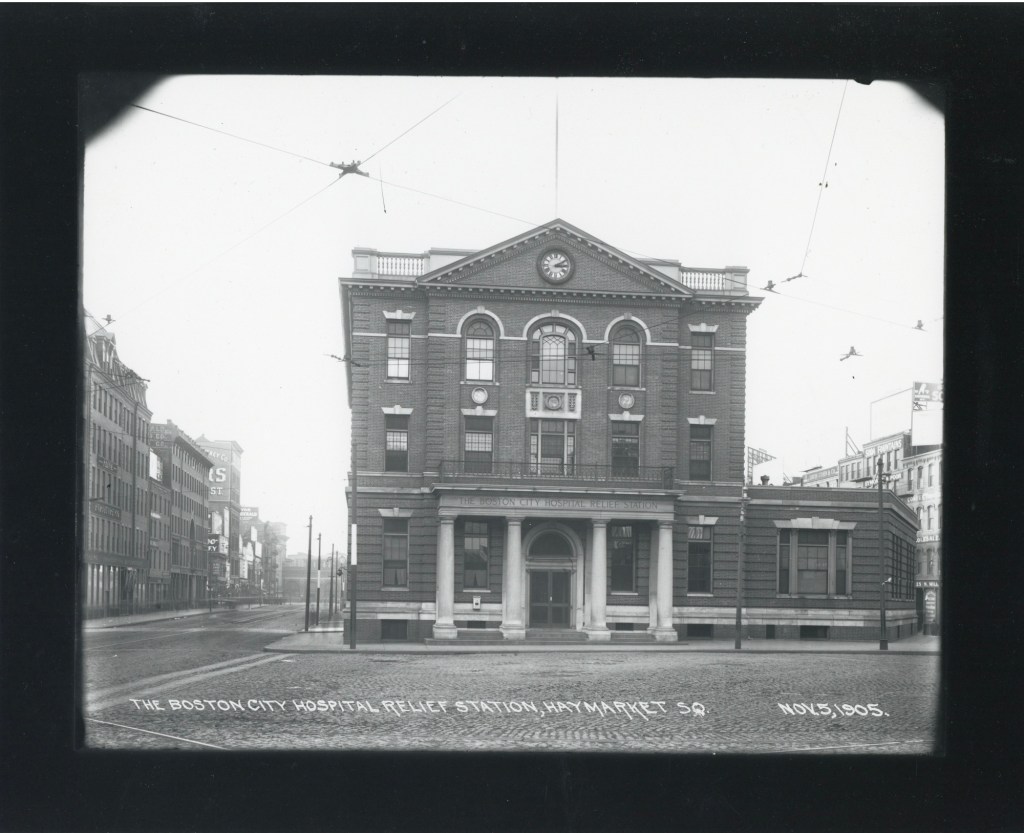
In 1858, as Boston began to see a massive influx of immigration into the city and rapid industrialization, the City of Boston authorized the creation of a new hospital whose purpose was the “reception of those sick and injured: citizens of Boston who, from any cause, were unable to otherwise obtain care and treatment,” especially in cases of “acute illness and for the victims of accident or injury.” This was the Boston City Hospital, which was established in the South End, and is now known as the Boston Medical Center. The hospital was thought to be too far away for victims of injury of illness to get to promptly, so a relief station was built in Haymarket Square, replacing the recently demolished Boston & Maine Railroad Station. The new, standalone hospital building was constructed of brick and stood three stories tall and opened in 1902. On its first day of operation, doctors and staff saved the life of a man who had attempted suicide by ingesting carbolic acid. A Boston Globe reporter speculated that had the patient been transported to the more distant Massachusetts General or City Hospitals, he would have surely died. The Colonial Revival style building was designed by the firm of Kendall, Taylor & Stevens, who specialized in medical facilities and other institutional building designs. The structure was demolished by the 1960s, when much of the Government Center/West End areas were razed for urban renewal.
 Buildings of New England