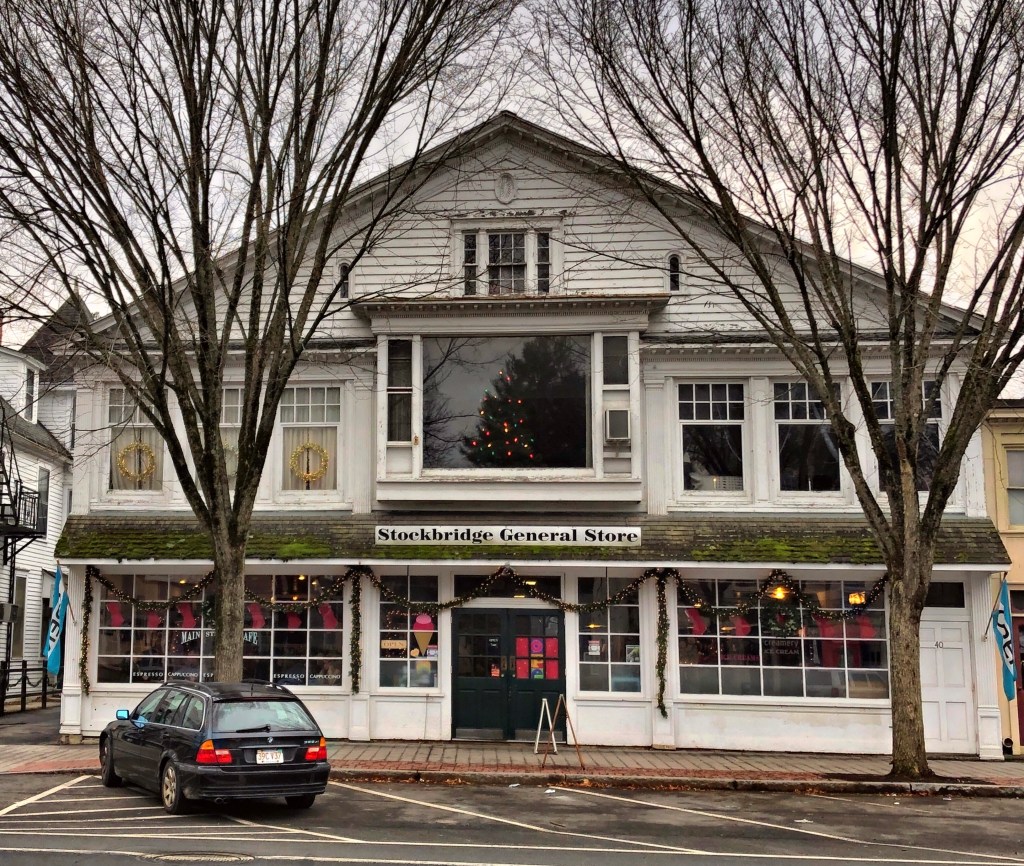
Guerrieri Block // 1921

Norman Rockwell‘s ‘Home for Christmas’ painting in 1967 depicts the Main Street scene in Stockbridge, Massachusetts, and epitomizes the essence of Christmas in small towns across the country. In the iconic painting, you can find many landmarks (including the Town Offices building) that make up the quaint main street, that typifies many small New England towns. At the center of his painting, the Guerrieri Block can be seen with a Christmas tree lit up in the window on the second floor. The Guerrieri Block was built in 1921 by Antonio Guerrieri, a skilled woodworker who sold and repaired antiques in one of three street level shops in the block. He and his family lived in an apartment on the second floor. The next year he completed construction of a shop behind the block where he worked out of. In 1953, Norman Rockwell moved to Stockbridge and spoke with Antonio about using the second floor of his building as a studio. Antonio constructed a large central bay window with plate glass to flood the space with light and allow Rockwell to work while observing the street below. Rockwell used the space as his studio until 1957. The building has since been occupied as a general store.

Hollis Hunnewell House // 1870

In 1870, when Boston’s new Back Bay neighborhood was being developed, Hollis Hunnewell and his wife Louisa, decided to erect a mansion to establish themselves in the burgeoning neighborhood. Hollis was the first son of Horatio Hollis Hunnewell, the businessman and railroad tycoon who made a fortune, eventually developing a family compound in nearby Wellesley. The couple hired esteemed architect Charles Brigham to design a home on the prominent corner lot that would live up to the Hunnewell name, and he did not disappoint. Just three years after the home was completed, they added a one-story addition, adjacent to the alley to quell a wind-tunnel effect that was occurring down the alley. In December, 1876, a fire broke out in the home, trapping maid Annie O’Hara at the top floor where she died. After the fire, the Hunnewell’s decided to renovate the home, adding the prominent corner tower with cresting. Hollis died in 1884, leaving his wife and two children alone in the home (along with the housekeepers, maids, and other help) until her death in 1890. The home is an excellent example of late Second Empire architecture in Boston, and it showcases the immense wealth some distinguished families had in the region in the 19th century. Today, the 13,000 square foot home is occupied as a single family home, assessed at over $17.5 million!