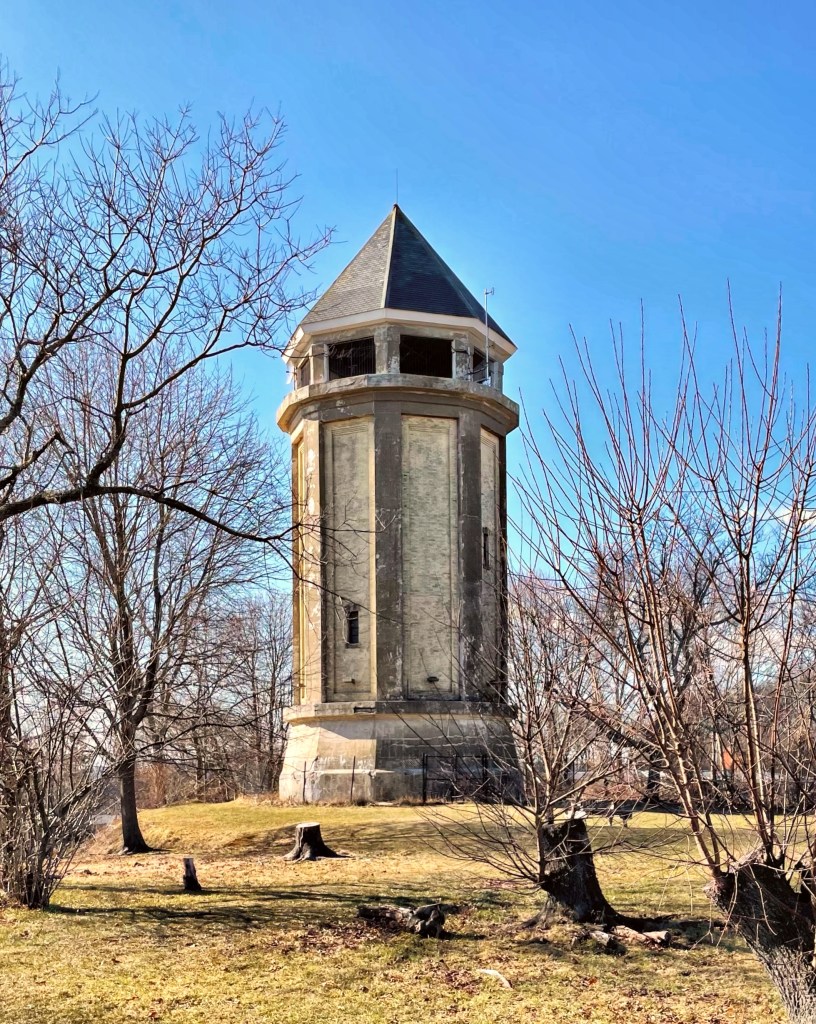
Point Allerton Artillery Fire Control Tower // 1942

Those who have visited the tip of the coastal Boston suburb of Hull, Massachusetts, will recognize this tall tower, but may not have known its intended purpose. This is the Point Allerton Artillery Fire Control Tower, built atop the highest point in the town, to serve as part of the Coastal Defenses built around the World Wars. Several fire-control stations were built at Point Allerton going back to 1907, but this seven-story concrete tower is the last to remain here. This tower was built around 1942, as the US Government grew increasingly serious about the potential for war, with new batteries and surveillance bases built all along the coast, many of which remain to this day. Fort Revere, a remnant of the coastal defenses, remains in Hull, nearby. This 7-story fire control tower is the center of Point Allerton, and by virtue of its base elevation (124 feet), had its top observation level at 179 feet above sea level, making this the tallest observation point in the Boston harbor defenses. The tower was later deaccessioned by the government and is owned and maintained lovingly by a private homeowner on their land. The tower is luckily preserved for future generations to learn about this lesser-known part of Boston-area history.
Fort Revere Tower // 1903

The Town of Hull, Massachusetts was first settled in 1622 and officially incorporated in 1644, when it was named for Kingston upon Hull, England. The town juts out into the Boston Harbor, which historically had provided as a defense for approaching vessels into the harbor. As early as 1673, Telegraph Hill in Hull, was used as the highest point in the Boston harbor area from which signals could be sent warning the approach of vessels. The site was first used as a fort in 1776 to defend the port of Boston. Fort Independence was built on top of the hill in 1776-1777, to be succeeded by the much larger Fort Revere in 1903 (see next post). The first telegraph tower was built on the hill in 1827. Several other telegraph stations later occupied the site until 1938, when radio communications made the site obsolete. Though little of the original Revolutionary-era fort remains, the fort which began construction at the turn of the 20th century lasts as a stunning reminder to the importance of coastal defenses, high atop hills. At the highest point of Telegraph Hill this water tower which rises 120 feet off the ground was built in 1903 for the new Fort Revere as the first reinforced concrete water tower in the United States. At the top of the tower, an observation deck (now closed) was also used to send messages to other harbor defenses. The tower was restored in 1975 was designated an American Water Landmark in 2003. It was periodically open to the public until mid-2012 when it was closed due to safety concerns.