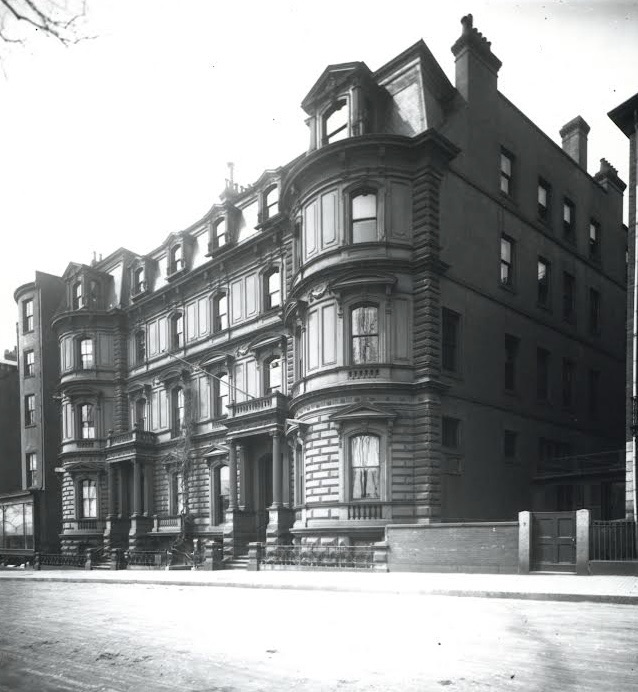
Brewer & Beebe Townhouses // 1863-1917

Boston is ever-changing and while change can be good, there have been some major architectural losses. This trend of redevelopment is not new however, as this single site on Beacon Street has seen two major losses, all before 1918! This lot on Beacon Street was originally home to Hancock Manor, a landmark Georgian mansion built between 1734-1737 for the wealthy merchant Thomas Hancock (1703–1764), and later inherited and occupied as the home of United States Founding Father John Hancock, yes, that John Hancock. In 1863, the Hancock Manor was sold at public auction and was purchased for $230. The house was demolished within days. While the building was torn down, souvenirs of it were actively sought as it fell. To replace it, two of the finest homes ever built in Boston were constructed on the site, from plans by elite Boston architect, Gridley James Fox Bryant. The double Second Empire style homes were first occupied by wealthy merchants, James Madison Beebe (the house on the left) and Gardner Brewer (right). In 1916, plans for the extension of the Massachusetts State House necessitated a taking of these (and other nearby) properties. These two houses were razed by 1917.

I wonder if the Hancock Manor would have survived to this time, would preservation prevail to save it?

Massachusetts Normal Arts School // 1886-1967

The Massachusetts Normal Art School was one of the many Richardsonian Romanesque buildings constructed in the Back Bay, but it did not survive like so many others did. The building’s history goes back to the 1860s, when wealthy Bostonians petitioned for the Commonwealth of Massachusetts (State Government) to assist with the founding of new institutions to enhance the quality of life in the state. Due to this, the legislature funded three major institutions including the Massachusetts Institute of Technology (1860) and the Museum of Fine Arts (1870), and founded in 1873, the Massachusetts Normal Art School. The Normal Arts School was tasked with training future teachers for public schools and budding professional artists in the arts, with courses ranging from drawing to architecture. The Commonwealth of Massachusetts rented space in various buildings in Downtown Boston before they appropriated $85,000 and hired the firm of Hartwell & Richardson to design and oversee construction of the new school at the corner of Newbury and Exeter Streets. The Richardsonian Romanesque building was constructed of red brick and brown freestone, featured entrances on both street facades, and held gallery spaces inside for members of the public to view the work created at the school. The school outgrew the original building, which could comfortably fit just 100 students, and in 1929, a new building was constructed at Brookline and Longwood Avenues. Before moving one more time to its current location in 1983, the school was renamed to the Massachusetts College of Art and is best known as MassArt today. The original school in Back Bay was demolished in 1967 and was home to a surface parking lot before the existing building was constructed.