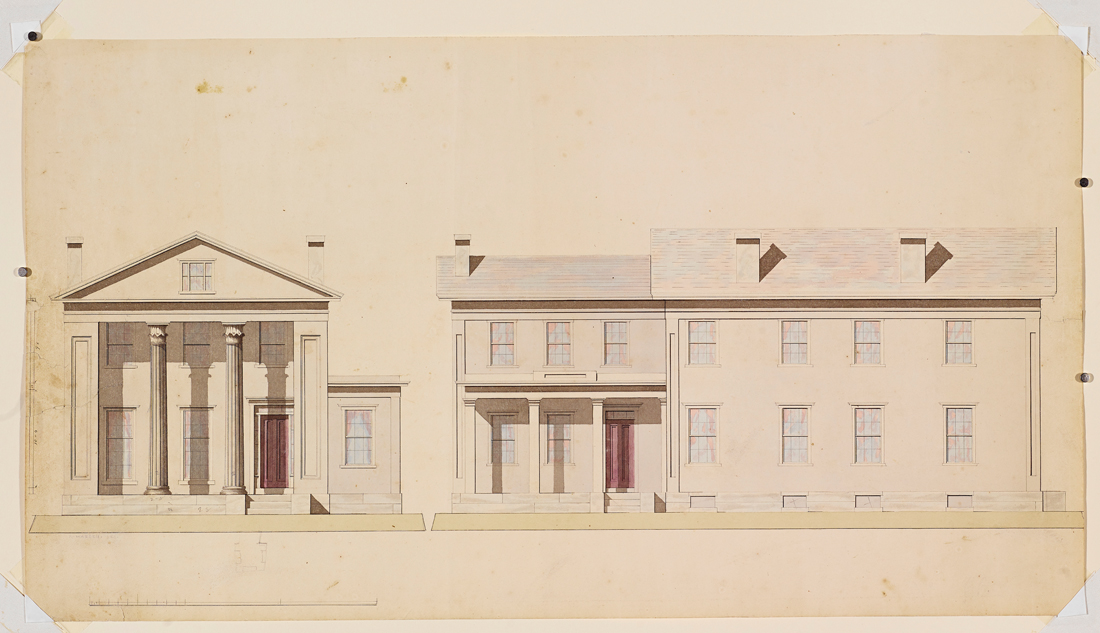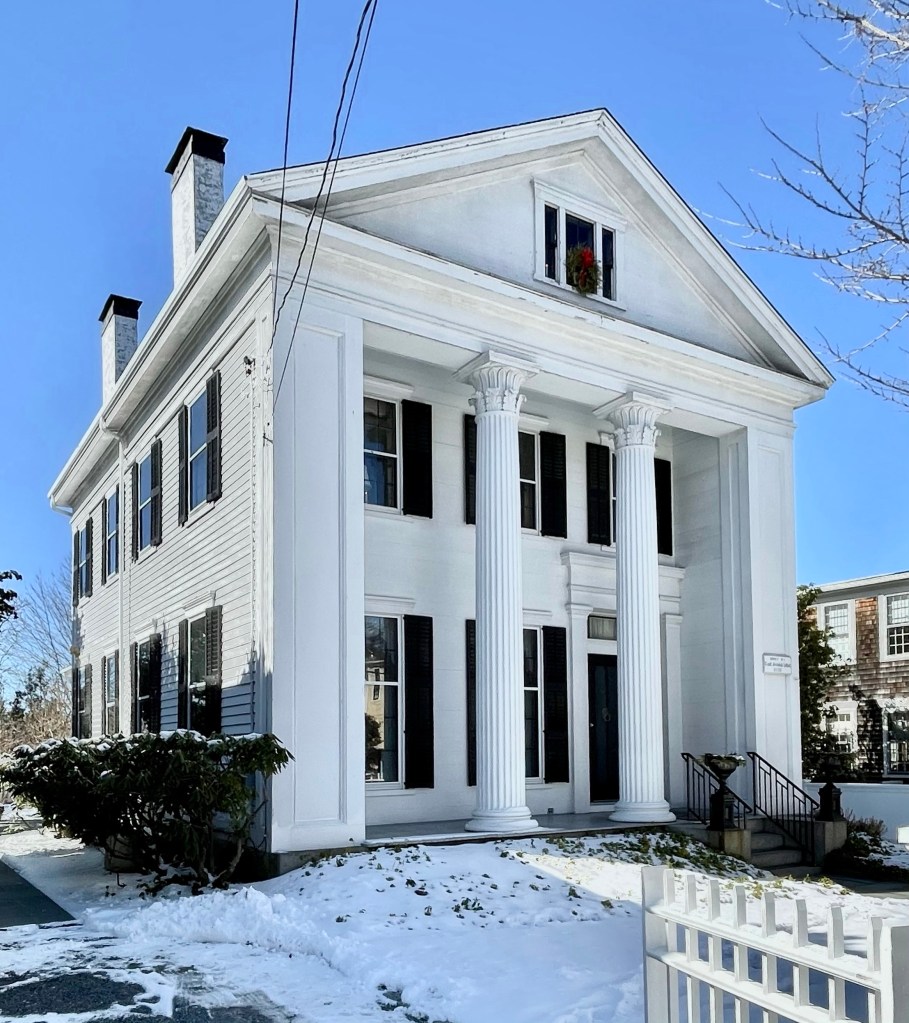
Josiah Talbot House // 1835

Anyone that has followed this account for a while knows at least one thing, I LOVE Greek temple-front homes. Designed by famed architect, and Bristol-native, Russell Warren, this 2-story, 3-bay, gable-roof Greek Revival house is one of the finest in the state. Its facade has a pair of fluted Corinthian columns, set in antis (where the side walls extend to the front of the porch). A simple side-hall entrance is framed by heavy Doric pilasters, supporting a broad, plain entablature, making this such a head-turning Greek Revival home. The walls are sheathed with horizontal flush boarding at the facade to give a smoother look and clapboards on the side and rear. The home was built for Josiah Talbot, a sea captain. The house is excellently preserved to this day, almost 200 years later.
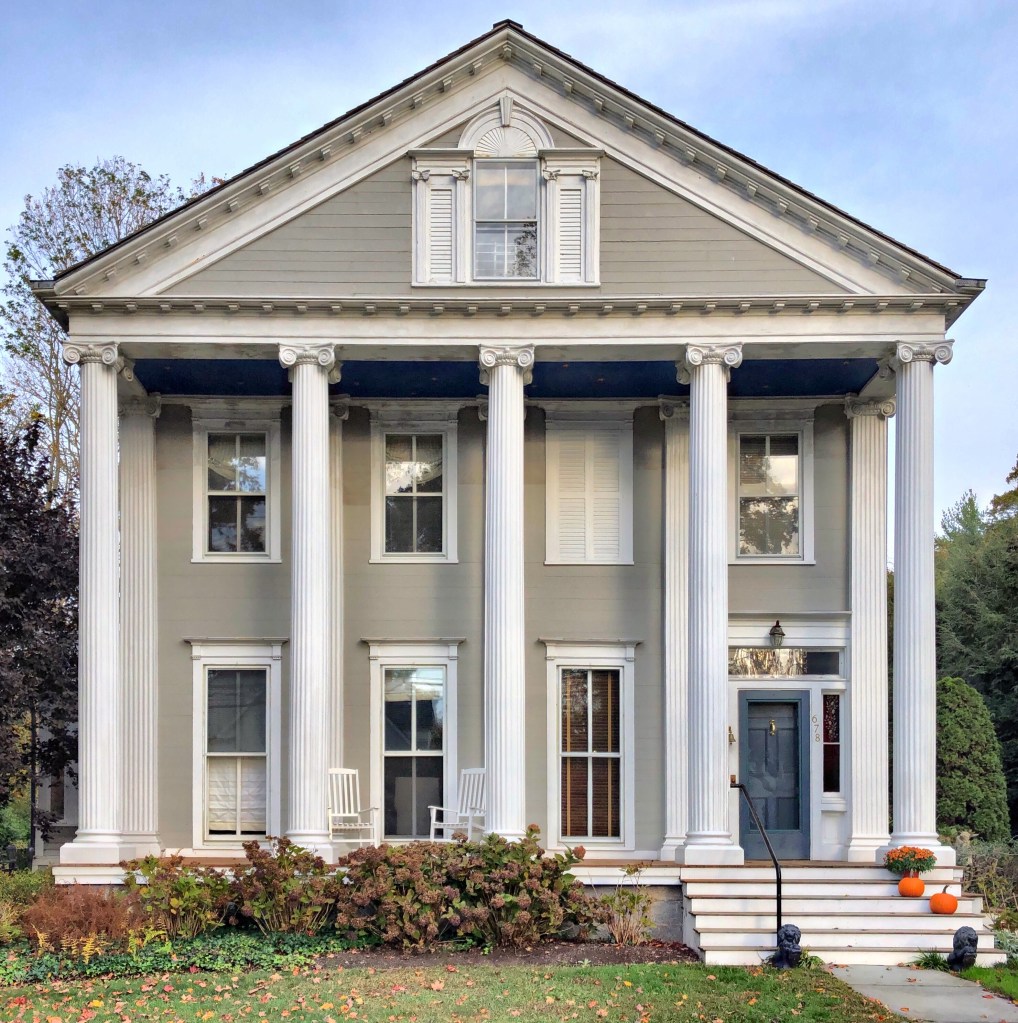
Perry House-Trinity Church Rectory // 1832

I have a thing for temple-front Greek Revival homes, and this is no exception. This marvelous home was built in 1832 for Francis Dimon Perry (1809-1884), who inherited some of his father’s wealth and became President of Southport National Bank in town. He was a devoted member of Trinity Church throughout his life. Upon Mrs. Perry‘s death in 1893, couple left their residence to the Trinity Church to be used as the parish rectory.

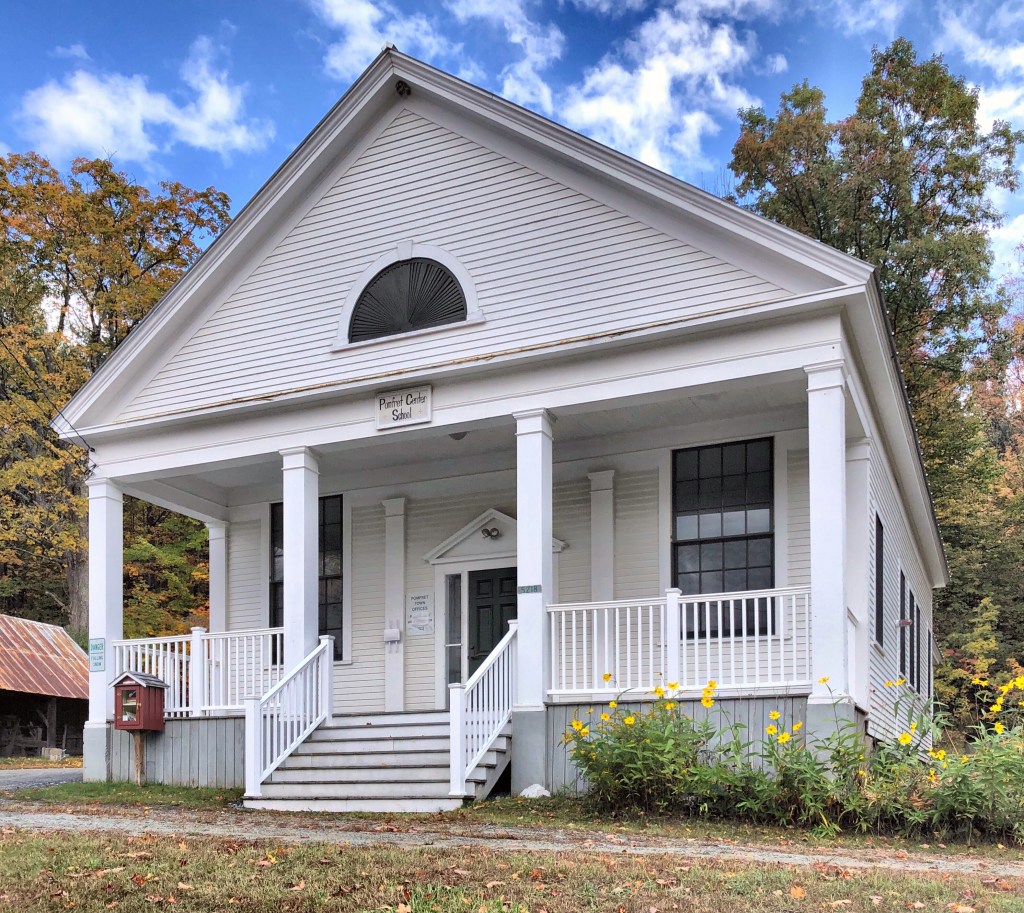
Pomfret Methodist Church // c.1850

Located across the street from the Congregationalist Church (now Town Hall) in Pomfret Center, the Methodists in Pomfret Vermont built this church building just a couple years after their neighbor was completed. Replicating the Greek Revival style seen across the street, the building showcases a templed form with projecting portico, as an excellent vernacular example of the style. Similar to its neighbor, this church was sold to the Town of Pomfret in the 1880s, modernized in the early 20th century, and converted to a district schoolhouse.

Saint Elizabeth’s Center // 1838

The only two-story temple-front Greek Revival home in the Upper Falls Village of Newton, MA stands on Elliot Street, on the same block as the Mary Immaculate of Lourdes Catholic Church and Rectory. The home was built in 1838 at the present location of the church, but was moved in 1908 to its present location at the opposite end of the block for the erection of the large church. The original owner was Dr. Samuel Whitney, the village doctor who also operated his office out of the large house. By 1844, he moved to Dedham and sold the home and practice to Dr. Abraham D. Dearborn who ran his practice out of the home until the mid 1850s. After successive ownership by mill owners, the property was acquired by the Archdiocese of Boston who moved the home and used it as a rectory until the Colonial Revival rectory was built. The home has since been used as a parish center, but has not been well maintained over the years. Plans were unveiled in 2015 by a long-time resident to purchase the home from the Catholic Church for conversion of a community center with offices for non-profits, but it has not materialized sadly. Its future is unclear.

White Columns // 1853

The majestic Greek Revival house on Maine Street in Kennebunkport was built in 1853 for Eliphalet Perkins III, a member of the Perkins Family, one of the earliest families to settle in the area known today as Kennebunkport. Eliphalet apparently sold the home to his son, Charles, who moved in within the year with his new wife Celia Nott. The couple decorated the ornate home inside and out with furnishings still retained inside after the Kennebunkport Historical Society acquired the building in 1955. The home is now known as White Columns, and houses the First Families Museum. One interesting thing I noticed is the rounded arch windows in the pediment, an awareness to the Italianate style which took over in the 1850s-1870s throughout New England, though this home is quintessentially Greek.