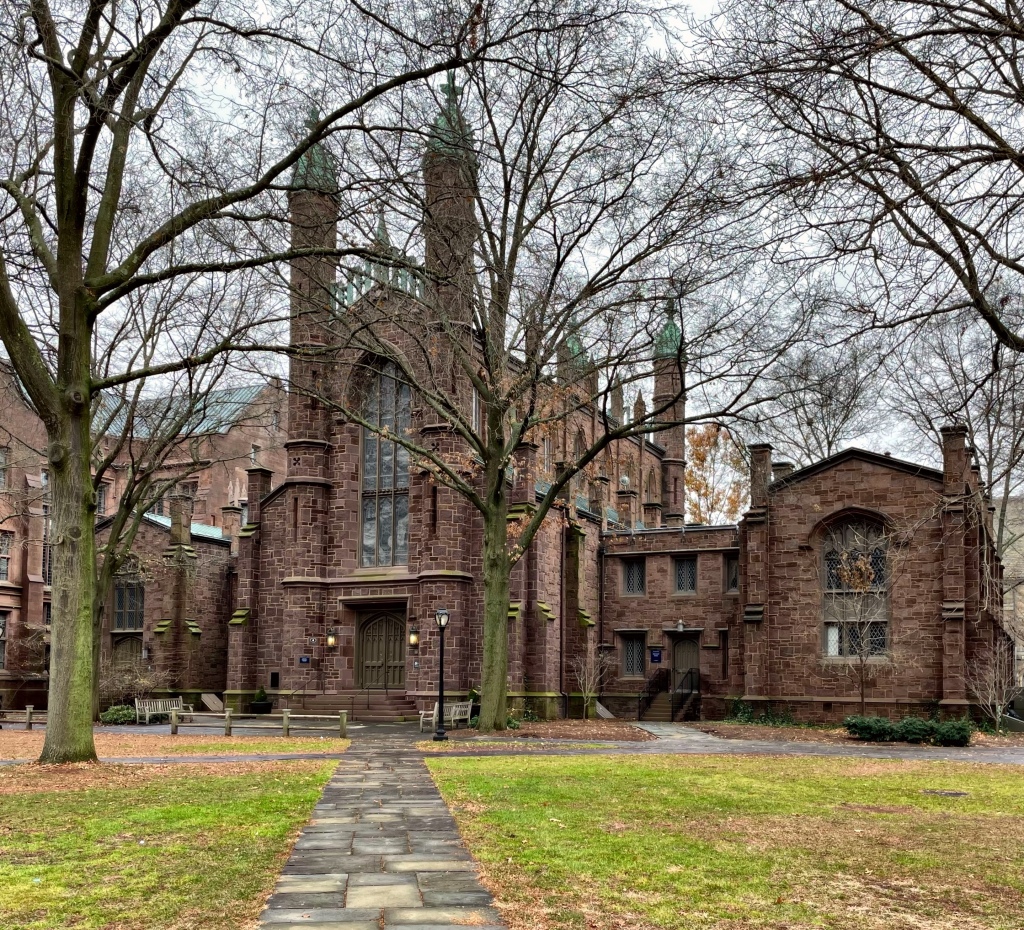
Yale University – Dwight Hall // 1842

One of the most architecturally significant college buildings in the United States, Dwight Hall was designed to house the growing book collection of Yale College as its library. The former Yale College Library, now Dwight Hall, represents a significant shift in Yale’s campus architecture from Georgian and Federal brick buildings to the Gothic mode which the campus is largely known for today. Dwight Hall was designed by local architect Henry Austin with the guidance of esteemed architects Ithiel Town and Alexander Jackson Davis, both experts in early high-style Gothic buildings in America. The design, to me, resembles the 1443 King’s College Chapel in Cambridge, England. The structure is constructed of brownstone from Portland, Connecticut, and it is composed of a central block with two smaller flanking wings on either side connected by smaller linking spaces. At the yard facade, two octagonal towers with domed copper roofs rise, flanking a large, pointed lancet arch window that extends above the doorway. The library was outgrown fairly quickly, necessitating an annex next door and eventually collections were transferred to Sterling Memorial Library in 1930, the Old Library was converted to a chapel and community service building and is known as Dwight Hall.
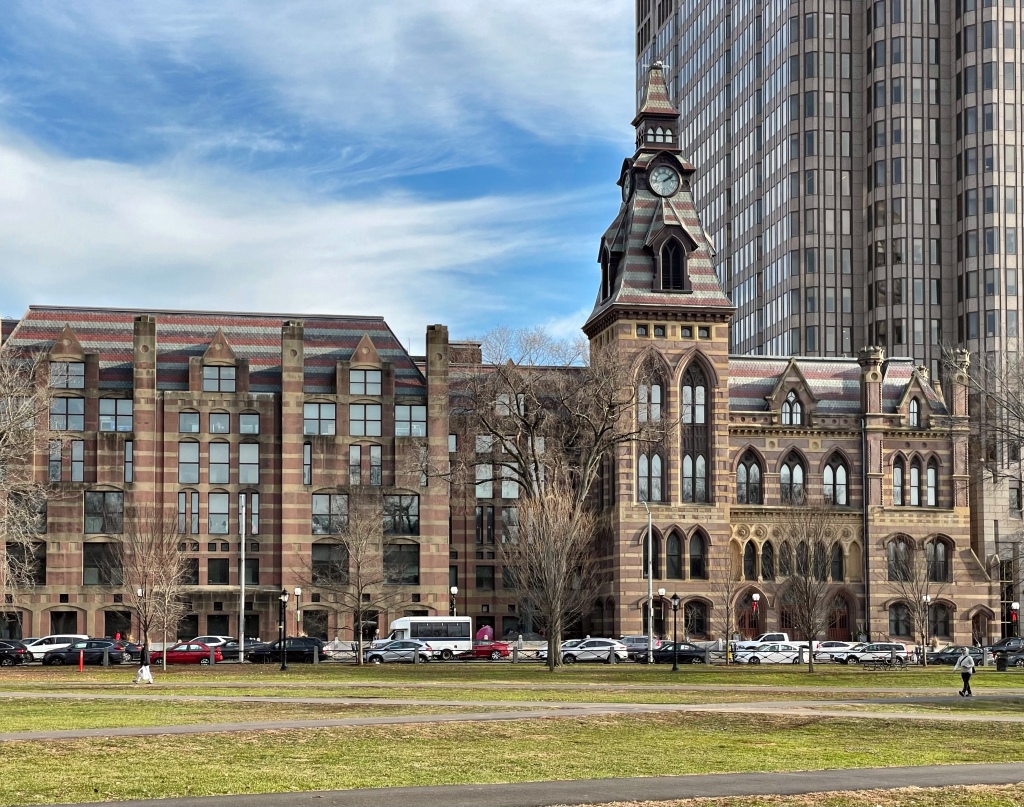
New Haven City Hall // 1861

Less than four centuries ago the area which is now New Haven, Connecticut, was the home of a small tribe of Native Americans, the Quinnipiac. White settlers arrived by 1638 and made a deal with the local sachem (leader) to protect the native Quinnipiac from raiding bands of Pequots and Mohawks in return of purchasing some of the tribe’s land by the Puritans. By 1640 a complete government had been established and the settlement, originally called Quinnipiac, was renamed Newhaven (later New Haven). The town plan was based on a grid of nine squares. In accordance with old English custom, the central square, now the Green, was designated a public common. By 1718, in response to a large donation from East India Company merchant Elihu Yale, an early college relocated from Old Saybrook to New Haven, and its name was changed to Yale College. The city grew exponentially with industry, education, and commerce, becoming one of the wealthiest and diverse cities in the state. As the city grew after the Civil War, a new City Hall was built. The New Haven City Hall was constructed in 1861-2 and was designed by local architect Henry Austin. To the left of City Hall and set back further from the street was the old Courthouse (1871-3) designed by David R. Brown (1831-1910). Together the buildings provide a united facade marking the first phase of the High Victorian Gothic Style in America. By the 1980s, plans for a new Government Center were discussed following decades of deferred maintenance and a decaying building. Luckily, cooler heads prevailed, and the facades of the building were preserved with a modern structure constructed behind to house city offices, from plans by local architect Herbert S. Newman. The Victorian Gothic and Post-Modern building stands proudly today, anchoring the east end of the Town Green.