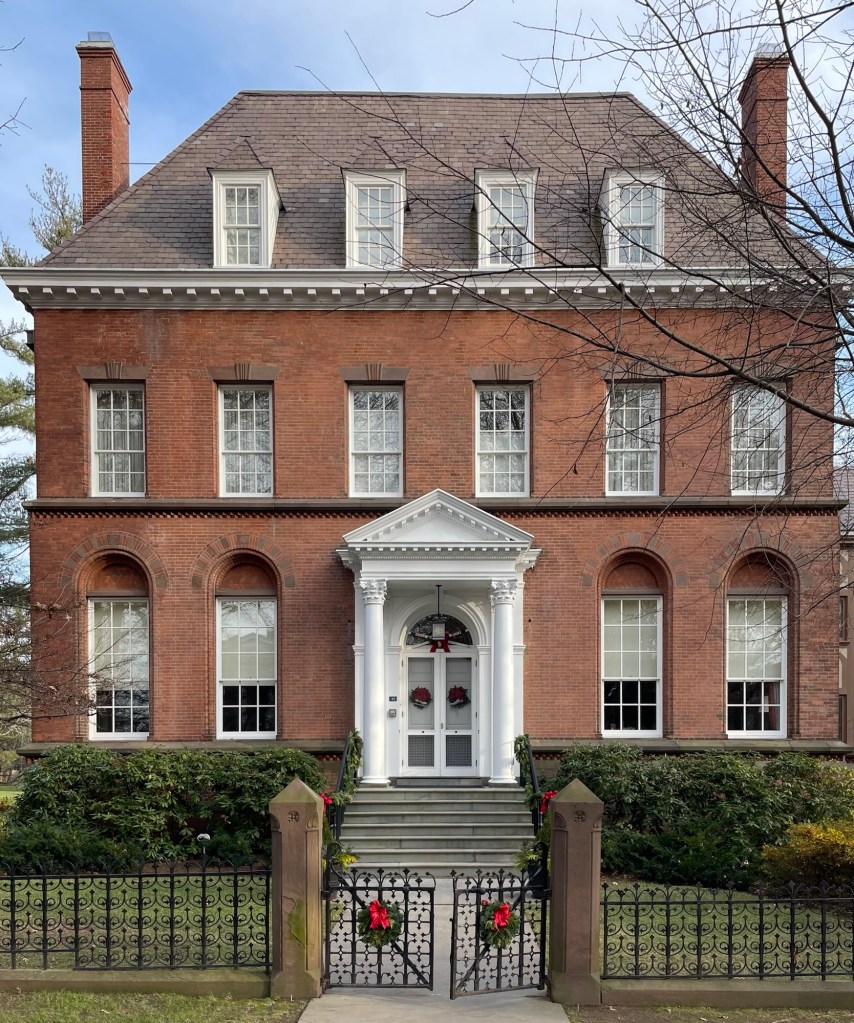
In 1871, wealthy engineer and philanthropist, Henry Farnam (1803-1883), purchased a house lot on the desirable Hillhouse Avenue in New Haven, Connecticut, where he would live out his final days in retirement. Mr. Farnam made his fortune beginning in 1839, when he was instrumental in building the railroad connecting New Haven to New York. In 1850, he moved to Illinois where he partnered with Joseph E. Sheffield to build the Chicago, Rock Island and Pacific Railroad, becoming that railroad’s president in 1854. In 1868, Farnam moved back to New Haven when he hired Russell Sturgis, Jr., to design and oversee construction on his home there. Henry Farnam also worked with Sturgis on Farnam Hall at Yale, where he is the benefactor and namesake of the building. Henry Farnam died in 1883, and in his will, he stipulated that he would gift his property to Yale College under the condition that his son, Henry W. Farnam, could live there until his death. Henry Walcott Farnam was an economist, and served as president of the American Economic Association. In 1933, the property ownership was officially transferred to Yale University, who in 1936, renovated the property, changing its appearance from Victorian Gothic to Colonial Revival. Architects, Richard A. Kimball and Ellery Husted furnished the designs for the stately residence. Since that time, the Farnam House has served as the residence of the Yale President.
 Buildings of New England