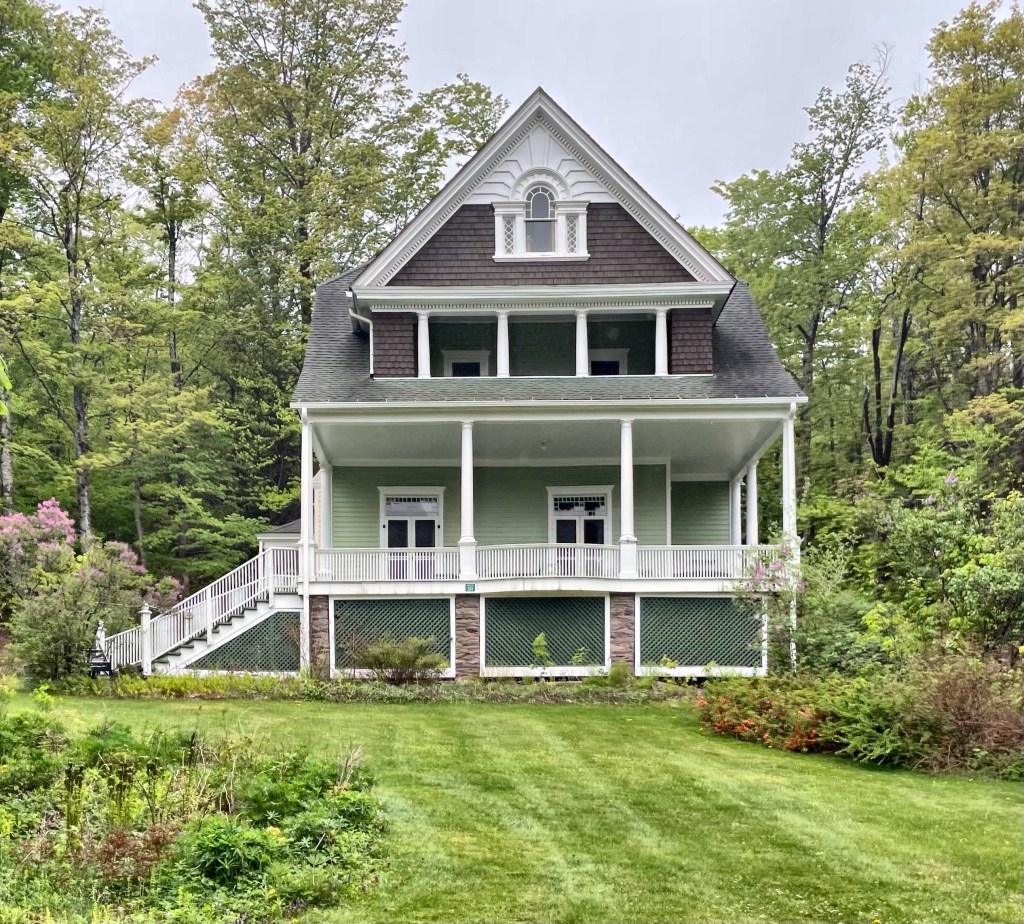
Esser Cottage // 1894

Hermann Esser (1845-1908) was born in Elbertfeld Germany and emigrated to the U.S. in the fall of 1866 and settling in Hoboken, NJ. On September 30, 1869, he married Bertha Michelmann of Hanover, Germany, who also emigrated to the U.S. years prior. In the states, Essen joined his old business partner Wilhelm J.D. Keuffel (also a German) and they ran the Keuffel & Esser Company, a scientific instrument manufacturing firm originally founded in New York City in 1867. Best known for its popularization of the slide rule, Keuffel & Esser was the first American company to specialize in the manufacture and sale of drafting and surveying tools. By the early twentieth century, it was one of the largest manufacturers of scientific instruments in the world. Their original store was located at 127 Fulton Street in Manhattan. Esser, with his wealth, decided to build a cottage in summer colony of Elka Park, New York, just north of Manhattan. The enclave was founded and has long been inhabited by wealthy German residents from New York City. This cottage was built for Mr. Esser in 1894, and is decidedly more Colonial Revival than many other cottages here. Esser only enjoyed a few summers here as he moved back to Germany in 1902, and died in 1908.

David Forrest House // c.1857

This home in Schenectady’s Stockade Historic District appears to have been built in the mid-19th century, and is an excellent example of a modestly sized Gothic Revival cottage. The house was occupied around 1860 by David P. Forrest, who served one term as Mayor of Schenectady in 1859, later becoming an Inspector of State Prisons from 1860 to 1862. The amazing Gothic bargeboard and other trimmings have remained and add so much intrigue to the home’s design. And that lancet window in the gable end! Swoon.

NYC Police Headquarters Building // 1909

Grand architecture in New York is not just limited to commercial buildings, churches and offices, even civic buildings here can go toe-to-toe architecturally with any in the world! On the border of the SoHo neighborhood, the former New York City Police Headquarters showcases the unity of the five boroughs into the City of New York in 1898, a city in need of a large and centrally located Police HQ. The firm of Hoppin & Koen was hired to design a large structure, fitting to represent the largest police force in the country and the five boroughs it represents. The grand Beaux-Arts building makes a statement with its perfect proportions, expanses of rusticated limestone and granite, and the massive central dome at the roof. The New York City Police Department relocated in 1973 to the larger One Police Plaza building, and the former headquarters was vacant for a decade until the early 1980s when the property was purchased by developers and converted to condominiums.