Moorfield Storey House // 1875

The house at 44 Edgehill Road in Brookline, is a brick Queen Anne style residence built for Moorfield Storey (1845-1929) by architect and neighbor, Robert Swain Peabody, who was Moorfield’s friend and college roommate. Both Peabody and Storey would later move in the early 20th century to the Fenway in neighboring houses, also designed by Robert S. Peabody. Moorfield Storey was a president of the American Bar Association and the president, for most of its existence, of the Anti-Imperialist League, an organization founded to oppose the annexation of the Philippines as a colony and to support free trade and the gold standard. Storey consistently and aggressively championed civil rights, not only for African Americans, but also for Native Americans and immigrants. He opposed immigration restrictions, and supported racial equality and self-determination. He would become the first president of the National Association for the Advancement of Colored People (NAACP), from its founding in 1909 until his death in 1929. The Storey House in Brookline is a well-preserved and early example of the Queen Anne style, that would dominate architectural tastes for the following decades.
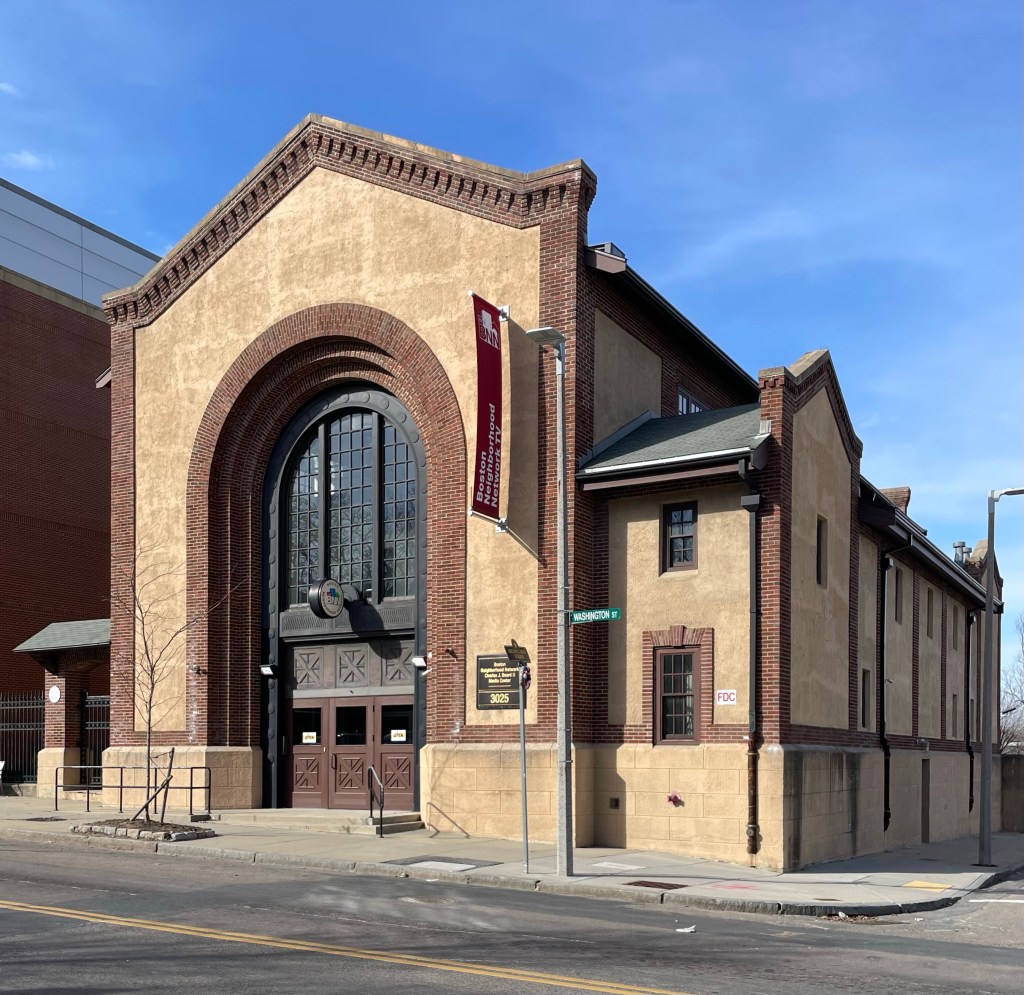
Egleston Square Substation // 1909

Streetcar suburbs of Boston have long been connected to the city by horse-drawn streetcars. As the city expanded and transportation shifted electrical, things changed in a big way! By the time the last horse-drawn streetcar was retired in 1897, the West End Street Railway Company had replaced its fleet of 9,000 horses with electric streetcars. Things were built upwards, with an elevated railway constructed between 1898 and 1901 that ran down Washington Street in the Roxbury neighborhood of Boston along the boundary of Jamaica Plain. The route had a stop in the middle of Egleston Square, with the surrounding neighborhood largely occupied by wood-frame, detached triple-deckers, two-family, and single-family houses, with many occupied by workers from the breweries nearby. Located on Washington Street in Roxbury, the Egleston Square substation was built in 1909 by the Boston Elevated Railway Company (predecessor of the Massachusetts Bay Transportation Authority) to convert AC (alternating current) electricity to DC (direct current) for use by its street railway cars and elevated cars. The building was designed by Robert S. Peabody of Peabody and Stearns, a prominent and expensive firm (yes the MBTA once invested in their infrastructure). After the station was effectively abandoned by the MBTA, the substation fell into disrepair, with a roof in failure in 2005. It was then acquired by Boston Neighborhood Network Media, a local nonprofit, who have converted it for use as office and television studio space. Scott Payette was the firm responsible for the intensive restoration and renovation.