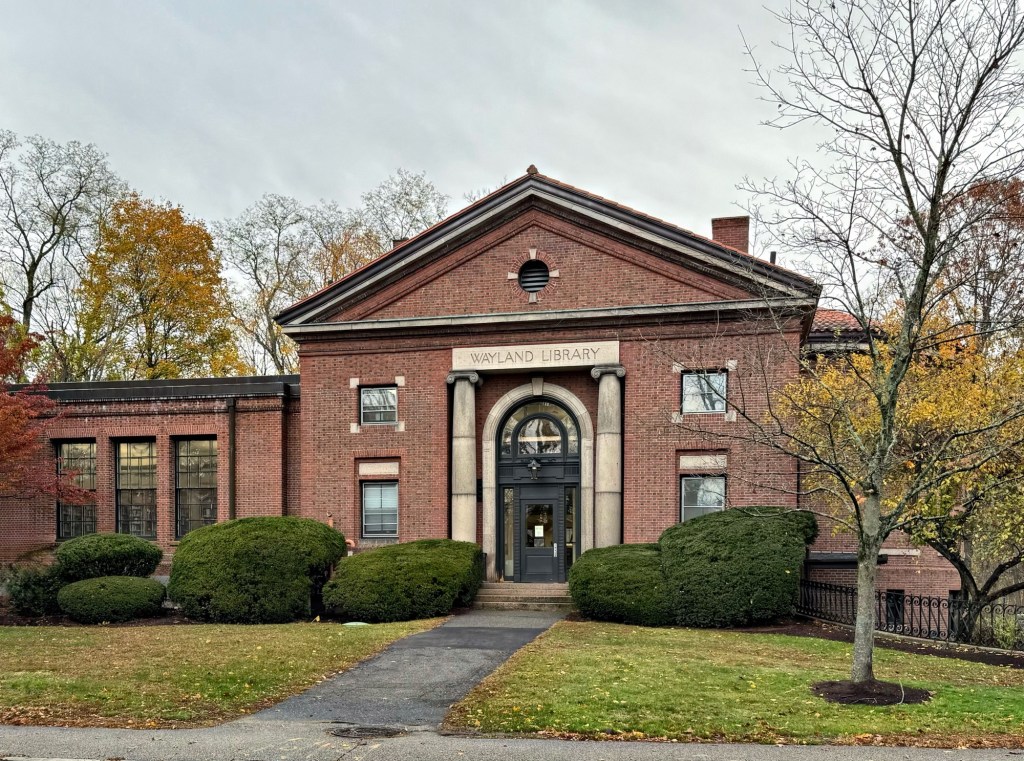
The Wayland Public Library is not only significant architecturally, but also historically as it was founded in 1848, with some claiming that it is the second free public library established in the United States. The first physical space for the Wayland Public Library was established in 1850 using a small room in the Town House. The Town House was outgrown and replaced in the 1870s by a large, Victorian Town Hall (razed in 1957) with designated space in the building for the expanded town library. As Wayland became an affluent Boston suburb in the late 19th century, wealthy resident, Warren Gould Roby (1834-1897), who lived just north of the town hall, donated land and $25,000 to the town for the purpose of constructing a library
that would be as fireproof as possible. Designed by architect, Samuel Mead of the firm, Cabot, Everett & Mead, the handsome building is said to have been inspired by Mead’s travels to Italy where he gained an interest in Roman architecture and Renaissance art. The influence is seen on the exterior with the Romanesque Revival style and on the interior with an ornate frieze around the rotunda. The building was expanded in 1988 by Tappe Associates and remains one of the great early 20th century libraries in New England.
 Buildings of New England