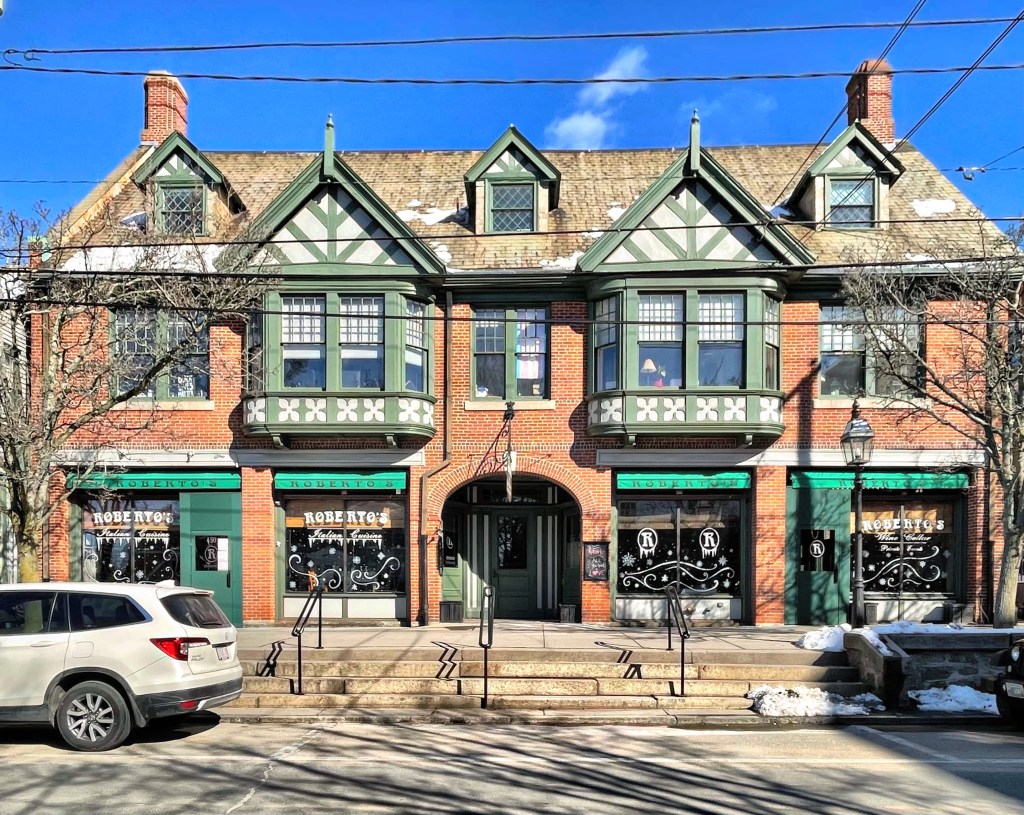
In 1899, the Bristol Young Men’s Christian Association (YMCA) selected architect Wallis E. Howe to design this five-bay, gable-roof, Tudor Revival building as its headquarters. Architect Howe created a rich effect with red brick and white mortar in combination with Tudor half-timbers in green, and buff-colored stucco. The building is a rare example of the Tudor style in Bristol, but is one of the most successful in the state (in my opinion), due to its strong presence and massing working with the use of materials and colors. The large central archway led upstairs to a library and gymnasium for use by YMCA members, while the ground floor featured four small businesses. In 1967, a new entrance and lobby, was constructed, linking the original YMCA to the since abandoned Bristol Customs House and Post Office.
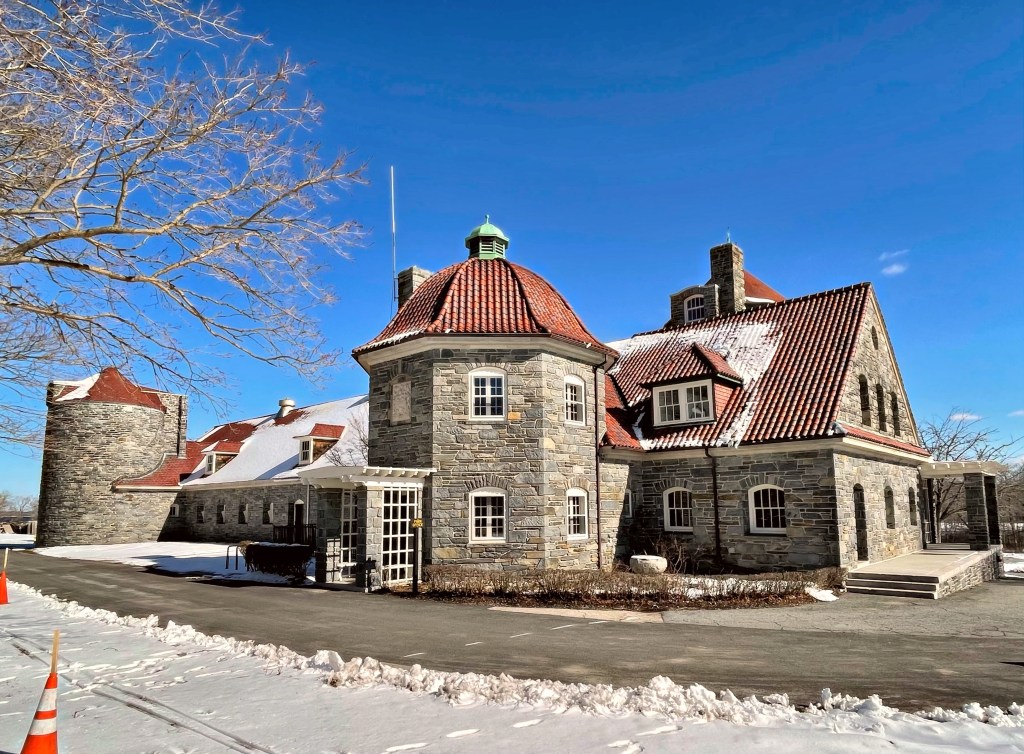
Samuel Pomeroy Colt (1855-1921), a Bristol industrialist, purchased three farms on Poppasquash Neck, in Bristol, Rhode Island in 1905. One of the farms he aquired, Coggeshall Farm, was featured in my last post. On the newly consolidated farmland, just outside the hustle-and-bustle of Bristol’s downtown core, Colt built a large summer dwelling called ‘The Casino’. He lived at his family estate in town a majority of the year, but used ‘The Casino’ as a gentleman’s farm and a space to raise his prize-winning Jersey cattle and Berkshire sows. Colt wished that the citizens of town share his enjoyment of the property and had an open invitation carved onto the marble piers at the estate entrance which reads, “Private Property, Public Welcome”; access was freely allowed at the farm and shoreline. The two marble piers at the entrance to the estate are topped with massive bronze bulls modeled after two of Colt’s bulls, and were cast in Paris by Val d’Onse Company. Colt died in 1921. His will specified that Colt Farm not be sold and that it remain accessible to the public. Though he left a sum to operate the farm, it ran a deficit. The Casino was demolished in the 1960s as it was consistently destroyed by vandals, and became a public safety concern. The lasting cow barn was built in 1917, from designs by architect Wallis E. Howe. The barn utilized field stone from existing stone walls on the property and is capped with a red tile roof. The barn is unlike anything I have ever seen, and now is park offices. In 1965, after approval by Bristol voters, the State of Rhode Island purchased 466 acres of the Colt estate and created the largest public park in the Bristol County, known as Colt State Park.
 Buildings of New England