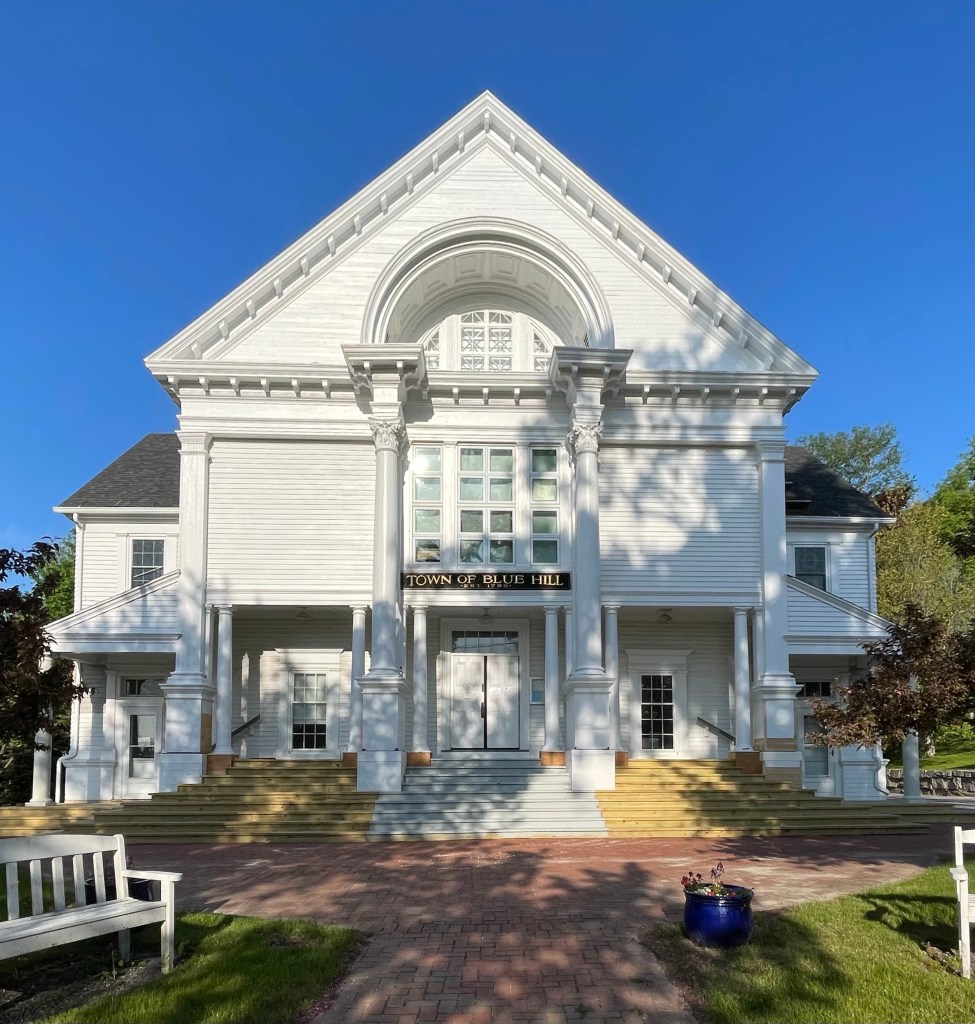
Blue Hill is a charming coastal town in Hancock County, Maine that retains so much of the charm that has been lost in many other coastal New England villages. Originally settled by the Penobscot Tribe, the town as we know it was incorporated in 1789 under the name “Blue Hill”, named after the summit overlooking the region. The town thrived early as a lumber and wood shingle exporter, later shifting to shipbuilding. The town was also noted for the quality of its granite, some of which was used to build the Brooklyn Bridge, New York Stock Exchange Building, and the U.S. Custom House at Norfolk, Virginia. In 1876, local quarries employed 300 workers. The town’s wealthy summer residents likely sought a new Town Hall for Blue Hill, as in the 1890s funding was acquired to erect a new building. It came as no surprise that George Albert Clough, an architect born in Blue Hill would furnish the plans for the new town hall. George was the son of Asa Clough an early settler and shipbuilder in town. He moved to Boston to work as an architect and later became the City of Boston’s first “City Architect” designing municipal buildings. For the Blue Hill Town Hall, he designed it in the Colonial Revival style, which remains well-preserved to this day.


Good afternoon: If you would, please point out the elements that categorize this as colonial and/ or colonial revival; what is being revived? As a laymen I am struggling to note what is colonial versus federal?
Thank you for your work and the debonair enthusiasm of your writing. The houses and, of late, chapels are all so many “whereaway” places.
Respectfully,
David Loring, Framingham, MA
LikeLiked by 1 person
Essentially, Colonial Revival is a revival of popularity and construction of the old Georgian and Federal period houses from (1700s-1830s) which took place after the Victorian period beginning in the 1880s. Colonial Revival buildings tend to be more stylized and more grand versions of the earlier homes. I suggest you buy “A Field Guide to American Houses” (2nd version) as it is the bible of architectural identification.
LikeLiked by 1 person
I have worn out 3 copies of this book! I keep one for ‘guests’ to read and have a dog-eared copy for myself.
LikeLiked by 1 person
Thank you. / David
LikeLike
I hope, during your visit to Blue Hill, you had a chance to visit the Jonathan Fisher House. The house is interesting, but Fisher was something of a polymath who painted, wrote books, built his own home, practiced ‘modern’ farming, etc. All in the late 18th and early 19th centuries. All while being the Congregational minister. An amazing man.
LikeLiked by 1 person
I did! I only saw the exterior though sadly..
LikeLiked by 1 person