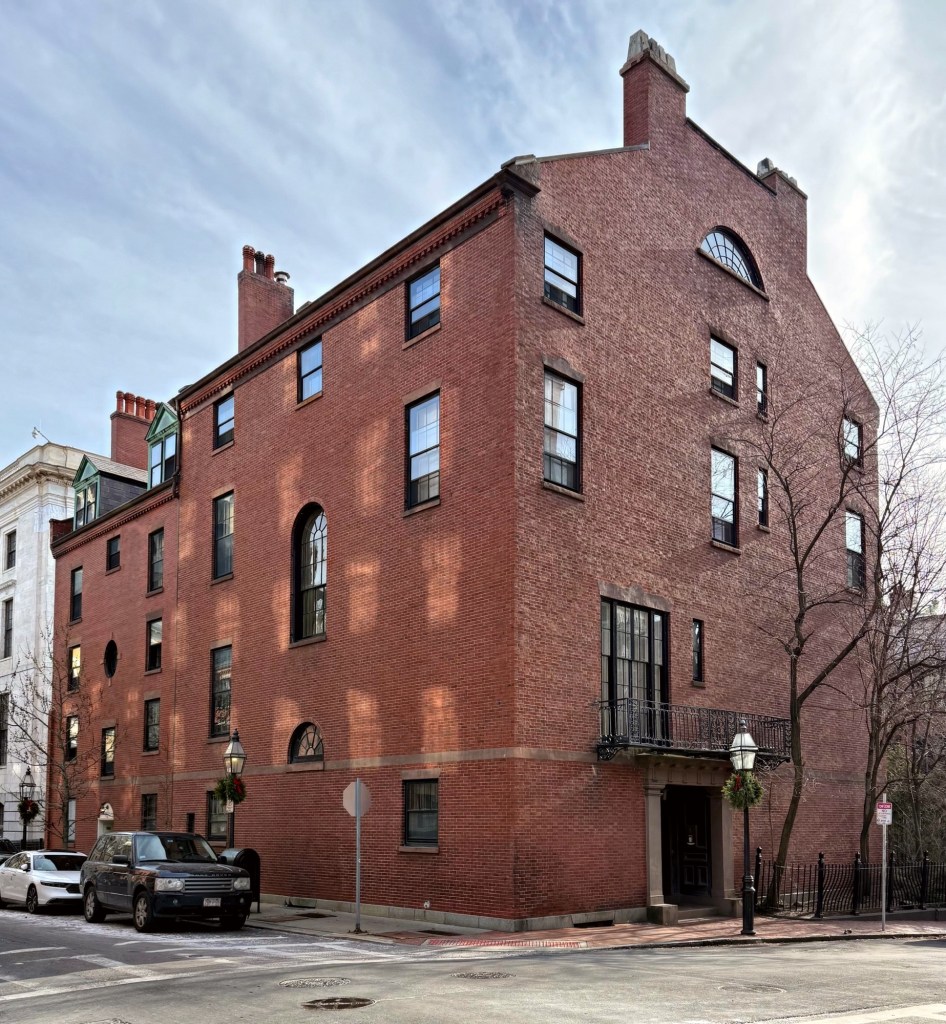
The Lyman-Paine Mansion at the corner of Joy and Mount Vernon streets in Boston’s Beacon Hill neighborhood is an architecturally significant Federal style house designed by a skilled architect and was owned by members of prominent local families. This four-story mansion was designed in 1824 by architect Alexander Parris for George Williams Lyman (1786-1880), a shipping merchant who became one of the Boston Associates, a group of wealthy Bostonians who funded the expansion of New England textile mills, which helped grow many industrial communities all over the region in the 19th century. This house served as Lyman’s winter estate, his summer mansion was the the Lyman Estate, “The Vale”, in Waltham, which he had inherited from his father. Upon George Lyman’s death in 1880, Lydia Lyman Paine, George’s youngest daughter, inherited this Beacon Hill mansion. Lydia’s husband, Robert Treat Paine, was a graduate of Harvard and a successful local attorney. Mr. Paine retired from law in 1872 to become the treasurer for the new Trinity Church building committee, where he averted a fiscal crisis during the mid-1870s when Henry Hobson Richardson’s cost overruns in designing the new Copley Square church threatened its completion. In addition to his pro bono work with Trinity’s finances, Paine was deeply interested in improving the quality of life of the working class, founding building and loan associations and institutes to allow immigrants to buy homes in the Boston area. In addition to their Joy Street mansion, the Paines had a country estate called Stonehurst, which is adjacent to the Vale in Waltham; it was renovated by Richardson. The mansion was converted to apartments (now condos) in the mid-20th century, and maintains its unique, vernacular Federal character, with asymmetrical facade and oddly placed and shaped windows.
 Buildings of New England