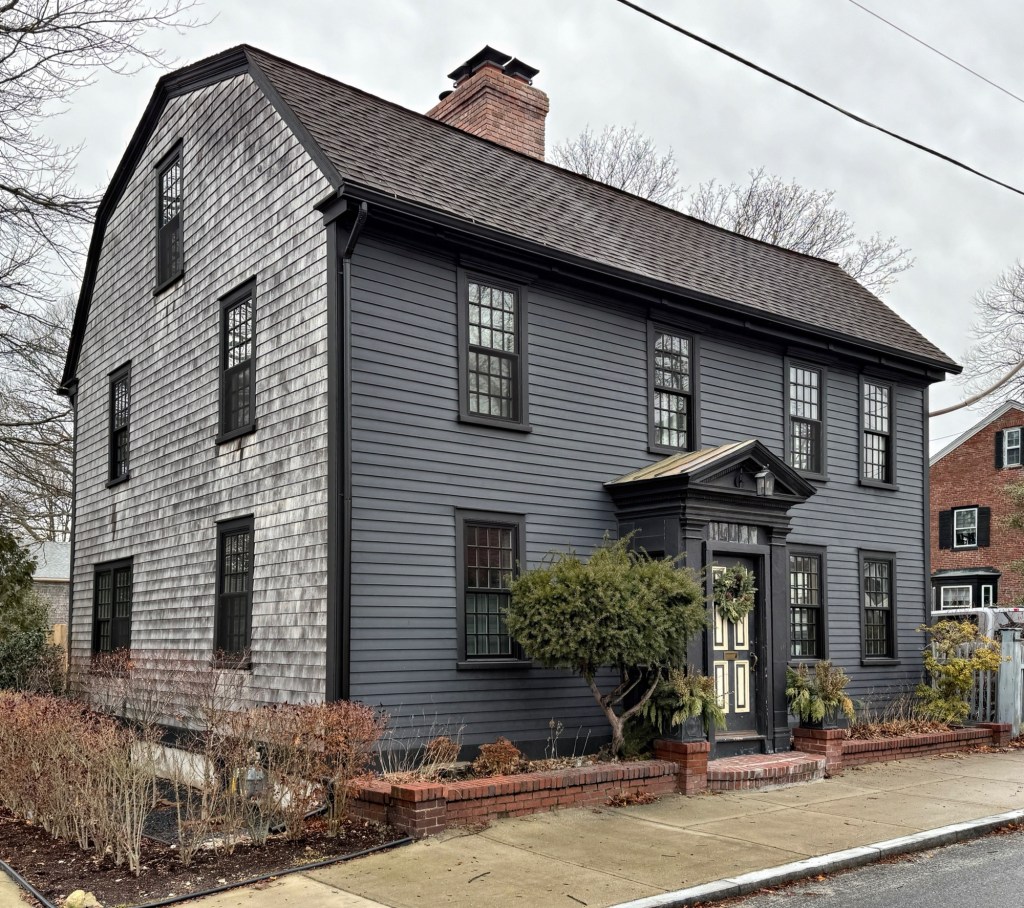
One of the more significant old homes in Warren, Rhode Island, the Gov. Josias Lyndon House on the aptly named Lyndon Street, dates to 1767 or earlier, and has connections with a colonial governor. It is not clear who originally owned this property, but the residence is best-known for its most famous resident, Governor Josias Lyndon (1704-1778), who lived here during the final years of his life with his wife and enslaved Africans. Lyndon worked as Clerk of the Assembly for the colony and in 1768, he was appointed Rhode Island’s last Colonial Governor, serving until 1769. His election is believed to have been a compromise between Samuel Ward and Stephen Hopkins, both of whom had already served multiple terms as governor. After his one term, Lyndon declined reelection and served as chief clerk for the General Assembly of the Superior Court of the County of Newport. At the time of the British occupation of Aquidneck Island (Newport), Gov. Lyndon moved to this home in Warren, where he remained until his death from smallpox in 1778. An often undertold fact about Josias Lyndon is that he enslaved a man named Caesar Lyndon. Caesar was highly literate and was entrusted to carry out Lyndon’s business, acting as both a purchasing agent and secretary. Caesar also held his own small lending business with enslaved as well as free Blacks and whites borrowing money from him. Josias allowed Caesar to marry, which he did to Sarah Searing. It is not clear if/when Caesar was granted his freedom, or if he accompanied Josias to Warren or remained in Newport.
 Buildings of New England
This is interesting. Do you see many asymmetrical Georgians? I am working on a log building in Ontario circa 1816. After removing the siding we have discovered that the building originally had two windows to one side of the door, and one to the other. At some point the two windows were covered up and a single, symmetrical window was put in their place. Otherwise it follows a perfectly Georgian style. We don’t see this often here.
LikeLiked by 1 person
It is definitely possible! Often, early homes and homesteads were built with whatever material and labor people could gather, and later, bays or saltbox roofs were added as the family grew. Symmetry wasn’t a requirement for Georgian homes, but mostly for the high-style homes for wealthy homeowners.
LikeLike