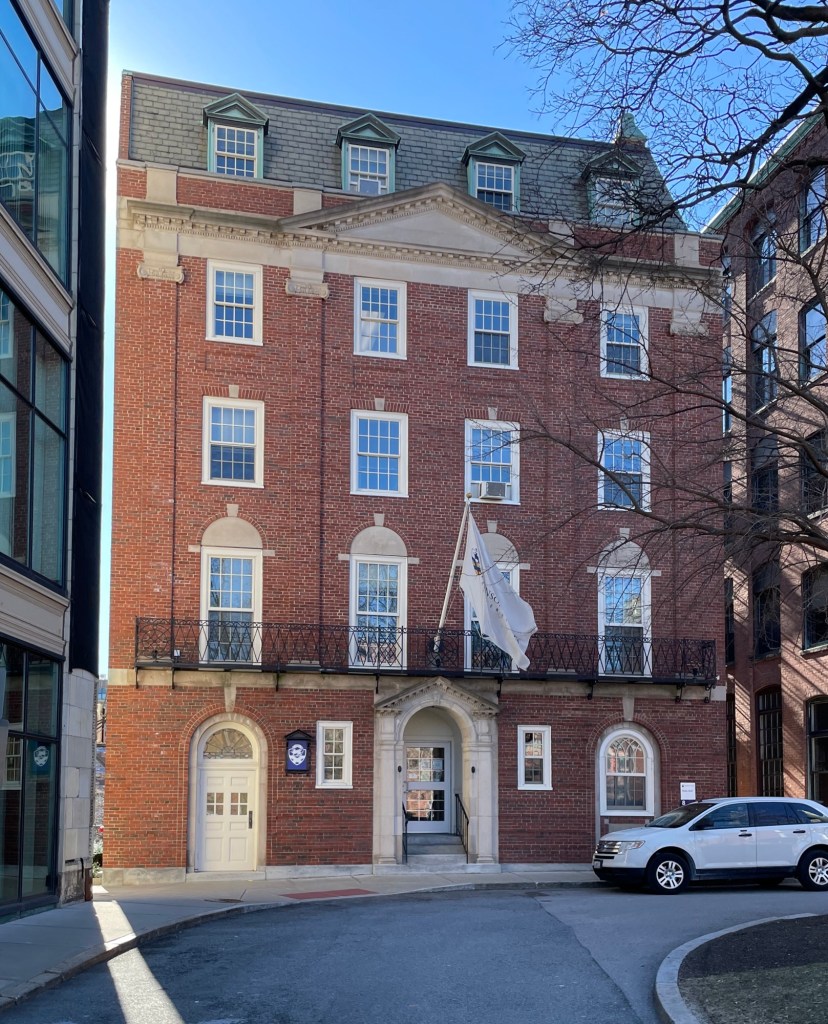
Plantations Clubhouse // 1927

Tucked away behind Abbott Park, a small green in Downtown Providence, the Plantations Club has stood for 100 years as one of the city’s finest examples of Colonial Revival architecture and was long a vital women’s club organization. This Georgian Revival brick building was designed by the firm of Andrews, Jones, Briscoe & Whitmore, of Boston for the Providence Plantation Club, a women’s social organization founded in 1916. The club was a success, starting with about 150 members and it reached more than 1,300 members, just one year after its inception. As the only female architect of the society, Frances E. Henley got involved in promoting the Club in terms of its visuals and interior design of the building, working closely with the architects. Ms. Henley was the first woman to study architecture at the Rhode Island School of Design and the first woman to independently practice architecture in Rhode Island. When the club no longer needed such a building, Johnson & Wales University acquired the building in 1962, and since then, it has been known as Wales Hall, housing a variety of offices and services.

Alumnae Hall – Pembroke College – Brown University // 1926

It’s not often that a building has not one, but three distinct and beautifully designed facades. Lucky for us, the 1926 Alumnae Hall at Pembroke College (now Brown University), fits the bill! Alumnae Hall on the Pembroke Campus was dedicated in October 1927 with funds for the building raised through the efforts of the Alumnae Association with Stephen O. Metcalf would duplicate all gifts of students and alumnae. The campaign continued until 1926, when the $50,000 contributed by the students and the $150,000 contributed by the alumnae, together with Mr. Metcalf’s matching funds, were deemed sufficient to start the building. The cornerstone was laid in May 1926 with the Boston architectural firm of Andrews, Jones, Biscoe and Whitmore as architects, who designed the building in the Colonial Revival style. Alumnae Hall, built of brick with limestone trim, was designed to accommodate the social and religious activities of the Women’s College. Its main entrance is a balustraded stone terrace on the campus leading to an auditorium on the main floor, the various sections create a visually stunning complex of wings and facades built into the landscape.