Socony-Mobil Building // 1956

One of the unsung heroes of Modernist architecture in New York City is one of my personal favorites, the Socony-Mobil Building at 150 E 42nd Street in Manhattan. Completed in 1956 from plans by Wallace Harrison of the iconic firm of Harrison & Abramowitz, the development stands out amongst the competing masonry buildings and glass skyscrapers in the area. At the time of its completion, the Socony–Mobil Building was the first skyscraper to have its exterior wall entirely clad with stainless steel, as well as being the largest air-conditioned building in the world! The base is clad with opaque blue glass panels framed with stainless steel moldings; above, the tower and wings are clad in over 7,000 embossed stainless steel panels. The firm reviewed over 100 different designs until they settled upon the four raised relief panels: a rosette-like motif for above and below the windows; a large and small rosette to flank the windows, and two variants displaying a design of interlocking pyramids. The panels were likely designed by or inspired by Oskar Nitzchke (1900-91), a German-born designer who worked at the firm and worked on the similar style Alcoa Building (1953) in Pittsburgh. The building was developed as a speculative project, but the largest tenant, the Socony-Mobil Oil Company, later renamed Mobil, helped to give way to the naming rights. The building was landmarked by the City of New York in 2003.

Macy’s Department Store – Herald Square // 1902

Thanksgiving in the days of Covid-19 will be different in more ways than one. A notable loss will be the absence of the annual Macy’s Thanksgiving Day Parade in New York, which has been a national pastime broadcast on televisions for millions of Americans every year. The six-mile route through the city, giant balloons and all, would end at Macy’s Herald Square, the flagship store of the department store chain. The building (one of the largest stores in the world) was completed in 1902 and its 2.5 million square feet of space, occupy an entire city block. The building was designed by Interestingly, in 1900, a small five-story building on the corner of 35th and Seventh was purchased by Robert H. Smith in 1900 for $375,000 ($11.5 million today). The idea had been to obstruct Macy’s from becoming the largest store in the world. It is largely supposed that Smith, was acting on behalf of Siegel-Cooper, which had built what they thought was the world’s largest store nearby in 1896. Macy’s ignored the tactic and built around the building, which now carries Macy’s “shopping bag” sign by lease arrangement! Oh, and Macy’s even hired the same architect for their department store that Siegel-Cooper used for their building, Theodore de Lemos, adding insult to injury. A great example of a spite building!

1908 image of Macy’s Herald Square courtesy of LOC.

New York Appellate Courthouse // 1899

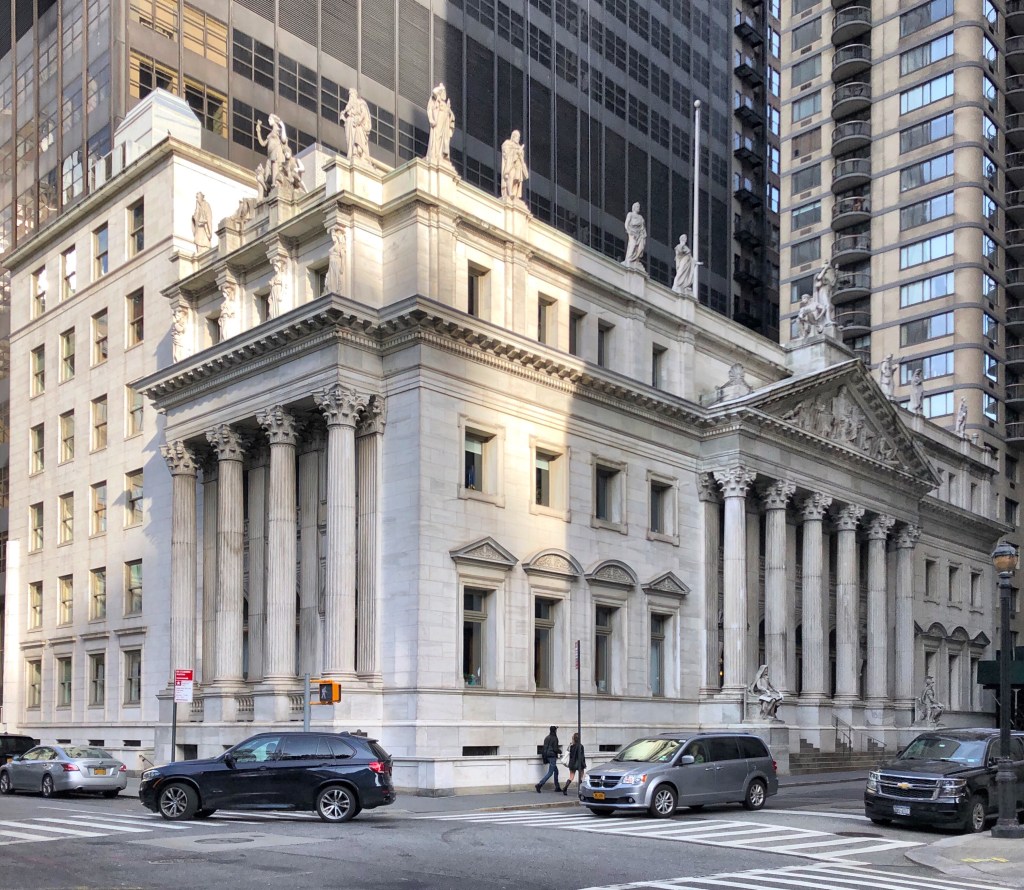
Distinguished for its classic beauty, this small marble courthouse expresses the best of Classical tradition, in its columned portico and fine sculptures adorning it. Located at the edge of Madison Square Park, the building was constructed between 1896 and 1899 to serve as a courthouse for the Appellate Division of the New York State Supreme Court. The marble Classically inspired Beaux-Arts courthouse, was designed by James Brown Lord and is considered to be an excellent example of the City Beautiful movement, which sought to introduce monuments and beautification to American cities. Of the nearly $650,000 spent on the building, 25 percent was spent on sculpture, a huge sum at the time. Sixteen sculptors – sponsored by the National Sculpture Society and among of the most esteemed of the day – worked on the thirty 12-foot marble statues on the facade, the most ever to work on a single building in the United States. Sculptures by Daniel Chester French, Charles Henry Niehaus, Karl Bitter, and more adorn the balustrade and entrance steps. Additionally, four caryatids sculpted by Thomas Shields Clarke on the Madison Avenue front, showcase a rare feature not typically seen in American architecture, representing the four seasons.

In 1953 a $1.2 million restoration of the facade was undertaken by the Department of Public Works during which the huge marble statues were removed and cleaned. It was at this time that the general public first realized one of the lawgivers was Mohammed. Representatives from Pakistan, Egypt and Indonesia petitioned the State Department to destroy the statue rather than restore it, citing Islamic canon that forbids the depiction of human beings in painting or sculpture. When the statues were replaced in 1955, each was moved over one spot to fill in the void where Mohammed had stood. Today one empty pedestal remains.

141-147 5th Avenue // 1896 & 1900

This stunning Beaux-Arts store and loft structure, is located on a
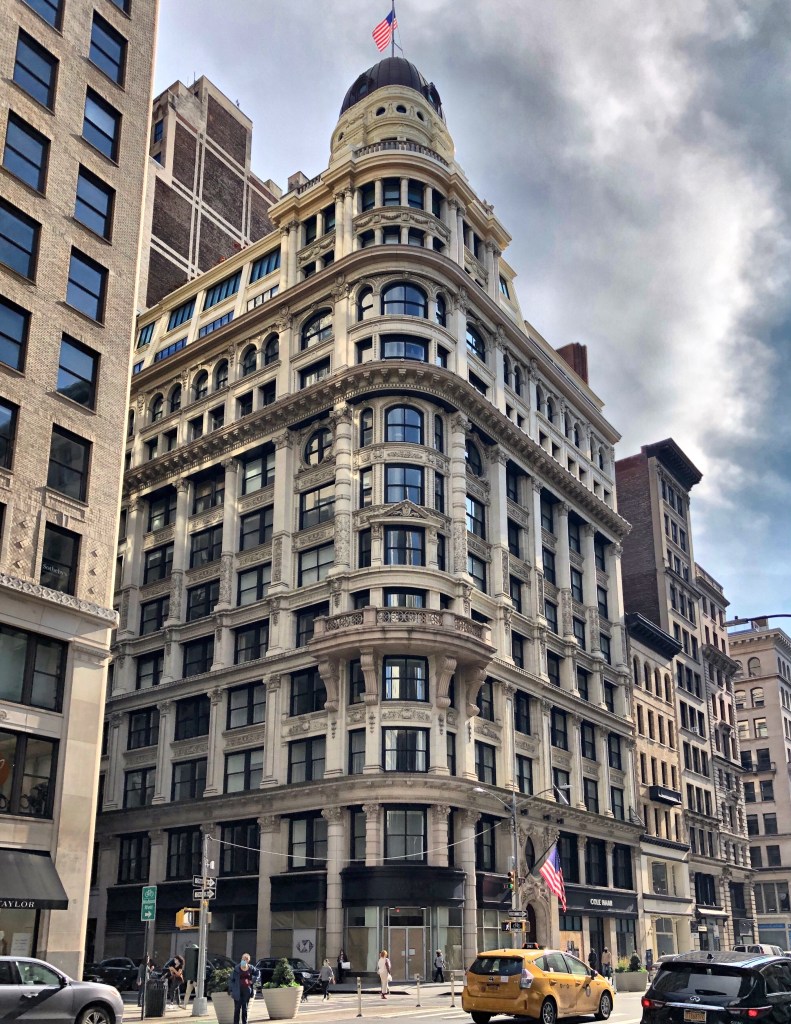
prominent corner site at 5th Ave and 21st Street in Manhattan. The structure is faced in limestone and terra cotta and was constructed in two phases. The original three southern bays (on the right side of the image) on 5th Avenue were designed by prominent architect Robert Maynicke for real estate developer Henry Corn. In 1899, two years after its completion, architect Henry Edwards Ficken designed an addition to the north wrapping around and running along 21st Street. The addition continued the richly embellished facade and supplemented it with a twelve-story, curved corner bay which is crowned by a dome. The building appears to have been constructed without a major tenant, and many companies utilized the iconic space including: the Merchant Bank of New York, Park & Tilford’s, a fancy grocer, and lace companies. In the mid 20th century the building suffered from deferred maintenance until 2005 when the building was restored and converted to 38 apartments (including one utilizing the dome)!

Old Penn. Station // 1910-1963

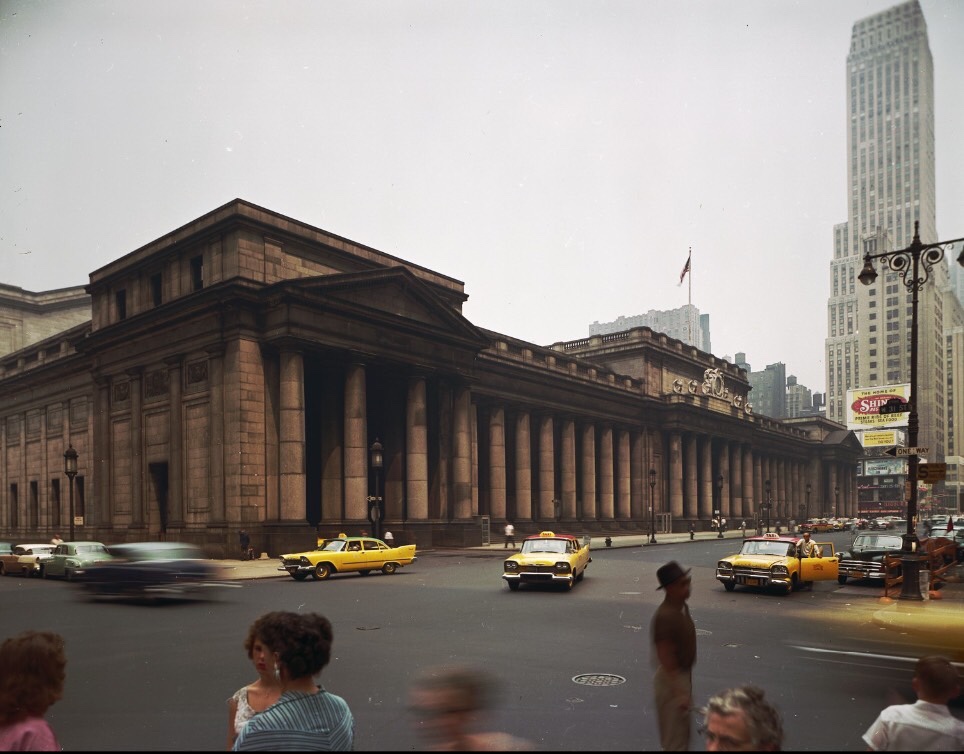
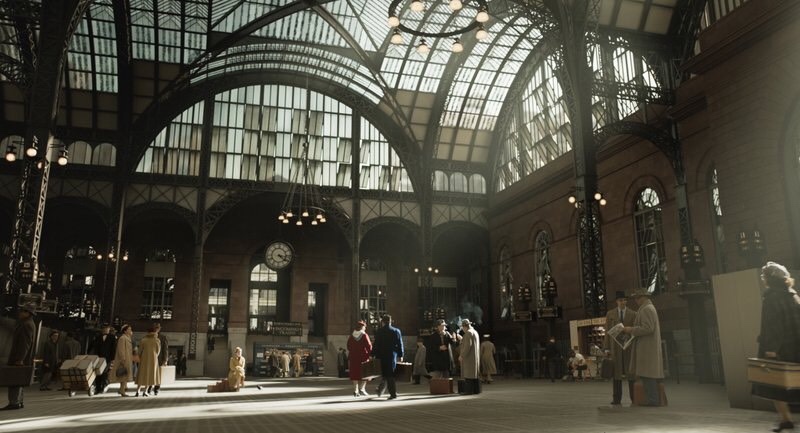
Pennsylvania Station in Manhattan was opened in 1910, and its sheer scale immediately evoked a sense of awe. At the time it was completed, it was the largest building ever built occupying two entire city blocks, and boasted the biggest waiting room in history. Over 500 buildings were demolished for the station to make way for the Charles McKim-designed station, an icon in the Beaux-Arts style. The structure had “nine acres of travertine and granite, 84 Doric columns, a vaulted concourse of extravagant, weighty grandeur, classical splendor modeled after royal Roman baths, rich detail in solid stone, and an architectural quality in precious materials that set the stamp of excellence on a city.” Sadly, being one of the most beloved architectural gems in the city did not constitute its maintenance nor preservation.

In 1961, after numerous plans for redevelopment, air-rights were sold on the building and in 1963, Penn Station was razed. The former grand station was replaced by Madison Square Garden and Pennsylvania Plaza, an office skyscraper, all with a modernized station below. When the building was destroyed, art historian Vincent Scully famously said, “One entered the city like a god. One scuttles in now like a rat.” In 1965, two years after Penn Station’s demolition commenced, the city passed a landmarks preservation act, thereby creating the New York City Landmarks Preservation Commission. Additionally, Grand Central Station was proposed to be demolished later in the decade, but was saved thanks to preservation efforts.

John Hoyt Perry House // c.1875

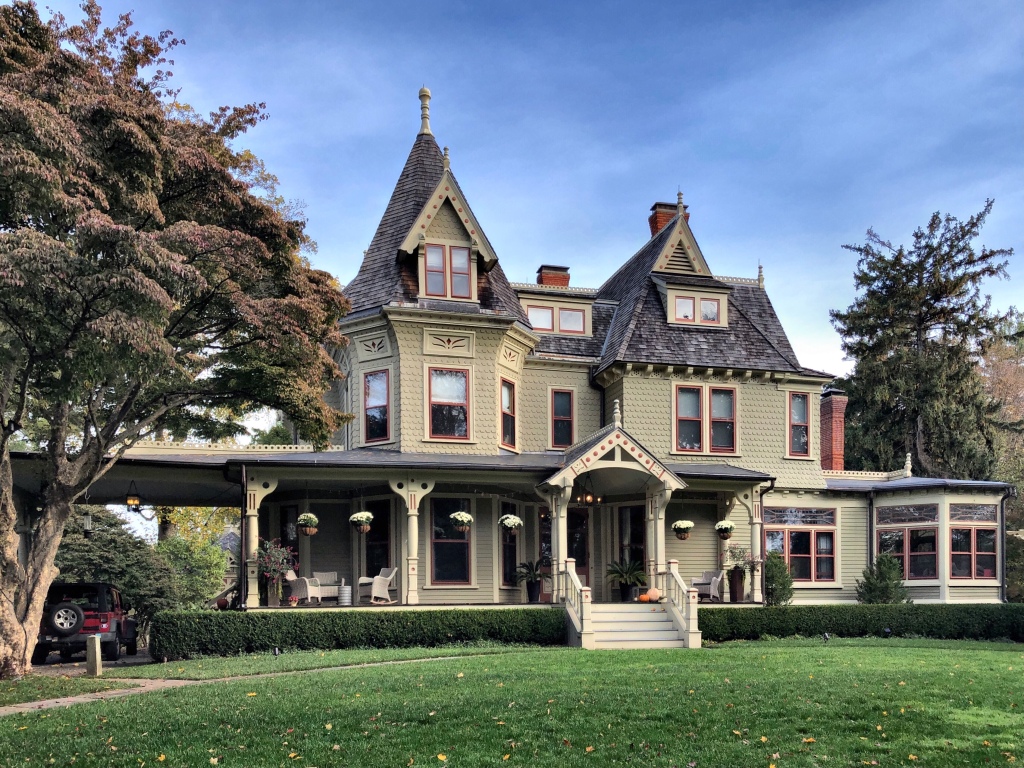
John Hoyt Perry was born in Southport in 1848, and graduated at Yale in 1870. He received his professional education at Columbia Law School and was admitted to the bar in Bridgeport, CT in 1872. He had an active law career in Connecticut, later working as a judge. He served Southport in the House of Representatives throughout much of the end of the 19th century. In 1913 he was elected to the Connecticut Senate and served as the minority leader. He served as counsel for the United States in arbitration proceedings with Chile in 1902, and as counsel for the town of Fairfield. This home in Southport was constructed for him, likely around 1875 after he accepted his position as a head attorney at a major firm nearby. The home can be classified as a blending of Stick style and Queen Anne Victorian design with the asymmetrical form, tower, large porch with projecting porte-cochere, shingle siding, and bargeboards.

Southport Savings Bank // 1865

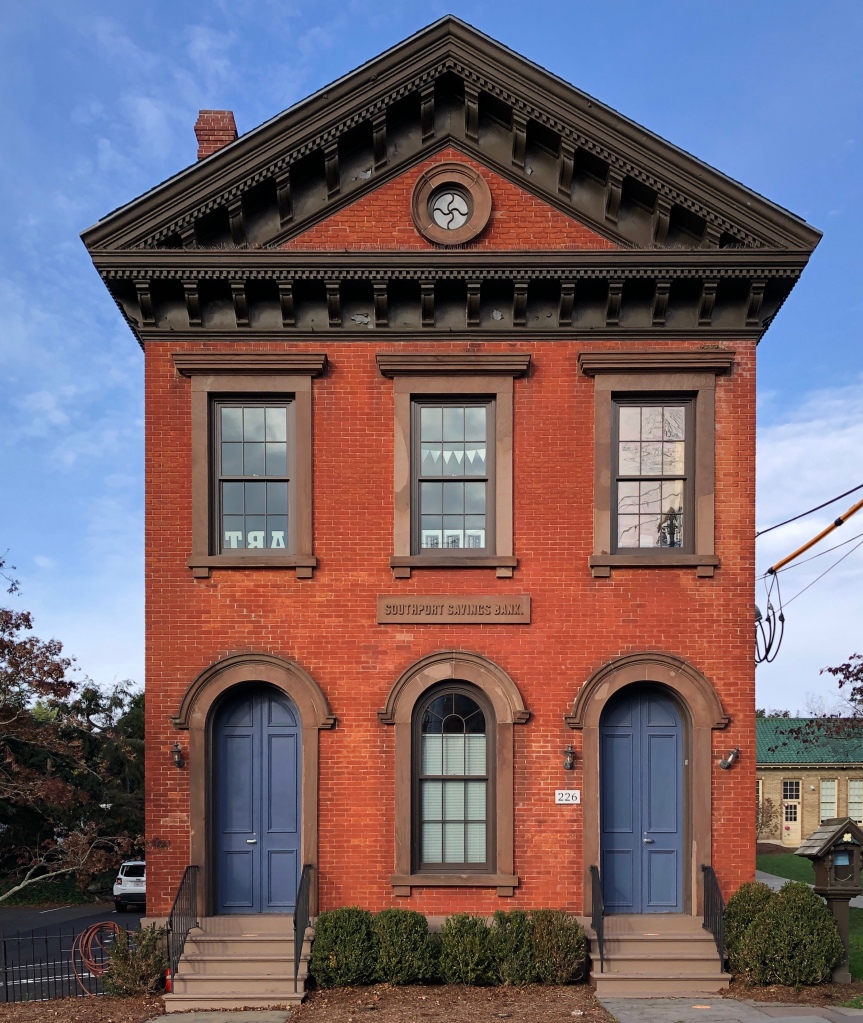
The Southport Savings Bank obtained a charter from the Connecticut General Assembly in May 1854, and was organized on September 25 of that year. Original incorporators included Paschal Sheffield, Austin Perry, Wakeman B. Meeker, Charles Perry, Prancis D. Perry, E.D. Sherwood, John Meeker, Frederick Marquand, and Andrew Bulkley. A new building, located at the foot of Main Street, was constructed to be accessible to shipowners, shop keepers, the farmer patronage, and commercial traders. This bank building was occupied in 1865, eventually merging with Bridgeport People’s Savings Bank on July 1, 1955, becoming the Southport Branch of the People’s Savings Bank – Bridgeport. It ceased to be a bank in the 2010s and is now occupied by the Southport School.

Pequot Library // 1894

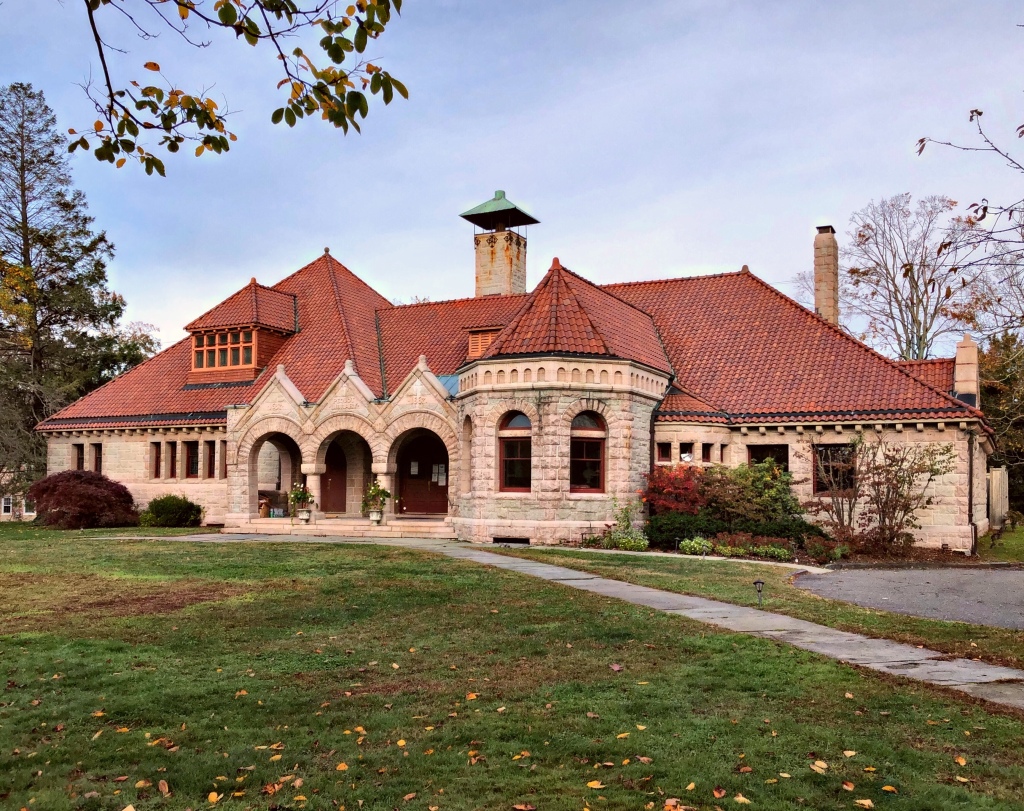
The Pequot Library in Southport, Connecticut was founded in 1889 by Virginia Marquand Monroe and her husband Elbert B. Monroe. The library, designed by noted New York City architect Robert H. Robertson, opened to the public in March 1894. The building is Romanesque Revival in style in a granite sandstone construction. There is an expansive roof area topped with red tile and hipped dormers; an arcaded entrance porch with three arched openings serves as the focal point of the front facade. It was Mrs. Monroe’s intention that Pequot be as “free as air to all”, which it remains as to this day.

Trinity Church, Southport // 1862

The Trinity Episcopal Church in the Southport section of Fairfield, Connecticut was established in 1725. Twenty families met for worship at its first meeting house in the center of town on Thanksgiving Day, 1725. Since then, the church has constructed five different places of worship in locations around town. Architect Albert C. Nash designed the church which was constructed during the years 1854-56. Sadly, the building’s near total destruction by wind during a tornado on January 1, 1862, required the church to be completely rebuilt as originally planned, with a few structural alterations. Trinity Church is an excellent work of early Gothic Revival church architecture in wood, one of the best I have seen in my trips around the region.

Simon Sherwood House // 1884

The Simon C. Sherwood house, built in 1884, is a fine late nineteenth-century eclectic Victorian home, somewhat unique to the Southport area of Fairfield, CT, which is dominated by early-mid 19th century styles. Simon Couch Sherwood was the son of Edwin Sherwood, a wealthy shipping merchant who made a fortune from trade between New York and Savannah. The Queen Anne-Eastlake style home was added onto with a larger porch, obscuring an original oriel window on the side elevation. Sadly, the home has a safe, yet inappropriate pale yellow body color with white trim, which does not showcase the intricacies of the Victorian era home.