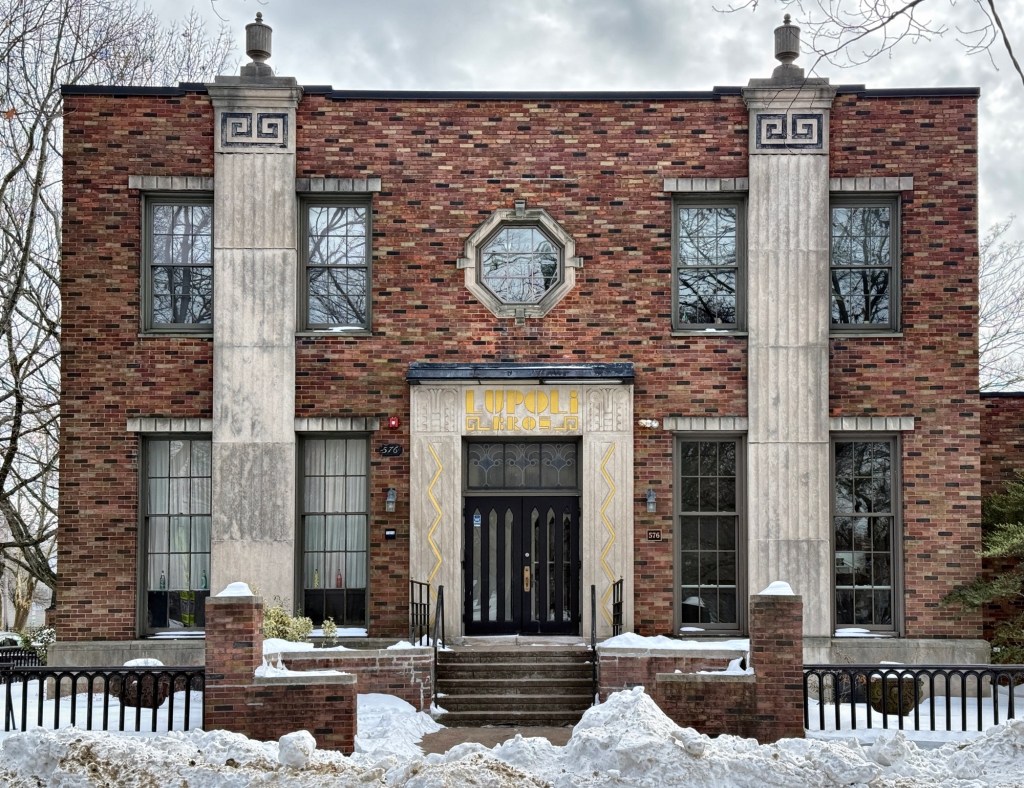
A rare example of the Art Deco architectural style in New Haven, the former Lupoli Brothers Funeral Home on Chapel Street in Wooster Square is more than meets the eye! This Art Deco jewel box was originally constructed in 1841 as a large, single family home and modernized nearly 100 years later in its current design. In 1841, Henry Lucas Hotchkiss (1810-1861), a businessman and president of the L. Candee Rubber Company, had a two-story Greek Revival style home built on this lot for his wife, Lucy. The home was originally two stories, but a third floor was added in the 1860s, around the time the rear stable (still extant) was constructed, for another owner. In the early 20th century, as the Wooster Square neighborhood became a center of Italian-American life and business in New Haven, the property was purchased by Liberato Lipoli (1862-1934) who moved to Connecticut from the Piedmont region of Italy. A year after their father’s death, sons Mario, Gennaro, Antonio and Louis Lupoli, established a funeral parlor catering to the local Italian American community. In 1935, the Lupoli Brothers hired local architect, Lester Julianelle to reimagine the former Hotchkiss House in a modern style. The result is the refaced building with Classical Revival and Art Deco elements including the iconic entry reading, “Lupoli Bros” in the iconic lettering. The Lupoli’s closed the parlor here in 2008 and the building was converted to eight condominium units.
 Buildings of New England