In 1898, before the Berzelius Society at Yale built their present “tomb” in New Haven, the organization funded one of the finest residence halls in town at the time. The building was known as “The Colony” and would house Seniors who were members of the secret society. Located on Hillhouse Avenue, the stately Colonial Revival/Neoclassical building was designed by architects Henry Bacon and James Brite. Bacon is best known for having designed the Lincoln Memorial on the National Mall. Yale purchased the Colony dormitory in 1933 for student housing, later using it for faculty offices before demolishing it in 1969 to facilitate construction of the Yale Health Services Center, one of the least inspiring buildings on the campus.
One of my (many) favorite buildings at Yale University is Bingham Hall, a monumental and landmark example of the Collegiate Gothic architecture style. Built in 1928, replacing the 1888 Osborn Hall (last post), Bingham Hall was constructed as an inward-facing freshman dormitory by architect, Walter B. Chambers, who had just overseen the completion of his first building at Yale, the Colonial Revival style McClellan Hall. Built of Longmeadow brownstone, Bingham Hall largely constructed from funds donated by the children of Charles W. Bingham (Yale, 1868), a Cleveland based businessman. The building stands five stories with a massive nine-story corner tower and helped solidify Yale’s iconic Collegiate Gothic architecture for the future buildings and growth as well.
Like many other buildings on campus, Vanderbilt Hall is named for its wealthy sponsors, but its foundation is one of family tragedy. One of Yale’s stunning Collegiate Gothic structures, the building is named after William Henry Vanderbilt II (1870-1892), who attended Yale in the early 1890s. William contracted typhoid fever from a water pump while touring the western United States and died during his junior year. His father, railroad tycoon Cornelius Vanderbilt, constructed Vanderbilt Hall in 1894 as a memorial to his son and donated it to the University. The highly prized Vanderbilt room, which is located above the archway, is apparently one of the finest residential spaces on the campus. Architect Charles C. Haight designed the building which enclosed the southern edge of the yard, created a gateway, and is one of the early architectural statement pieces for the campus in the Collegiate Gothic style. Haight would receive later commissions at Yale based on his work on Vanderbilt Hall.
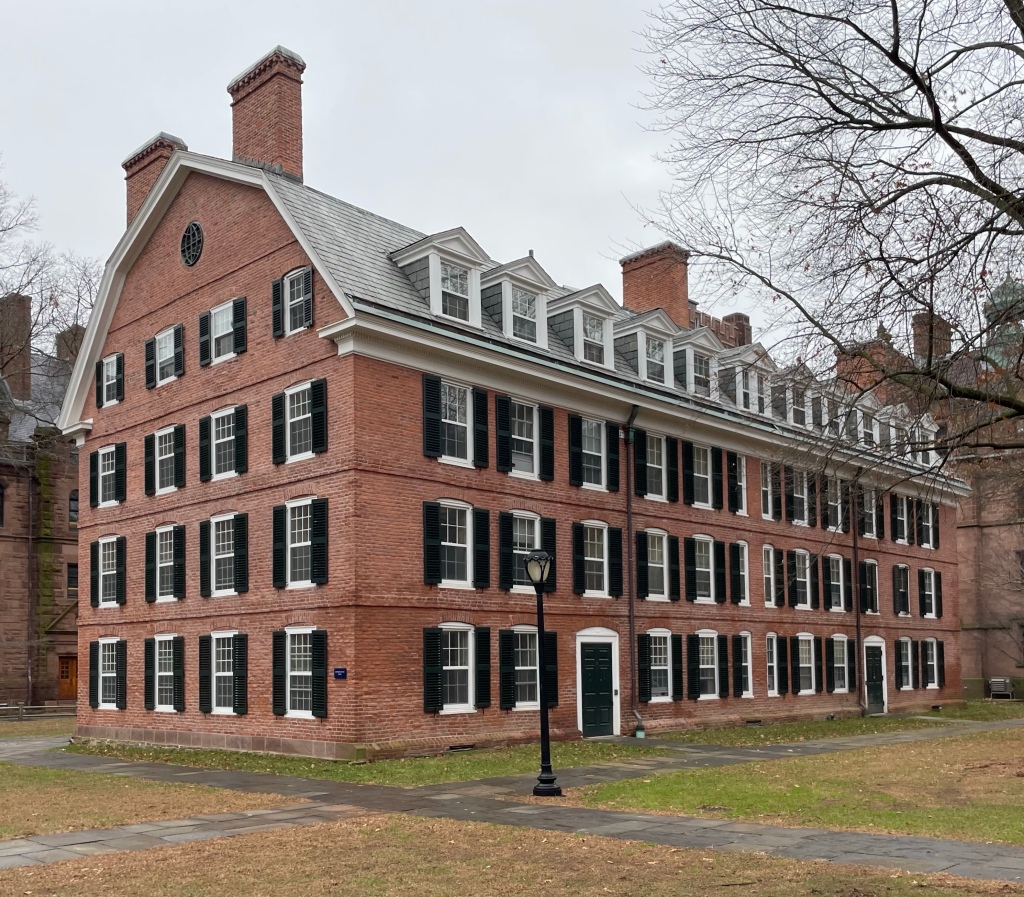
Welcome to Yale! When Yale College, one of the nine Colonial Colleges moved to New Haven in 1718, a wooden building was soon constructed and known as the College House. By 1747, the College House held less than half of the college’s enrolled students, and college presidentThomas Clap announced that funds would be raised from the Colony of Connecticut for a “new College House” of three stories. The design followed the traditional Georgian appearance of Harvard College’s Massachusetts Hall, but by the 1790s, it was already outdated. The building was threatened with demolition, but Connecticut Hall was instead given an additional story and a new gambrel roof by 1820, being incorporated into the Brick Row, fronting the Green along College Street. But by the middle of the century the Brick Row was out of style and Connecticut Hall was being described as “dilapidated, scabby and malodorous.” After the Civil War Yale decided to raze all its old Georgian architecture and redevelop the West side of the Green with larger and more modern buildings. Luckily for us, by the 1890’s the Colonial Revival style was booming in popularity and before Connecticut Hall could be demolished, a group of alumni organized to save and restore it. Connecticut Hall stands today as the third-oldest of only seven surviving American colonial-era college buildings, and the second-oldest structure built for Yale College in New Haven (the oldest exant). It was built, in part, by at least five enslaved Africans, including one of whom was owned by Yale president Thomas Clap.
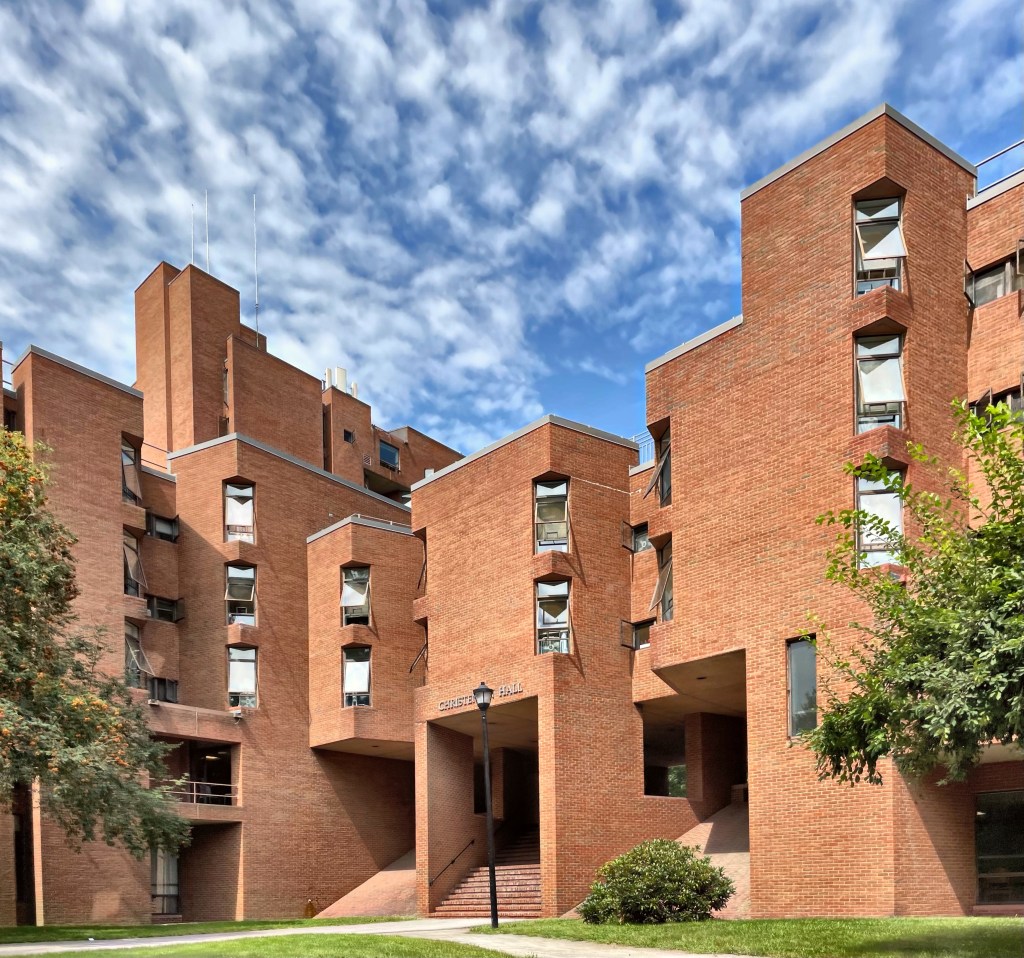
Christensen Hall at the University of New Hampshire in Durham is a rare example of the much-maligned Brutalist style of architecture in the state. In the late 1960s, the university needed more housing and a dining hall for new students of the growing campus, but a very low budget to accomplish this. They hired Ulrich Franzen, a German-born architect (featured on here previously) who attended school at Harvard, learning Modernist principles there that would shape his career. The boxy buildings feature deep recessions to provide each student an identifiable corner and windows. The concrete frame building and engineering provide breezeways and forms that conventional buildings would not be able to accomplish. The building was completed in 1970 and was immediately applauded by architects and was featured numerous architectural publications.


 Buildings of New England