Chester Public Tomb and Hearse House // 1850

Near the entrance to the Brookside Cemetery in the charming village of Chester, Vermont, these two very different looking buildings were constructed for one purpose, death. Before the proliferation of funeral homes and cremation, infrastructure for the dead was a necessary piece of the built environment for towns and cities all over the region. The wood-frame building seen here was built as a hearse house, which would shelter the horse-drawn hearse for the town. Prior to the advent to funeral homes, most wakes were held at the home of the deceased, after-which, the body would be transported by the horse-drawn hearse to the cemetery for burial. This was followed by a memorial service at the nearby church. If the ground was frozen or if the family did not yet have the funds to bury their family member, the body would be held in the public tomb until the burial. The Chester Public Tomb dates to 1850 and was built by local mason, Arvin Earle from stone  quarried near Gassetts, a hamlet in the north part of Chester that was shipped to Chester Depot by the newly completed railroad. While no longer in use, these two vernacular buildings hold a very important history of the town and have been lovingly preserved by local residents. 

Old Settlers’ Burying Ground // 1674+

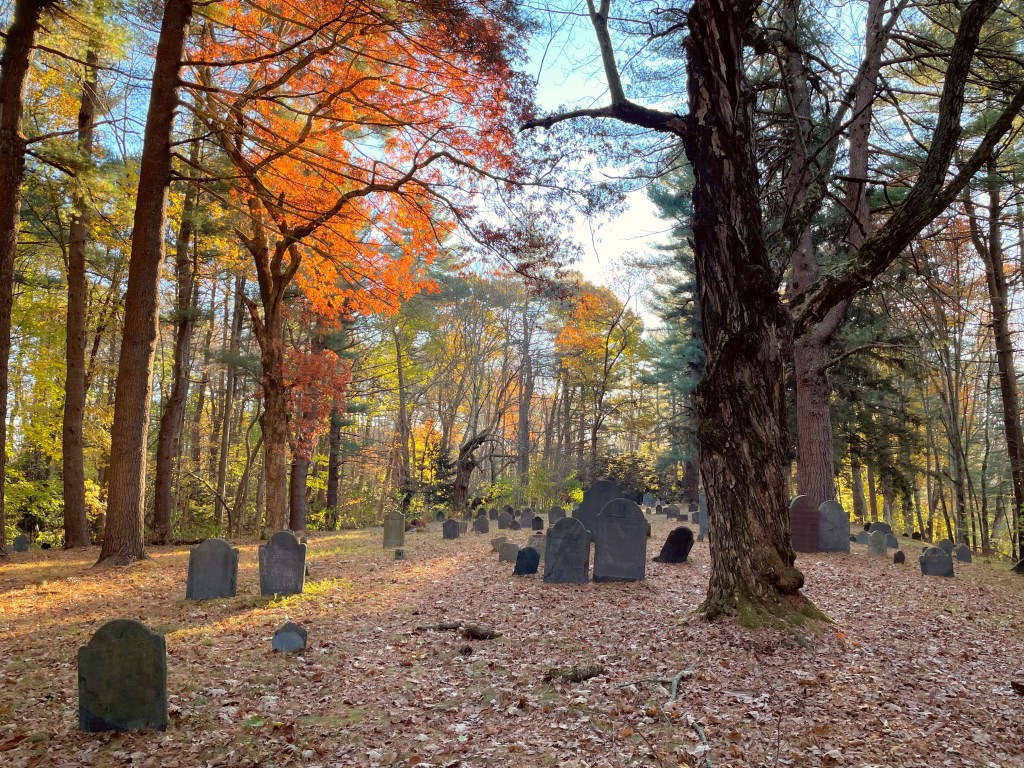
I know.. I know.. It’s not a building, but I couldn’t help myself but to find this hidden cemetery and take some photos! Tucked way off a street, across railroad tracks and down into a grove of trees, I came across this Colonial-era cemetery known as the Old Settlers’ Burying Ground. Established by 1674, it is the town’s oldest formal cemetery with gravestones dispersed, both standing up to the heavens and seemingly jutting out of the ground like crooked teeth. The Old Settlers’ Burying Ground contains approximately 196 stones and an estimated 230 burials. The stones in the cemetery reflect the continuum of headstone iconography popular from the 17th through 19th centuries, depicting winged death’s head, soul effigy, heart, hourglass, skeleton, and cherubs, to name a few. The cemetery is thought to possibly have unmarked graves of the colonists who were killed during the Lancaster Raid, the first in a series of five planned raids on English colonist towns during the winter of 1675 as part of King Philip’s War. Metacom, known by English colonists as King Philip, was a Wampanoag sachem involved in leading and organizing Wampanoag warriors during the war. The tension that led to these raids began from the decline in the fur trade due to overhunting, the decrease in the native population due to European-derived diseases, and the invasion of English livestock on native land. According to one estimate, at least fourteen Lancaster inhabitants died and twenty-three were captured and taken as prisoners, some of those 14 are likely buried here in unmarked graves.