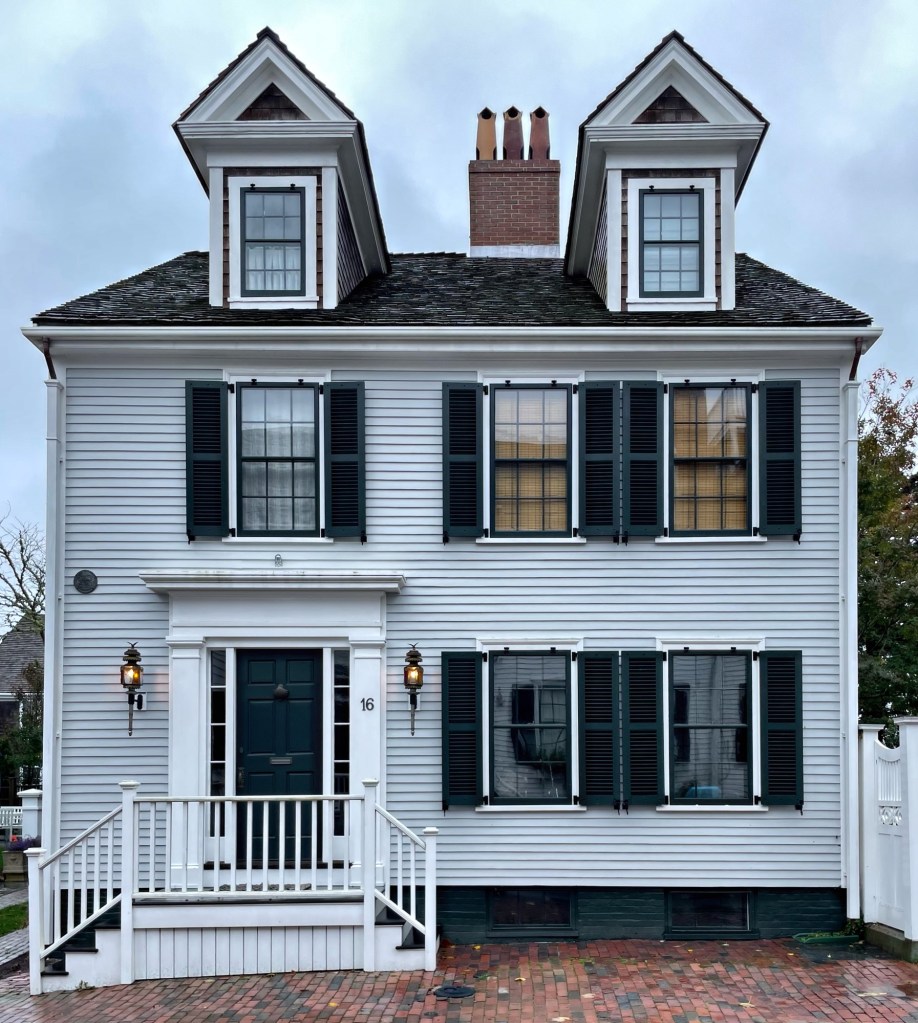
Coleman House // c.1750

In 1802, a young sea captain, Laban Coleman purchased this house on Orange Street on Nantucket within a year of his marriage to Jane Carman. Historians estimate the date of construction of the house to be from sometime between 1729 and 1750, but it could date closer to the time that Coleman purchased the house from a joiner, Elisha Raymond, who possibly built the house. I particularly love the simple door with transom above and the narrow, second-story stairhall window. What do you like the most about this Nantucket home?

Levi Starbuck House // 1838

One of the more unique Greek Revival style houses I have yet seen in New England is the Levi Starbuck House on Orange Street on Nantucket. The house was built in 1838 by housewright William M. Andrews who sold the completed property that year to Levi Starbuck, a wealthy sea captain for $5,000. When he bought the house, Levi Starbuck (1769-1849) was 69-years-old. Levi Starbuck is credited by some as inspiration for the character Starbuck in “Moby Dick.” He would spend the last ten years of his life in this opulent new house on Orange Street. Architecturally, the house is clad with flush siding with projecting paneled pilasters with fret patterns on the top and bottom breaking up the bays of the house.

Captain Silas Jones House // c.1774

Brick houses are not too common on Nantucket, so I love to highlight them whenever possible! This gambrel-roofed residence was built by 1774 for Silas Jones, a whaling captain around the time of his marriage to Judith Gardner. As originally built, this house had brick endwalls while the facade and rear walls were constructed of wood. It was not until under the ownership of Silas’ son, Daniel, that the house was “modernized” with its present appearance. Daniel added brick walls to the front and rear walls, added brownstone lintels and sills to the openings, and added twin chimneys, likely replacing a single, central chimney. Due to his materiality and heavy presence, the house looks more like it belongs in Salem or Providence, so seeing it in the coastal town of Nantucket makes my heart sing. Standing out is a good thing!

Andrew Myrick House // 1755

Nantucket is an old house lovers dream. A large part of the reason for this is that much of the island was designated as a local historic district in 1955, making it one of the earliest historic districts in the United States! This means that since 1955, the Nantucket Historic District Commission has been overseeing the island’s preservation, demolitions and alterations to historic buildings. This is the Andrew Myrick House located on Orange Street. The Georgian dwelling was built in 1755 by Andrew Myrick (1704-1777), a shipbuilder and storekeeper who was born in Charlestown, Massachusetts and eventually settled on island, constructing this home for his family. He and his wife Jedidiah had over 16 children, some of which died in childhood. Myrick would eventually hang himself at the age of 71. The home remained in the family until 1827. Fun fact: Andrew’s grandson, Peter Myrick was said to have set sail from Nantucket in 1833 in search of sea serpents. He came back empty handed.

Folger Block // 1831

Built the same time as the stately brick, Folger House on Main Street (last post) in Nantucket, owner Philip H. Folger (1792–1865) in 1831 erected these rowhouses quickly selling them for profit. Each of the five connected dwellings were sold to private owners, and have seen alterations over time adding to the intrigue on this block. The Folger Block is comprised of five Federal-style, 2.5-story, wood-frame buildings with wood-frame party walls between each unit. Each row house sits atop a raised brick basement and has a side-gable roof pierced by twin front-gable dormers. Charming door surrounds include sidelights and transoms to allow light into the entries.