Dana King House // 1879

Another stately Victorian-era house on Nashua’s Concord Street is this brick beauty, known as the Dana King House. The property was constructed in 1879 for Dana William King (1832-1912) who had quite a history. He was born in Alstead, New Hampshire where he lived until he was 19, moving to Boston to “make his fortune”. In 1852, he shipped aboard a whale boat in East Boston, and realized that whaling wasn’t for him. He was persuaded by his brother to move in with him in Detroit, where he worked as a grocery clerk before moving back to New Hampshire, settling in Nashua, where he did make his fortune. He began working at a local mill until the outbreak of the American Civil War, where he enlisted in the First Regiment of New Hampshire, eventually rising to the rank of Lt. Colonel. He was captured during the war and held in prison in Shreveport for over seven months, failing at least one prison escape. He was eventually included in a prisoner swap and returned to Nashua in 1865. Upon his return, King used his war stories to gather favor locally, and he was elected Register of the Hillsborough County of Deeds, a position he held for over 30 years. The King House is a great, and rare example of the Victorian Gothic style of architecture in Nashua, notable for its steeply pitched slate gable roof with octagonal corner tower serving as a belvedere or cupola.
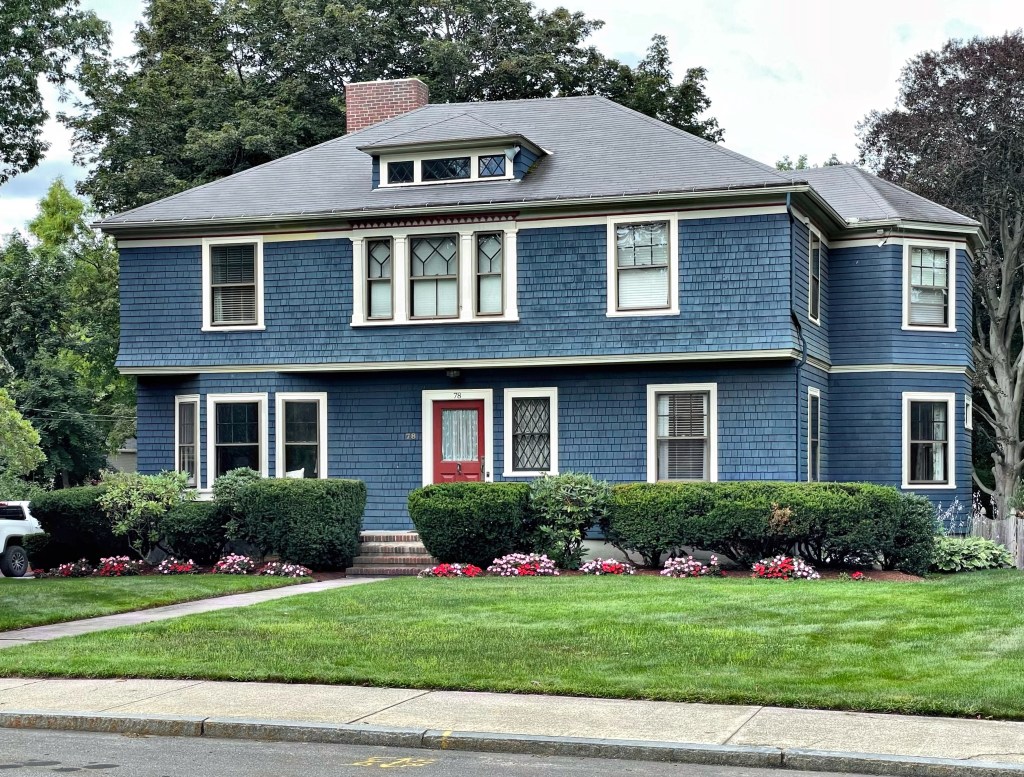
Charles Hoitt House // 1895

Charles William Hoitt (1847-1925) was born in Newmarket, New Hampshire, the son of William K. A. and Sarah C. (Swain) Hoitt. His father was a descendant of John Hoyt, one of the original settlers of Salisbury, Massachusetts. On the maternal side he is a descendant of Phineas Swain who served at Bunker Hill on the American side. Charles enrolled at Dartmouth College in 1867, and was graduated in the class of 1871. He moved to Nashua to work as Master of the Mt. Pleasant School and later worked as an usher at the Lincoln Grammar School in Boston. He eventually gave up teaching as a profession and returned to Nashua and worked at a local law office. He was admitted to the Hillsboro bar in 1877, and worked as a City Solicitor and later as Justice to the Nashua Police Court. With his standing, he erected this fine house on Concord Avenue, with a deep lot where he raised rare exotic birds. Judge Hoitt served in the New Hampshire House of Representatives in 1901 and in 1907, was appointed by Theodore Roosevelt to be the United States Attorney for the District of New Hampshire. His residence in Nashua blends Queen Anne, Shingle, and Colonial Revival styles elegantly. The property was purchased in the 1920s by the Unitarian Universalist Church of Nashua as a parsonage, a use it held until it was sold in 1977 to a private homeowner. The shingled porch was removed during the time it was a parsonage, but the house remains in excellent condition today!