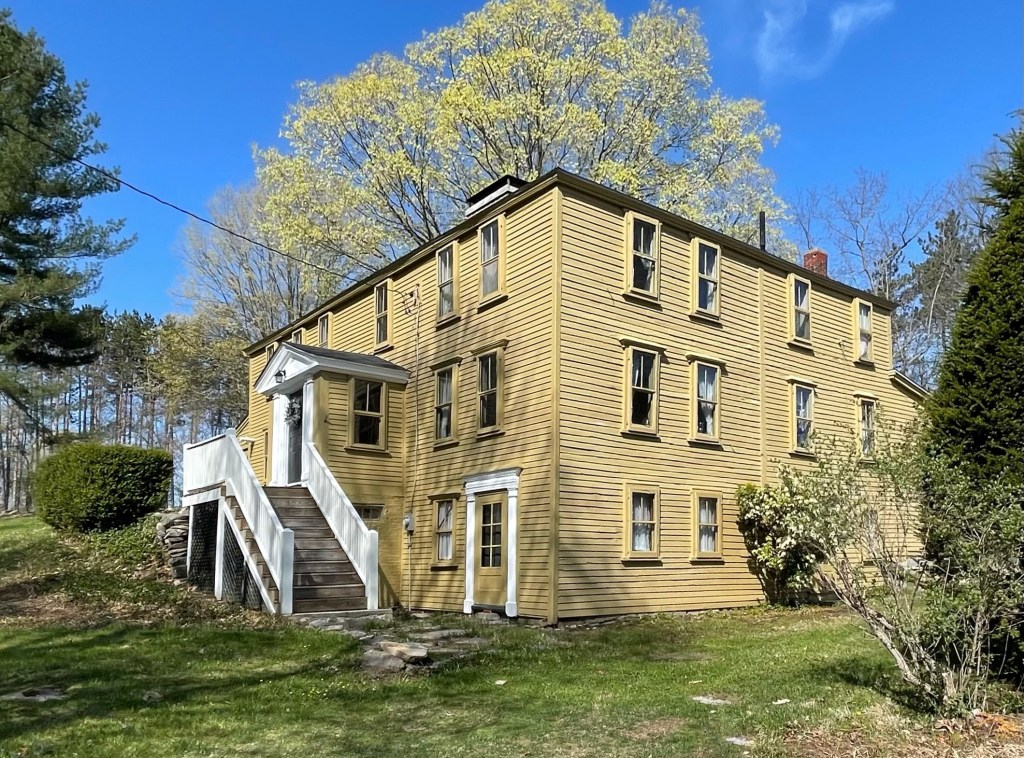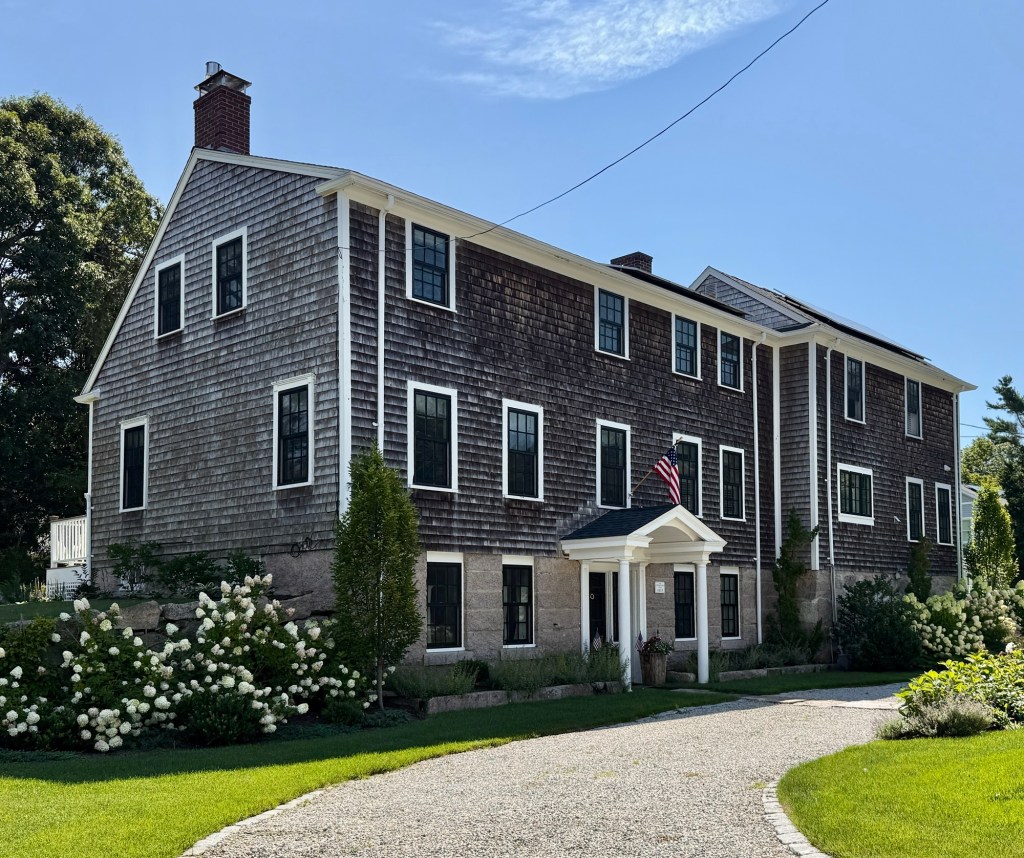
John Pitcher House – Old Parsonage, Marion // 1813

Known as the “Old Parsonage” this historic house in Marion, Massachusetts, was built in 1813 by Capt. John Pitcher (1788-1867) around the time of his marriage to Catharine Clark. John Pitcher was the brother of Elizabeth Pitcher Taber, a major benefactor of the town of Marion. The residence is unique in that the primary facade is actually facing away from the street, with the prominent three-story facade being the historic rear of the home. The Federal period house sits on a raised stone foundation with a central door and shingle siding above. Behind his home, a large pasture was grazed by sheep and cows until the land was sold off and subdivided for residential development later in the 19th century. When Capt. Pitcher died, he left his house to the Congregational Church, which used it as a parsonage for many years until 1966, when the church sold the property to Lawrence P. and Edith G. Pangaro, who co-founded the Marion Sentinel and the Sippican Publishing Company. The home was recently renovated.

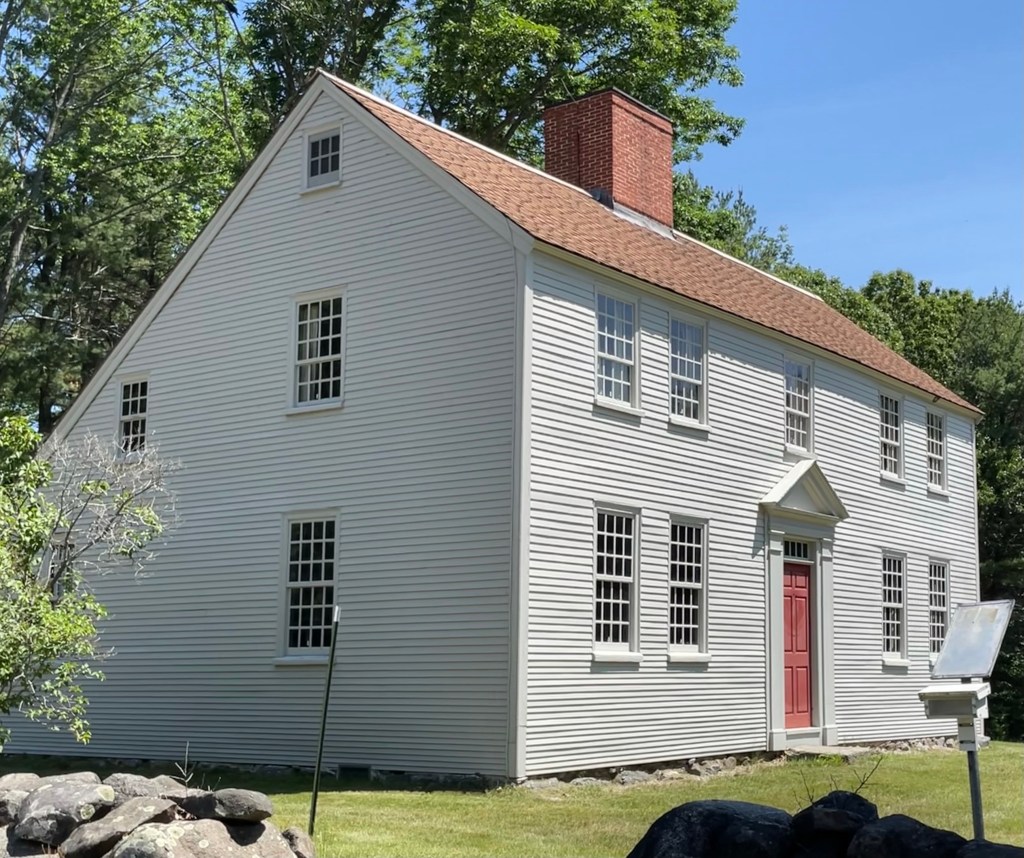
Cobb-Luce House // 1841

This beautiful side-hall Greek Revival style residence on South Street in Marion, Massachusetts, was built in 1841 as a parsonage for the Marion Congregational Church, built that same year. The first pastor to reside here was Rev. Leander Cobb, who assisted his father, Rev. Oliver Cobb, who had been preaching in Marion since the completion of the first meeting house in 1799. After Leander Cobb’s death in 1873, the church decided to sell this parsonage and it was purchased by Rev. Cobb’s second wife, Selina, who sold it to George Luce (1825-1893) a master mariner. In 1960, the property was sold to local historian and founder of the Sippican Historical Society, Olive Hiller Somers (1890-1967). The residence was renovated and retains much of its original architectural integrity.

Old Newington Parsonage // c.1725

The Old Parsonage in Newington, NH, is a rare survivor from the 1700s in the tiny town. It is one of few extant “saltbox” houses to be found in the New Hampshire seacoast. Like most houses of this type, the parsonage has a lean-to that was added a few years after the house was built. Like the nearby meeting house, the parsonage has long been inextricably connected to the public life and the identity of Newington. Unlike the much-altered meeting house, the parsonage retains the appearance of the 1700s and has been extremely well-preserved, giving a glimpse into 18th century life in Newington. The parsonage is estimated to have been constructed in 1725 when Richard Pomeroy, the first Sexton of the church, sold the property here for 19 pounds, with no mention of a dwelling. It was acquired by a John Knight (1685-1765). After his death, the dwelling was sold to the Town of Newington and restored to be used as a parsonage.

Old Acton Parsonage // c.1740

Not far off Main Street in Acton Center, this stunning old Georgian home was built around 1740 for Jacob Hooker a tailor and later served as the home of James Dudley, a blacksmith in the village. After the American Revolution, Acton called on Reverend Moses Adams (1749-1819) to be the minister for the Acton Meetinghouse. The town acquired the old Dudley House for Reverend Adams to reside in with his family. In 1780, the home was enlarged, and possibly given the raised foundation we see today. Mrs. Adams ran a store out of the basement, accessed by the doorway in the brick foundation. After Adams’ death in 1819, the property went to the next reverend in town, until his death decades later. In 1889, a carpenter, Moses Taylor, purchased the home, restored much of the woodwork, and replaced the historic windows with 2-over-1 windows, popular at the time. Moses moved a house on Main Street to make way for the new Acton Memorial Library, and was active in building and renovating homes in Acton until his death.