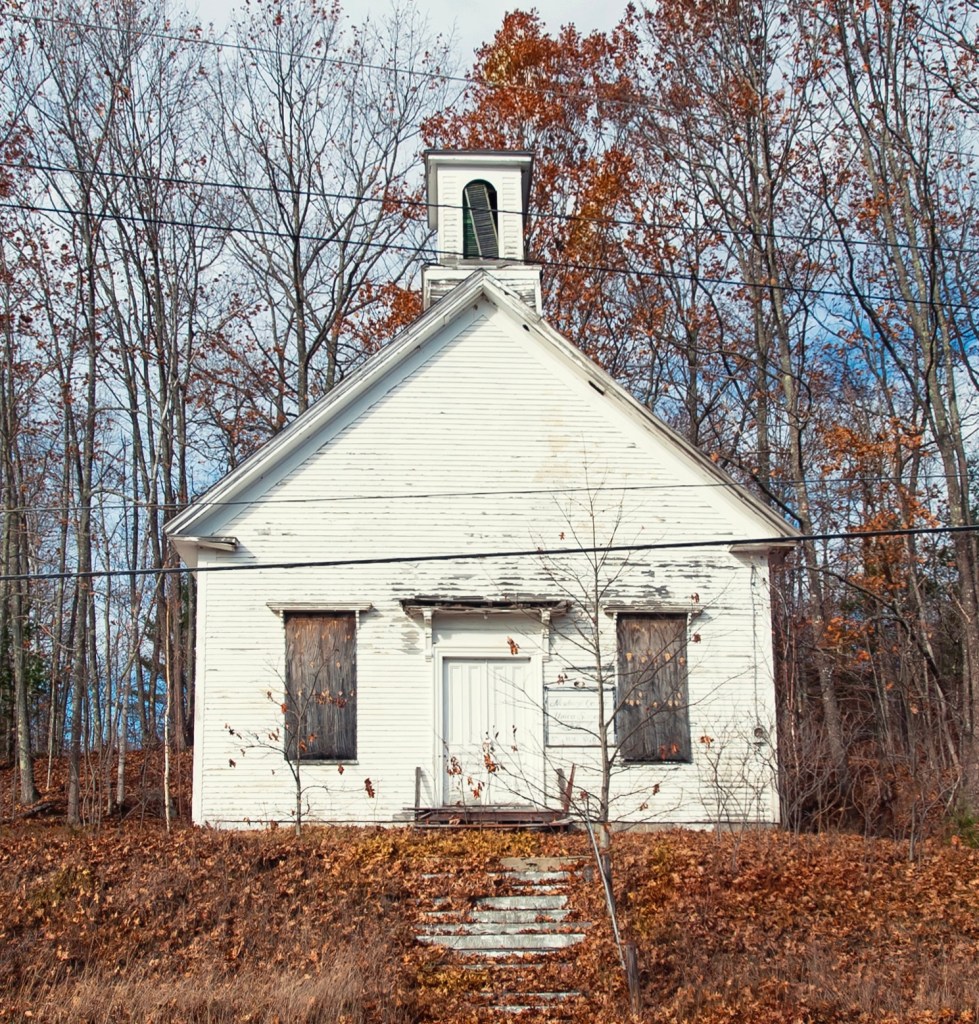
The Newburgh Center Union Church was built in 1878 as a non-denominational religious building for the small, rural town of Newburgh, Maine. At this time, the small town had just over 1,000 residents and it was not economically feasible for each congregation to build its own meeting house. The vernacular Greek Revival/Italianate style church building was eventually the house of worship of a local Pentecostal congregation, but that too appears to have disbanded. The building has been falling into disrepair, so hopefully it will be preserved.
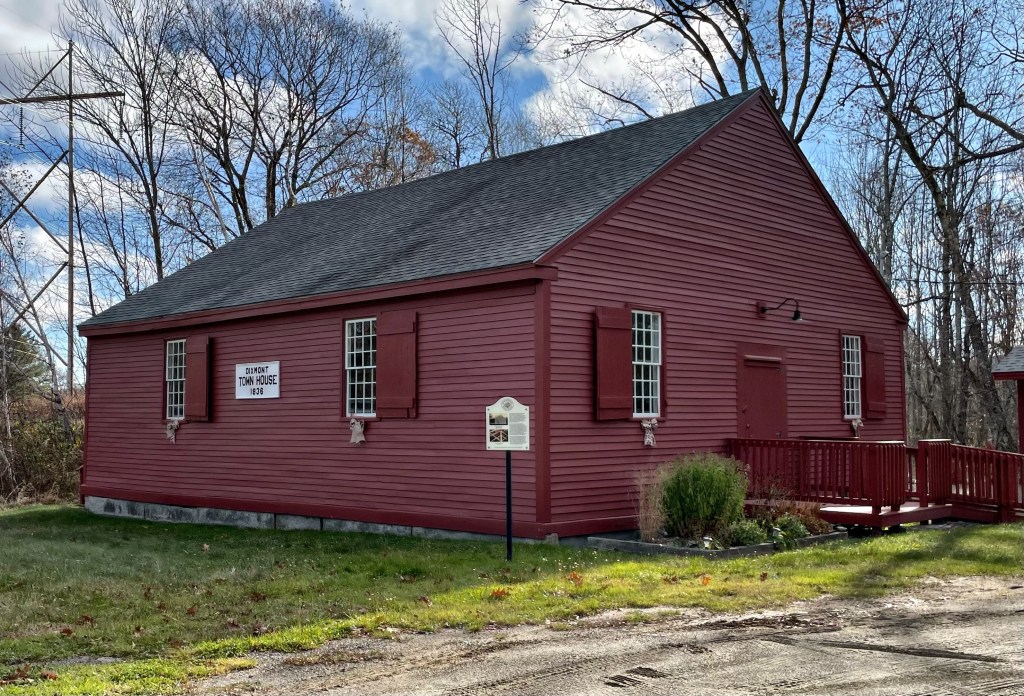
Dixmont, a small rural town in central Maine was originally originally a land grant by the Commonwealth of Massachusetts (of which Maine was then a part) to Bowdoin College, which sold the first settlers their land for profit to build on their campus. As a result, the town was originally called “Collegetown”, which was obviously short-lived. Dr. Elijah Dix (1747-1809) of Boston, who never lived there but took an interest in its settlement, encouraged others to settle there, and when the town was officially incorporated in 1807, it named itself after Dix, as Dixmont. A “malignant fever” broke out among the settlers in the early years, also killing Elijah Dix while in Dixmont on a trip there in 1809, he was buried in the Dixmont Corner Cemetery. Elijah was the grandfather of reformer and nurse Dorothea Dix. The early settlers had this Town House built in the center of the township around 1836 as a vernacular structure. The building (like many early town houses) was used for both secular and religious purposes. This small structure is one of the oldest surviving town houses in the state and served as the town government center until 1952 when it hosted its last town meeting. It was restored in the early 2000s and looks great!
Dixmont, a small rural town in central Maine was originally originally a land grant by the Commonwealth of Massachusetts (of which Maine was then a part) to Bowdoin College, which sold the first settlers their land for profit to build on their campus. As a result, the town was originally called “Collegetown”, which was obviously short-lived. Dr. Elijah Dix (1747-1809) of Boston, who never lived there but took an interest in its settlement, encouraged others to settle there, and when the town was officially incorporated in 1807, it named itself after Dix, as Dixmont. A “malignant fever” broke out among the settlers in the early years, also killing Elijah Dix while in Dixmont on a trip there in 1809, he was buried in the Dixmont Corner Cemetery. Elijah was the grandfather of reformer and nurse Dorothea Dix. The early settlers had this church built by 1834 by Rowland Tyler, a local master builder whose only other documented work is the 1812 City Hall of Bangor. The Dixmont Corner Church is one of Penobscot County’s oldest Gothic churches and also exhibits some Greek/Classical elements.

 Buildings of New England