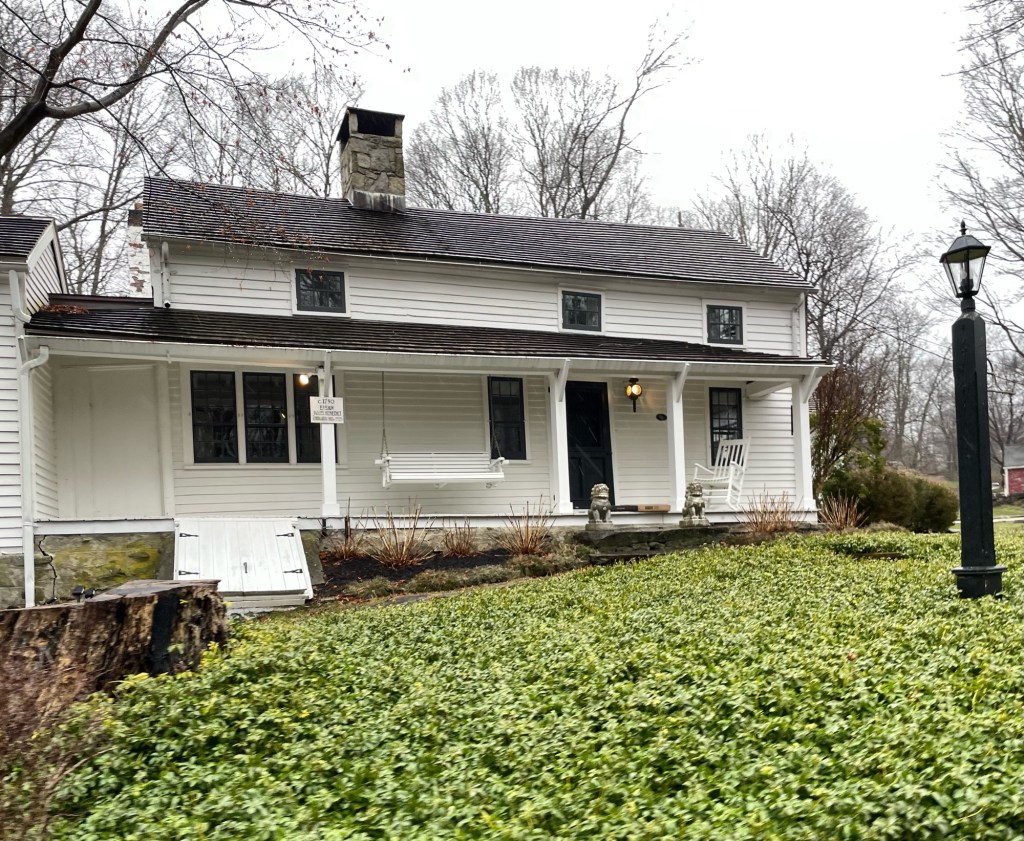
Benedict House // c.1740

The Benedict House in Ridgefield, Connecticut is a stunning Colonial-era cottage that was once the home of a cobbler, who had his shop on the property. The Benedict family, headed by James Benedict, Sr., were original proprietor settlers of Ridgefield. This house and shop have been attributed to James’ son James Benedict (1685-1762), who owned the land and was a shoemaker and deacon of the Congregational Church. Ensign Benedict was also a fence viewer, a term new to me. Fence viewers had power to make and enforce rulings regarding escaped or trespassing livestock, the location of fences, and, above all, maintenance of fences. With fences so crucial to keeping livestock where it belonged, loose boards and rotting posts were big concerns. The fence viewer could even compel a property owner to pay for needed maintenance or repair conducted by a neighbor if he or she failed to keep up their fence properly. The property left Benedict family ownership in 1848, and it was later extensively restored by renowned architect Cass Gilbert, who bought the property in 1920. Cass Gilbert also restored a few other Colonial-era houses in town. It was later the home of Robert and Mildred Wohlforth, both writers of note and six-decade residents of Ridgefield.

David Scott House // 1714

One of the oldest extant houses in Ridgefield, Connecticut is this charmer, which was moved not once, but twice! The house was built for David Scott (1678-1760), an Irish-born resident of the town, who purchased one of the town’s original Main Street house lots which sat undeveloped. Scott had abandoned his wife, Mary in Ireland, and settled in Ridgefield, entering into a new relationship with Elizabeth St. John. A woman scorned, Mary unexpectedly arrived in America and filed suit against her husband, citing Elizabeth as the “pretended wife of David Scott.” A judge awarded Mary three acres of her husband’s land. David Scott and his second wife lived at this 1714 house until they moved in 1740. His property (which included two enslaved Africans) was sold to Vivus Dauchy, a Frenchman. In the 1920s, as the Scott House section of Main Street commercialized, the owners relocated this house to Catoonah Street, building a commercial block in the former location. After numerous other owners, the most recent owner, The Ridgefield Preservation Trust (now the Ridgefield Historical Society) put it to use as a new historical society headquarters, after saving the Colonial-era home from demolition for stores and a parking lot! It was relocated to its current site and has been meticulously restored.

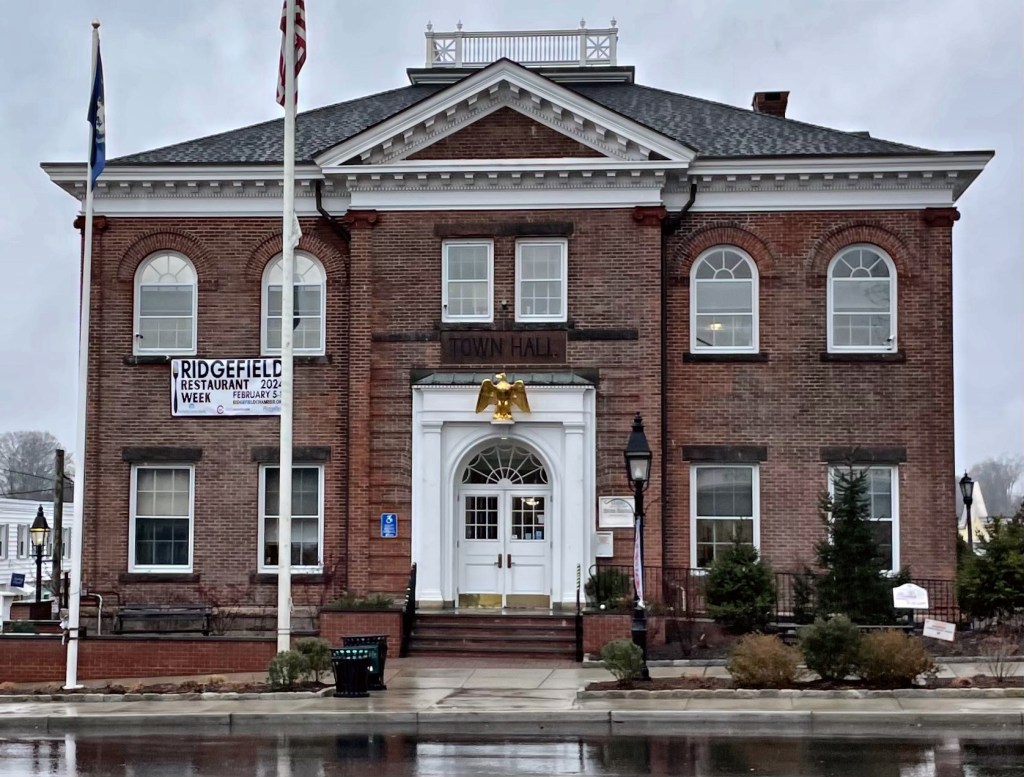
Ridgefield Town Hall // 1896

Ridgefield, Connecticut was settled in 1708 when 24 families from Long Island purchased land from Chief Catoonah of the Ramapo tribe. The Fundamental Orders adopted by Connecticut in 1639 directed would-be settlers, able to support a minister, to establish a settlement, build a Congregational church and farm the land. This is exactly what was done in Ridgefield, beginning in 1708. The original 24 proprietors received 7½-acre home lots drawn by lottery, with a 25th reserved for the minister. The lots were located up and down Main Street from a Common where a Meeting House was built. The town grew and for much of its three centuries, was primarily comprised of old farms. By the late 19th century, spurred by the connection of the railroad, Ridgefield was “discovered” by wealthy New York residents, who assembled large estates in town, a trend that has only picked up in the 21st century! Population growth and a large fire on the town’s Main Street in 1895 necessitated a new Town Hall building. The present Town Hall building was constructed in 1896 from plans by architect Philip Sunderland. Colonial Revival and Romanesque in style, the two-story brick building features a pedimented central bay also containing the entrance with fan light transom, round arched windows, brownstone trim, and narrow pilasters of brick. The building houses town offices today.