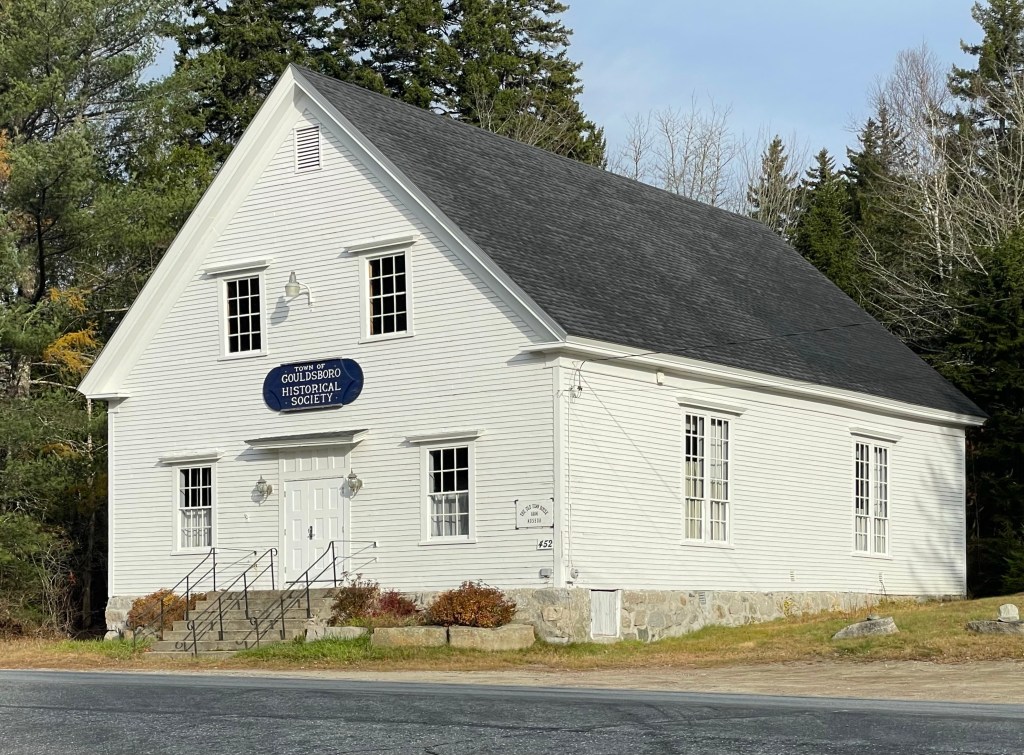
Gouldsboro Townhouse // 1884

Welcome to Gouldsboro, Maine! The town is a charming community made up of many small fishing villages and neighborhoods dotting the rugged Maine coastline. Land in what was then part of Massachusetts, was given to Colonel Nathan Jones, Francis Shaw and Robert Gould in 1764 by the General Court of the Commonwealth of Massachusetts. Francis Shaw and Robert Gould were both merchants from Boston. Francis Shaw had worked hard to develop Gouldsboro, and reportedly died broke because of it, and his son Robert Gould Shaw returned to his parents’ native Boston. Development in the area was slow and never really took-off due to the distance from Boston, but fishing, mills, and villages were built and remain to this day. Now, much of the area is home to summer residents flocking to the area from urban areas. This building was Gouldsboro’s second townhouse. It was constructed in 1884, soon after the first townhouse burned a year prior. The structure was used for town meetings and elections until 1983. It is now owned by the Gouldsboro Historical Society. It is a late, vernacular example of a Greek Revival townhouse.

Isabella Stewart Gardner Townhouse // 1860

152 Beacon (center) and 150 Beacon (right) demolished. Courtesy of Boston Athenaeum.

In 1860, David Stewart, a merchant from New York, built a townhouse on Beacon Street in Boston’s Back Bay neighborhood as a wedding present for his twenty year old daughter, Isabella Stewart, and her new husband, John (Jack) Lowell Gardner. The house was originally numbered 126 Beacon, but re-numbered as 152 Beacon ca. 1862 when homes were built on the south side of the street. The home was the city dwelling of the young couple, who also owned “Green Hill” in Brookline, and an estate on the North Shore. Isabella Stewart Gardner began amassing a large collection of art and their Back Bay home was insufficient to display it all. In 1880, John purchased the neighboring home at 150 Beacon from Andrew Robeson, a wealthy merchant from Fall River, whose main home is now the headquarters of the Fall River Historical Society. Soon thereafter they combined the two houses, with the address of 152 Beacon, to provide greater space for the display of the growing art collection being assembled by Isabella. After her husband’s death in late 1898, Isabella Gardner pursued plans for a new home that would provide a suitable setting for her art collection. She purchased land in the Fenway and began construction on her mansion, Fenway Court, now the Isabella Stewart Gardner Museum. One year after completion of Fenway Court, the two townhomes were purchased by Eben Draper, who razed them for his mansion in 1904 (see last post).