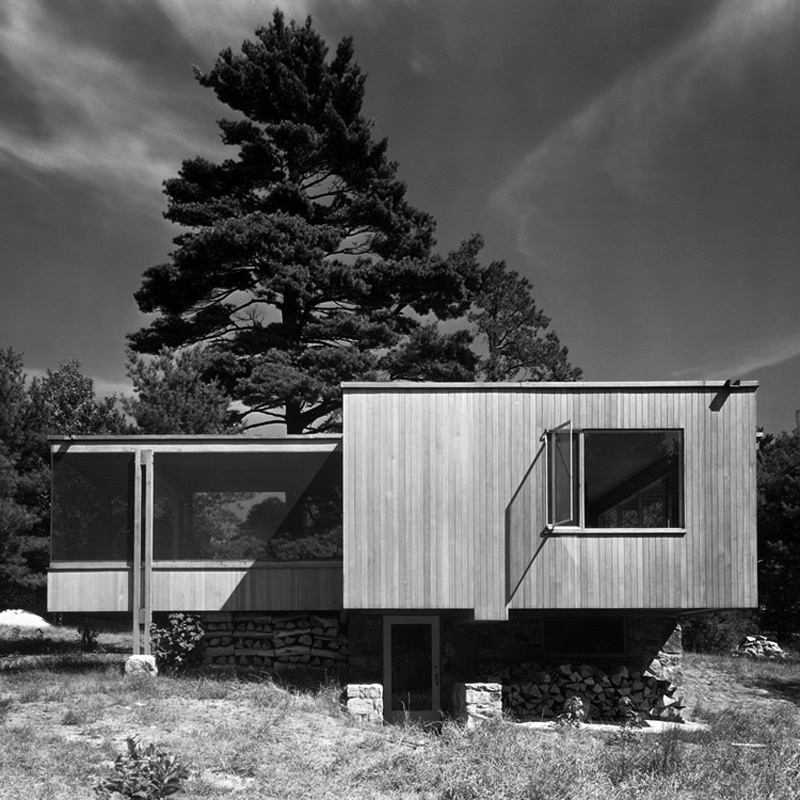
Chamberlain Cottage // 1940

Nestled into the forests of Wayland, Massachusetts, one of the most significant examples of early Modernist architecture, the Chamberlain Cottage, represents the European Bauhaus style adapted to the American landscape and New England vernacular. Designed in 1940 and completed in 1941, the house was commissioned by Harvard Economics professor, Henry Chamberlain and his wife, Margareth, as a weekend retreat from Cambridge. Professor Chamberlain commissioned Marcel Breuer and his mentor, Walter Gropius, then Dean of the Harvard Graduate School of Design, to design a home with a specific request for a screened porch similar to Gropius’ residence in nearby Lincoln. For the Chamberlain Cottage, the design responds to the uneven terrain and the potential for river flooding by two distinct parts: a grounded stone base and a cantilevered wooden volume above. The lower stone level functioned as a foundation while providing storage for a canoe and housing a fireplace that extends vertically through the structure; with the upper wooden volume containing living spaces. Despite its compact size for weekend visits, the upper level is well planned and includes a living space, kitchen, a single bedroom, and the porch. Due to its small scale and siting, the one-bedroom cottage was not easily adaptable for modern living. After falling into disrepair in the 1980s and ’90s, the home was purchased by architects Sidney R. Bowen and Angela Watson, who expanded the structure over the course of a decade to its current size of 3,742 square feet. It has been occupied and lovingly maintained by later owners. It remains a private residence.
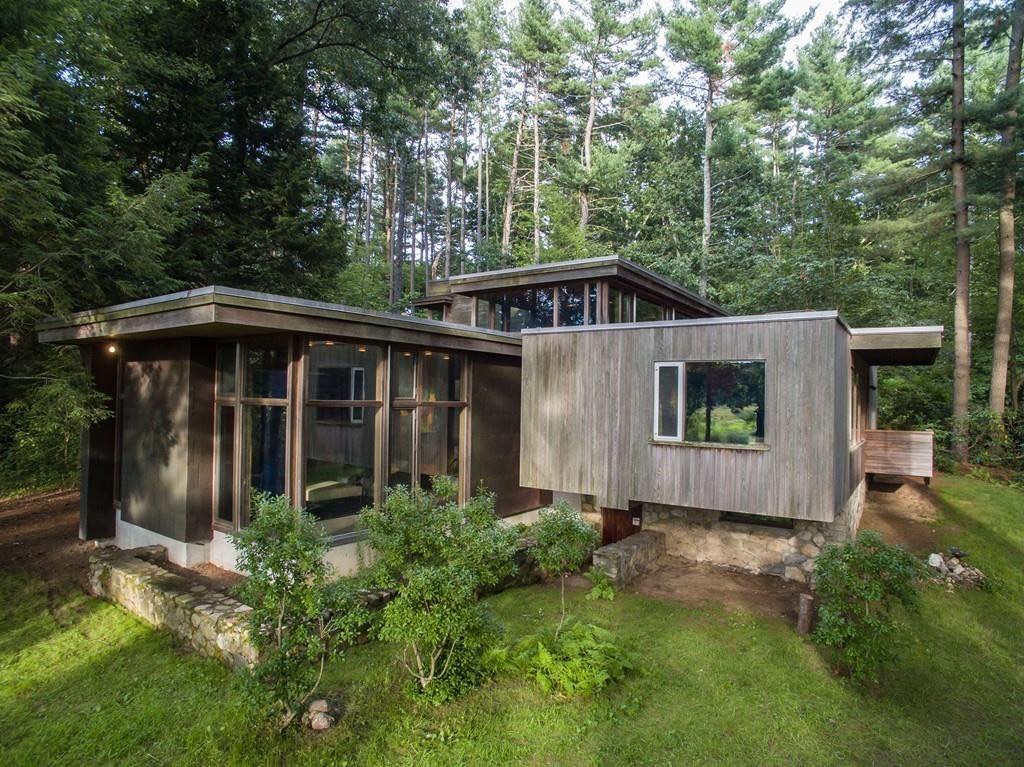
Wolfers House // 1947

In 1947, world-famous German-born architect Walter Gropius and his architectural group, The Architects Collaborative (TAC) were commissioned to design a simple summer house for his friends Arnold Wolfers, a noted political scientist, and his wife, Doris, whose father was president of the Swiss Parliament. The site was a wild bluff on the end of Naskeag Point in Brooklin, Maine, with broad views of Blue Hill Bay and Mount Desert Island in the distance. The Wolfers’ wanted a house that was not a typical shingled house, provided sweeping views of the natural scenery, and also fit within its surroundings. Gropius nailed it with this house. As originally built, the house was comprised of a main block with large living room, kitchen, laundry room, service hall, and bathroom. A breezeway connected the house to a wing of three bedrooms along a long corridor. Walls of glass frame the waterfront side to take advantage of the views, while the street-facing facade has less glazing to provide additional privacy. After Doris Wolfers’s death in 1987, the house was purchased by an investment banker and his wife and it was listed for just the third time in over 75 years, and has maintained its architectural integrity the entire time.

George Kaplan House // 1946

The George Kaplan House, erected in 1946, is an excellent and exceptionally well preserved example of the International Style in the Boston area. The home is located on a suburban road in Oak Hill, Newton, and displays characteristics such as strong geometric forms, a flat roof, banded windows interspersed with expanses of blank walls and absence of ornament. The Kaplan House was designed by Walter Gropius‘ firm ‘The Architect’s Collaborative’ (TAC) of Cambridge, which was founded just one year prior, and this home was their first completed project. The home was built for George and Ethel Kaplan, a young couple who moved here from Brookline. Kaplan worked in design himself and manufactured shoe fabrics.