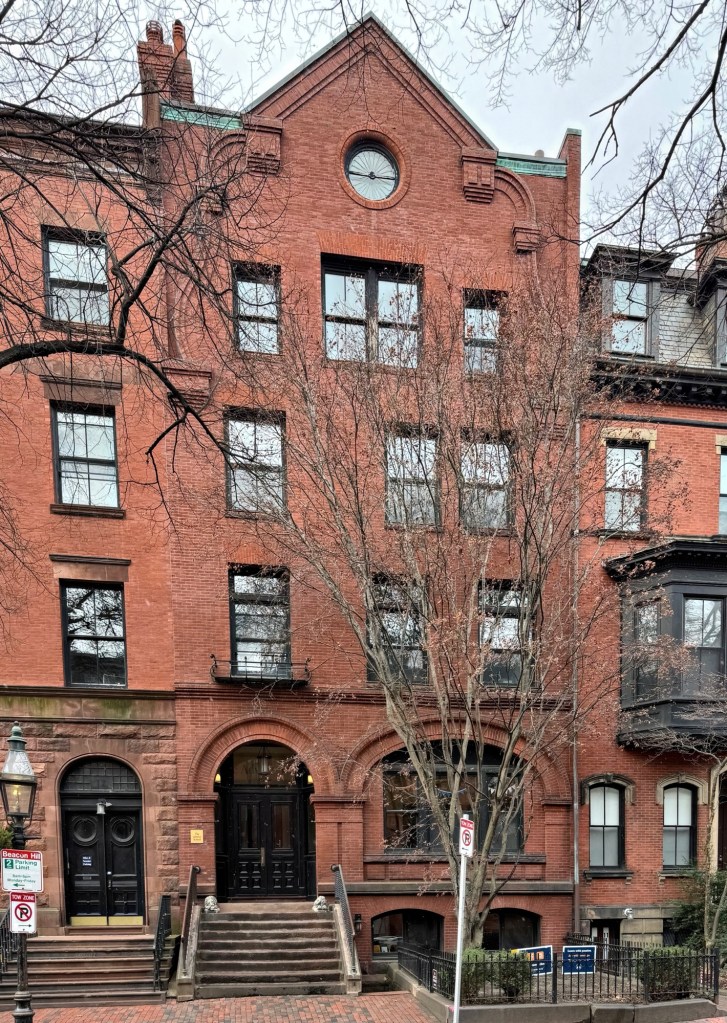
One of the many great townhouses on Brimmer Street in Boston’s Beacon Hill neighborhood is this residence designed as a unique interpretation of Queen Anne and Romanesque Revival styles. Original owner, Eliot Channing Clarke (1845-1921), an MIT-educated civil engineer. His uncle, Thomas Curtis Clarke, was a noted civil engineer, a member of the firm of Clarke, Reeves & Co., Bridge Builders in Pennsylvania, and served later as President of the American Society of Civil Engineers. When Thomas Clarke’s firm was designing and building a new bridge over the Mississippi River in Quincy, Illinois, he had his nephew lead in the design. In 1876, Eliot was appointed engineer in charge of a survey for a main drainage system for Boston. The project was adopted and construction began a year later, taking years to complete. In 1885, Clarke published the work that he oversaw, modernizing a rapidly growing Boston water and plumbing system. He became one of the leading sanitary engineers of the United States. In 1884, Clarke hired architect, S. Edwin Tobey, who designed this townhouse with a unique gable containing a ocular window and panel brick parapet as an interpretation of a Flemish gable. A traditional arched entry in brick is a nod to the Romanesque Revival style, which surged in popularity in Boston following the completion of H. H. Richardson’s Trinity Church. In 1969, the Clarke house’s interior was connected with its neighbor as the Advent School, a private K-6 school associated with the Church of the Advent across the street.
 Buildings of New England