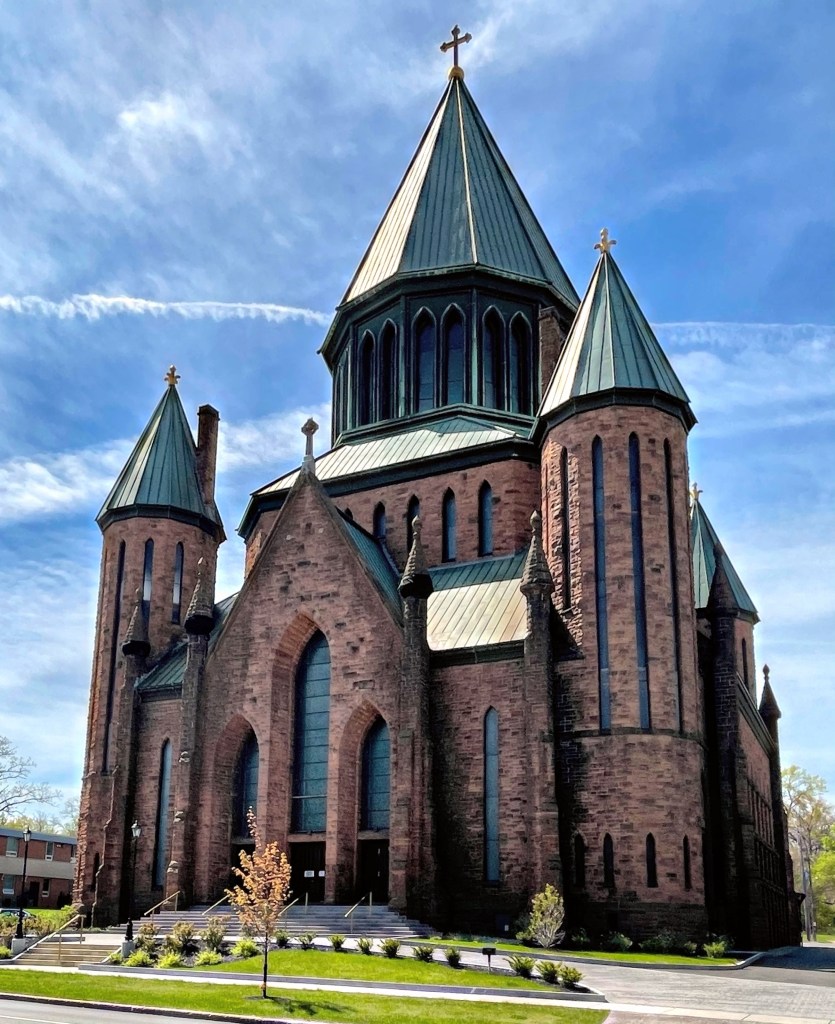
St. John the Evangelist Church in Schenectady, NY is probably the most imposing church I have ever seen (outside of European cathedrals). The church began in 1898 when Monsignor John L. Reilly purchased land across from Union College’s campus to erect a new church. He began collecting donations to fund a church suitable for Schenectady, and visited Europe to seek inspiration for the design. He worked with architect Edward Loth of nearby Troy, NY on the design which resulted in this massive 120’x130′ structure. The stone church has a small tower at each of its four corners with a central spire reaching 230′ high. The center spire was constructed of steel and glass to cast light onto the sanctuary below (sadly has been replaced with a metal roof). This is definitely one of the more memorable churches I have ever seen! What do you think of it?
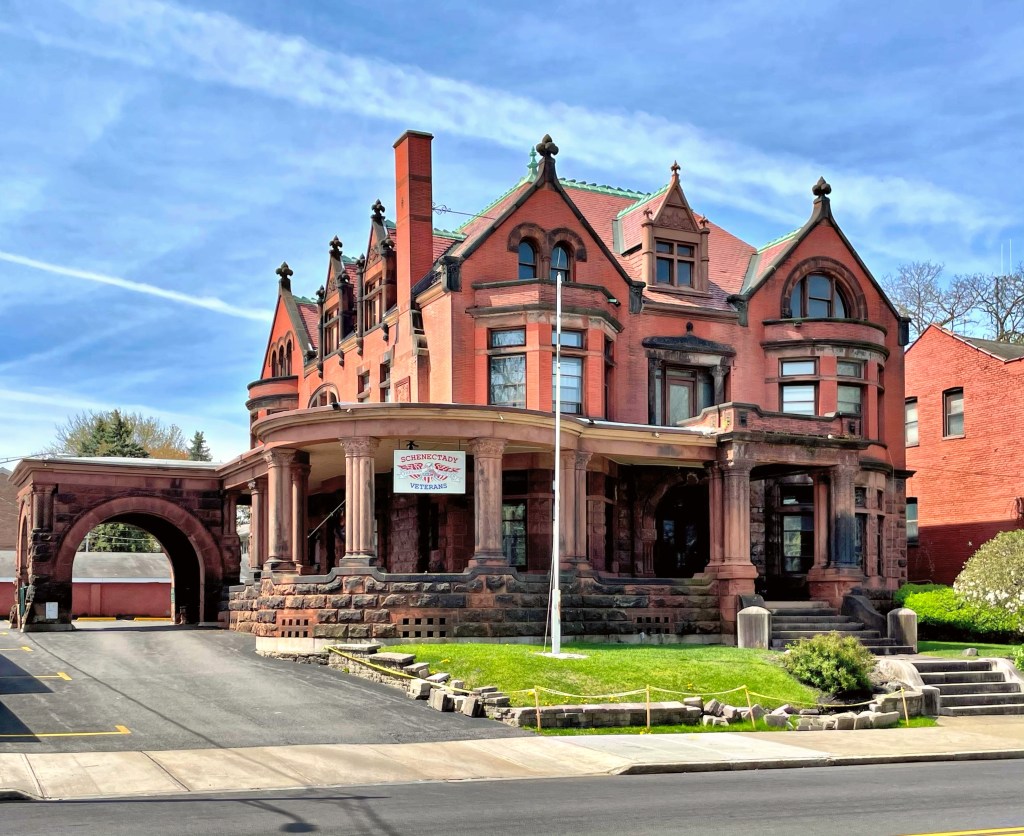
Henry Schermerhorn DeForest (1847-1917) was born in Schenectady, New York and became a leading citizen of the bustling upstate city. He attended school in his hometown before leaving to study at Eastman Business College in Poughkeepsie. He returned to Schenectady and married Lucie Van Epps, soon after gaining employment by her brother at his broom manufacturing company as a clerk and bookkeeper. He began using his earnings to buy and develop property in the city, eventually making him the city’s largest landlord. He was also a building contractor, with his company constructing more than 1,000 homes in the Schenectady area. He served as Mayor, in a role that he successfully advocated for General Electric to locate in Schenectady when it was formed from the mergers of several other companies, including Edison Machine Works, which had moved to Schenectady in 1886, creating a huge boom in development and growth for the city. After this, he has this large stone mansion constructed to showcase his wealth and success as a developer and Mayor. After his death in 1917, the home remained in the family for some time until it was acquired by the Schenectady Veterans Association not long after WWII, who maintain the building to this day.
Buildings of New England travels! Welcome to Schenectady, a great city in upstate New York, with an hard to spell and pronounce name! The name “Schenectady” is derived from the Mohawk word skahnéhtati, meaning “beyond the pines”. Schenectady was founded on the south side of the Mohawk River by Dutch colonists in the 17th century, many of whom were from the Albany area. In 1664 the English seized the Dutch New Netherland colony and renamed it New York. They established a monopoly on the fur trade around Albany, and issued orders to prohibit Schenectady from the trade through 1670 and later. The town grew mostly as an inland agricultural town until the Erie Canal was built in 1825, creating a navigable water route from New York City and the Atlantic Ocean to the Great Lakes, cutting through Schenectady. The town grew and became an industrial center, attracting a very diverse population of immigrants in the 19th century and African Americans as part of the Great Migration out of the rural South to northern cities for work. The community struggled (like many) in the mid 19th century but has seen a large resurgence as of late!
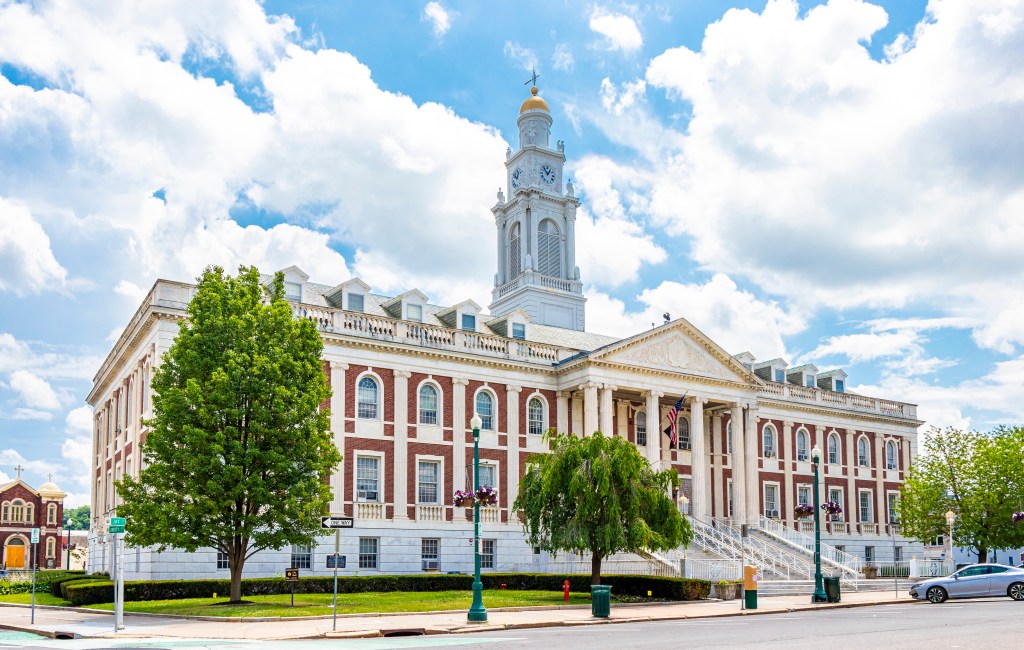
This building is the Schenectady City Hall, a massive architectural landmark which made my jaw drop when I saw it! The City of Schenectedy outgrew their old City Hall, and in the late 1920s, held a nationwide contest to select designs for a new City Hall. The contest was won by the prominent architectural firm McKim, Mead, and White. It appears that the designs were furnished by James Kellum Smith of the firm, the often overlooked genius of the MMW practice. The exorbitant cost of the project, which was undertaken during the Great Depression, caused the building to be dubbed “Fagal’s Folly” after Mayor Henry C. Fagal, who allowed all the cost increases while the city’s future was uncertain. He was not re-elected after this building was completed. The building is a pleasing mixture of Colonial and Classical Revival styles and features bold pilasters and a towering cupola
 Buildings of New England