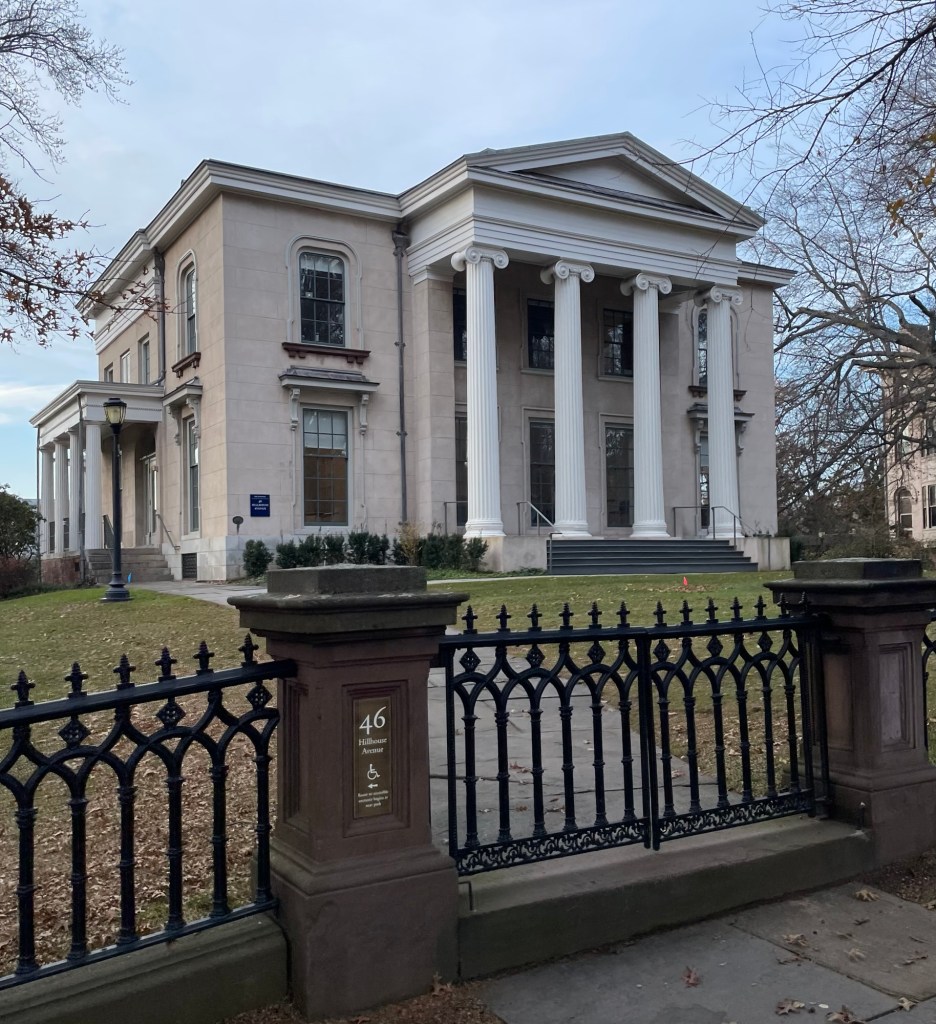
Skinner-Boardman Mansion // 1832

One of the finest houses in New Haven is this stately residence, the Aaron Skinner Mansion on Hillhouse Avenue. The mansion was built in 1832 for Aaron Nichols Skinner (1800-1858) from plans by architect Alexander Jackson Davis. Skinner was a Mayor of New Haven (1850-1854), and for a short time, ran a boy’s boarding school out of this house. Skinner was also a CT State Representative, serving two terms. The house was originally built as a three-bay, two-story house with one-story side wings and a rear ell. After his death, the house was purchased by Judge William W. Boardman, who in 1859, modernized the property hiring architect, Henry Austin, who filled in the side wings and added Italianate window mouldings. The monumental portico supported by fluted, Ionic columns, creates such a stately presence for the early house on the street. In the early 20th century, the mansion was owned by Rutherford Trowbridge, who renovated the house for his own use. The house remained in the Trowbridge family until the death of his last daughter, Miss C. Rachel Trowbridge, when the estate became the property of Yale University.
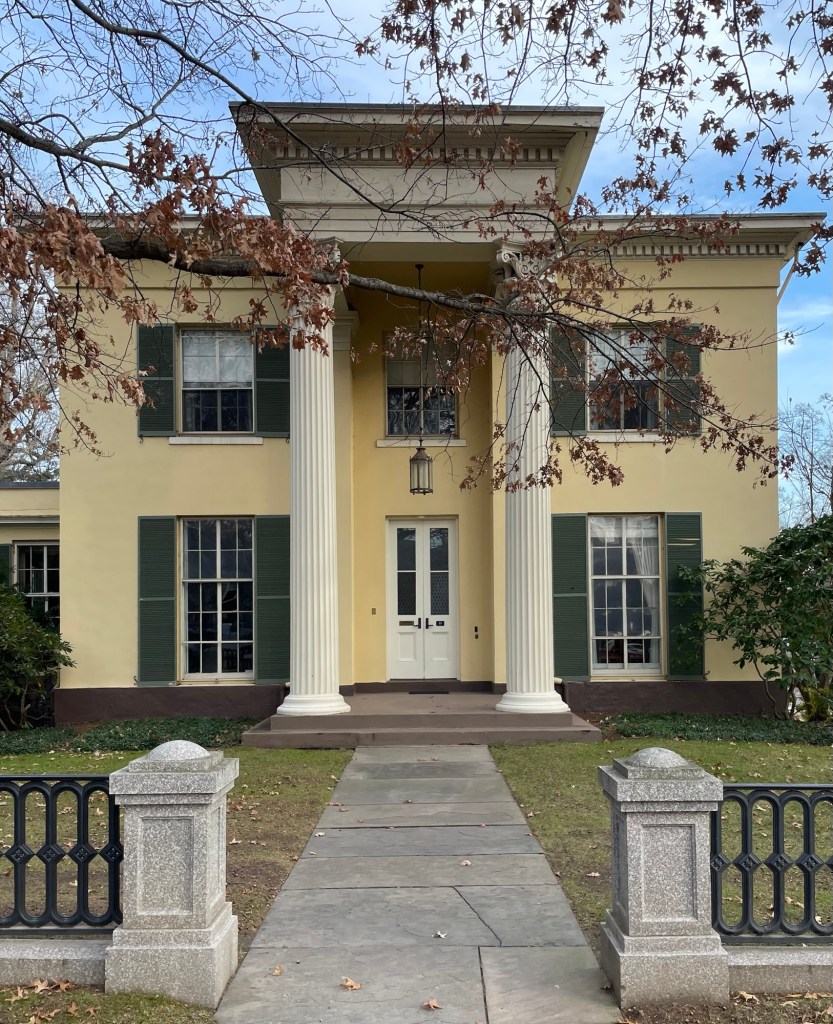
Pritchard House // 1836

One of the earliest houses built on Hillhouse Avenue in New Haven, Connecticut, is this stately Greek Revival mansion with monumental portico. The house was built in 1836 for Mary Pritchard from plans by great American architect, Alexander Jackson Davis. The mansion is two stories and is constructed of brick and stucco with a distinct two-story portico supported by fluted Corinthian columns. The architect also may have designed a barn at the rear of the house for Ms. Pritchard. Like many other former residences on Hillhouse Avenue, the house was acquired by Yale University, and is now the house of the Provost.

Dow-Starr House // c.1858

A big departure from the plain, yet classically proportioned Federal period homes in Warren, this Gothic Revival on Main Street turns heads when people pass by. A quintessential Gothic “cottage,” the facade of the Dow-Starr House in Warren has also been graced by a three-sectioned Gothic Revival porch as illustrated in Alexander Jackson Downing’s plan books from the 1840s. As completed, this house followed almost exactly Andrew Jackson Downing’s Design II as illustrated in Cottage Residences 1842 ; it differed only in its use of speckled fieldstone over coursed ashlar. The house was later acquired by and used as a convent for the St. Jean Baptiste Church in Warren, who also built a school building behind. The house has seen some alterations, but remains an important architectural landmark of the town.

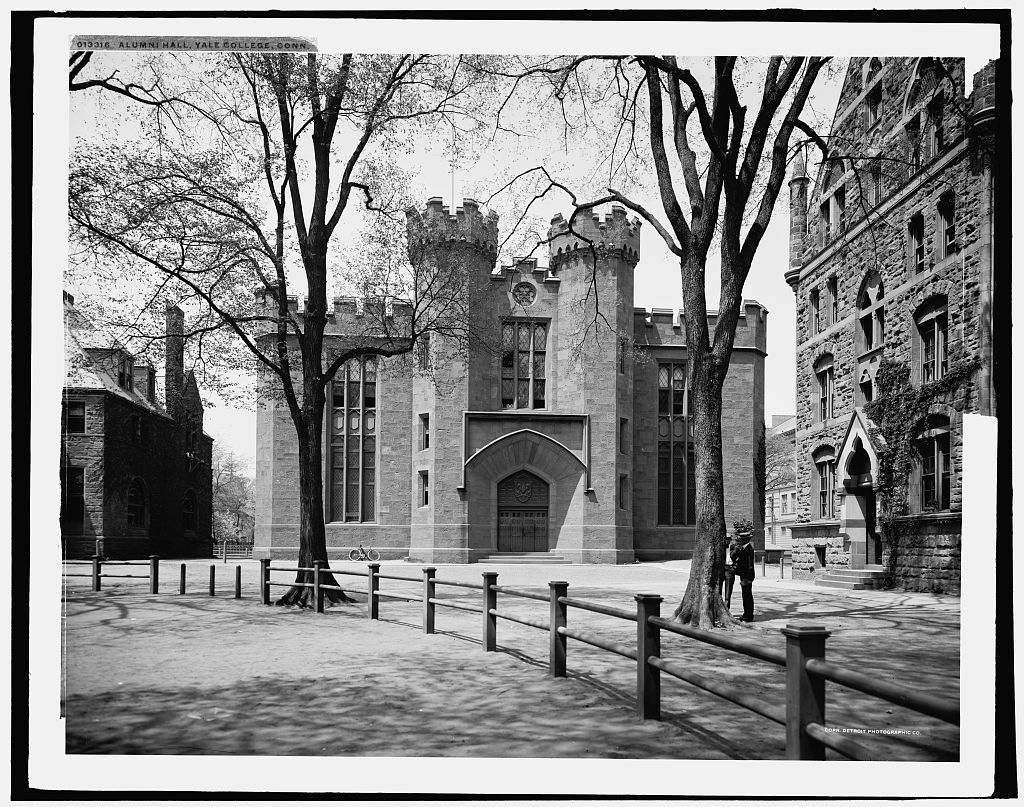
Yale University – Alumni Hall // 1851-1911

Detroit Publishing Company image

Alumni Hall at Yale was designed and built between 1851-1853, at the northwest corner of Yale’s Old Campus. Its was designed by Gothic specialist architect Alexander Jackson Davis, who completed Dwight Hall (the Old Library) a some years prior. The building had a large, open floorplan on the first floor for large gatherings as well as the entrance examinations, along with the biennial examinations that every student had to take at the end of his sophomore and senior years. As the building turned 50 years old, the campus around it was already looking very different. Shifting priorities for dormitory space in the yard necessitated its demolition for Wright Hall (next post). Alumni Hall was razed in 1911, but its two crenelated towers were salvaged when the building was demolished. They were incorporated into Weir Hall which has been incorporated into Jonathan Edwards College, one of Yale’s residential colleges.

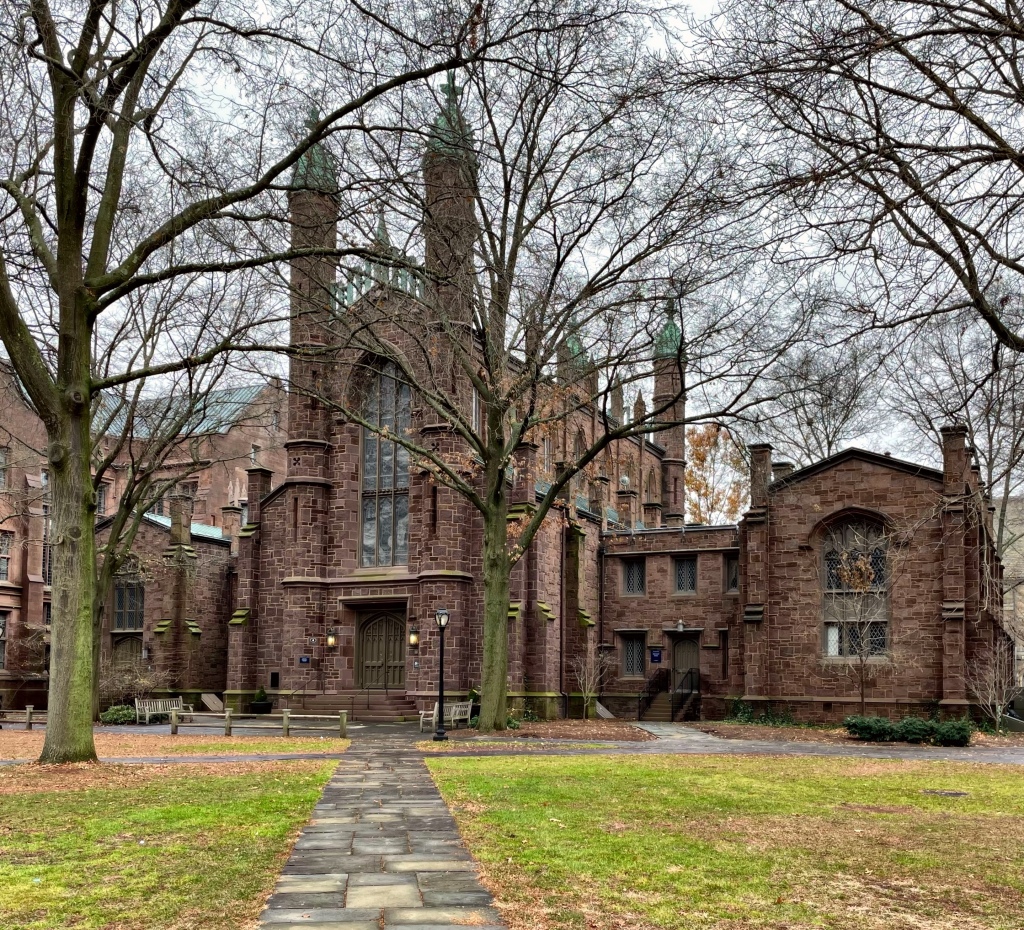
Yale University – Dwight Hall // 1842

One of the most architecturally significant college buildings in the United States, Dwight Hall was designed to house the growing book collection of Yale College as its library. The former Yale College Library, now Dwight Hall, represents a significant shift in Yale’s campus architecture from Georgian and Federal brick buildings to the Gothic mode which the campus is largely known for today. Dwight Hall was designed by local architect Henry Austin with the guidance of esteemed architects Ithiel Town and Alexander Jackson Davis, both experts in early high-style Gothic buildings in America. The design, to me, resembles the 1443 King’s College Chapel in Cambridge, England. The structure is constructed of brownstone from Portland, Connecticut, and it is composed of a central block with two smaller flanking wings on either side connected by smaller linking spaces. At the yard facade, two octagonal towers with domed copper roofs rise, flanking a large, pointed lancet arch window that extends above the doorway. The library was outgrown fairly quickly, necessitating an annex next door and eventually collections were transferred to Sterling Memorial Library in 1930, the Old Library was converted to a chapel and community service building and is known as Dwight Hall.