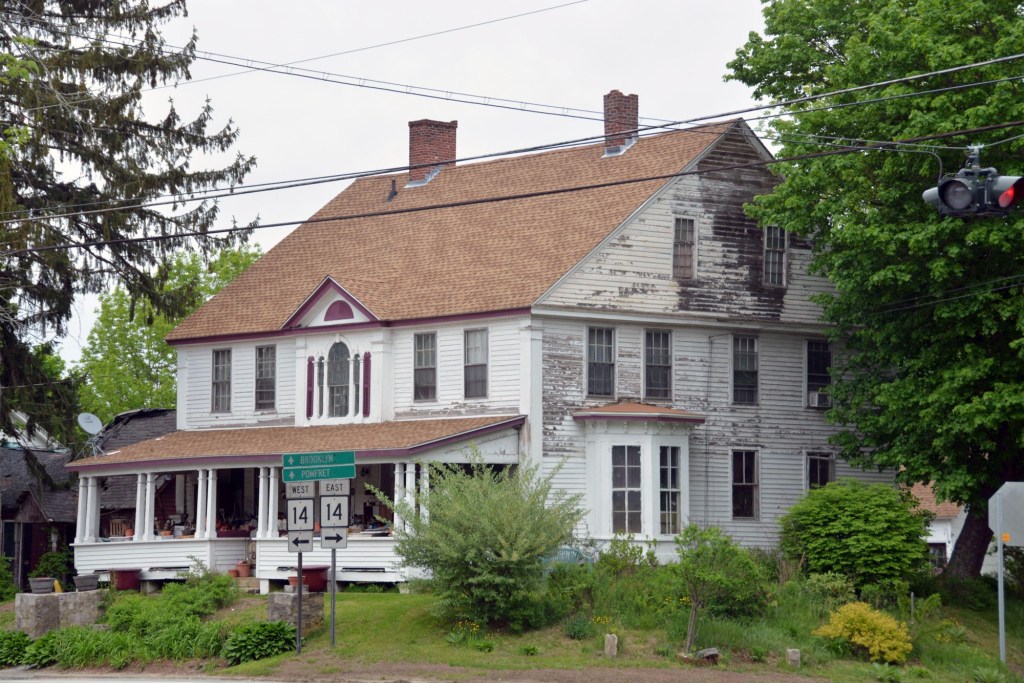
William Moore House // 1803-2019

Formerly located at the intersection of two historic turnpikes in Canterbury, Connecticut, the William Moore House was a historic and architecturally significant residence that stood over 200 years until its demolition in 2019. The large, Federal style house was built in 1803 for William Moore, a merchant who operated a store and also served as the town postmaster. The upper floor of this house at one time accommodated a ballroom where the local Masonic organization met. Later in the 19th century, the house became the home of prominent merchant, banker, and politician Marvin H. Sanger, Connecticut Secretary of State from 1873 to 1876. In 1921, it was the home of Lillian Frink when she became one of the first women ever elected to the Connecticut General Assembly, along with four other women elected that same year. The house with its projecting center pedimented bay, elaborate corner pilasters on pedestals, and elegant Palladian window represented the height of country Federal-period architecture until destroyed by a fire in 2018, leading the town to raze the building a year later in 2019. The lot remains vacant as of 2025.

Yale University – Trumbull Gallery // 1832-1901

Pre-1869 image of Trumbull Gallery, Yale Archives

Before there was Street Hall or the Old Yale Art Gallery Building, there was the Trumbull Gallery, the first college-connected art museum in the United States. This building was erected in 1832 by artist and collector, John Trumbull (1756-1843), who specialized in Revolutionary-era works, and was known as the “Painter of the Revolution”. In his later years, Trumbull sold 28 paintings and 60 miniature portraits to the Yale College, and helped establish the college-affiliated art museum. He is said to have designed this Classical style building, to house his collections, all with minimal windows to protect his collection from direct sunlight. The gallery also housed a crypt for Trumbull and his wife, hence its tomb-like appearance. When Street Hall was built, the collection and tombs were relocated there, and again in the late 1920s when the Art Gallery was constructed. In 1869, Yale College added windows to the building and operated the school treasury from here until it was demolished in 1901. The Trumbull Gallery stood just in front of the Old Library.

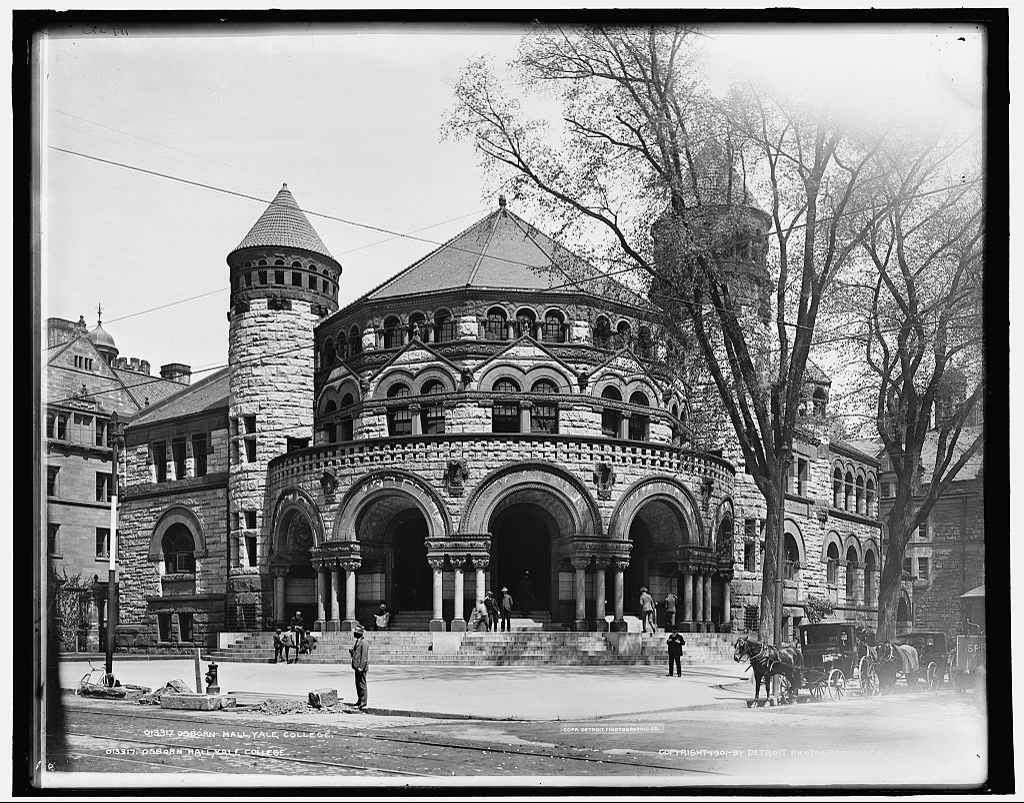
Yale University – Osborn Hall // 1888-1926

One of the biggest architectural losses at Yale was the demolition of the grandiose Osborn Hall in 1926, after standing less than 38 years! The building was constructed in 1888 at the southeast corner of the Old Yard at Yale, at the corner of College and Chapel streets, and was a landmark example of the Richardsonian Romanesque style of architecture. Designed by architect Bruce Price, the building was designed to face outward and was said to resemble a “squating toad with an open lip”. While architecturally stunning, the building was immediately met with criticism. Its construction necessitated the removal of the cherished Yale fence and the outward-facing design made it hard for students to focus on lectures while the sounds of horses and carriages on the cobblestone streets just outside. The short-lived Osborn Hall was razed in 1926 for Bingham Hall (next post), a prominently designed, but inward-facing building.

Powell Building // 1921-1990

Even skyscrapers face the wrecking-ball…The Powell Building was among New Haven’s first building recognized as a “skyscraper.” Built in 1921, the commercial building is Neo-Gothic Revival in style with the two bottom stories and the two top stories are detailed in Gothic motifs, with eight more plain floors between. The resulting shaft-like appearance distinguishes the Powell Building from other contemporary commercial structures in the city, which are essentially heightened versions of various historical styles. The architect, Roy W. Foote, was among New Haven’s leading architects in the first half of the 20th century, largely due to his local efforts in high-rise construction. The Powell Building was erected as a speculative venture by Albert H. Powell, whose primary business was a wholesale coal dealership. Early occupants were professional offices and a bank at the first floor. The building historically was located at the New Haven Green, between the Victorian Gothic City Hall and Classical Federal Courthouse. The building was sadly razed by 1990 by the New Haven Redevelopment Authority, who were VERY active in town knocking down neighborhoods in the second half of the 20th century. It was replaced by the Connecticut Financial Center skyscraper, currently New Haven’s tallest building.