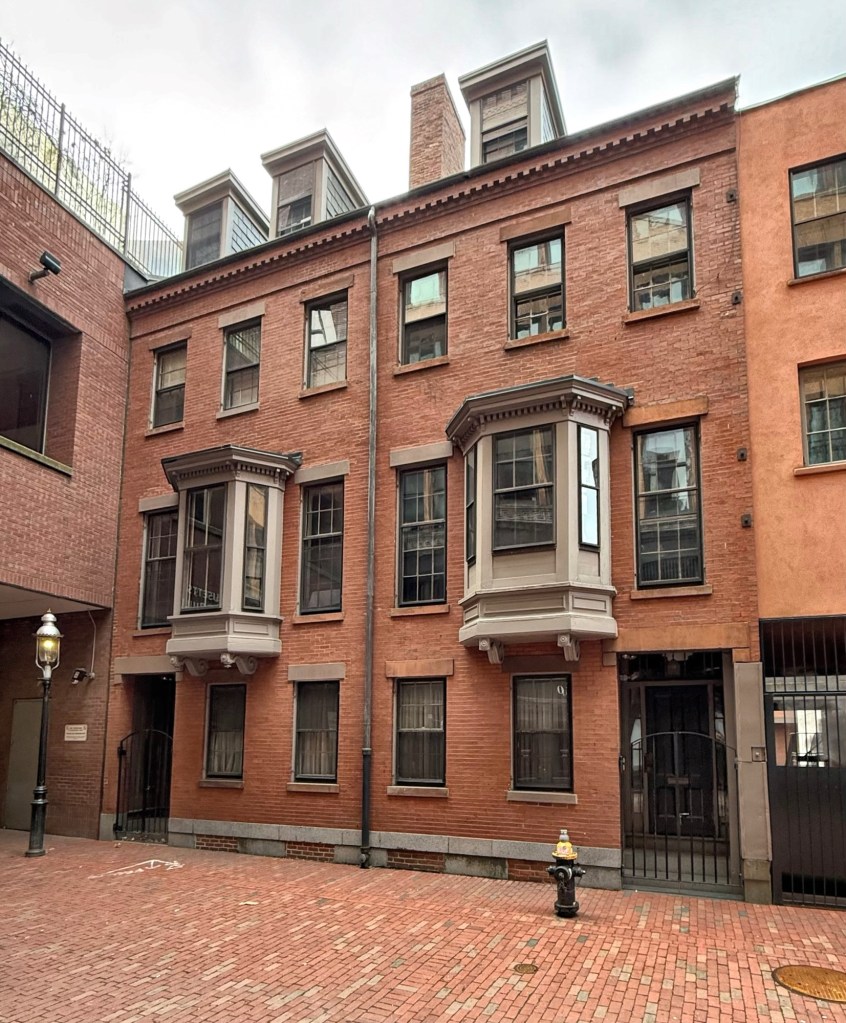
Hilt-Rayner Houses // 1844

This is your reminder to get lost and explore your city or town. Tucked off Boylston Street sits Boylston Place, a short, dead-end way that is passed by thousands every day, many not knowing about the little enclave of surviving 19th century buildings there. At the end of the street, the Hilt-Rayner Double House remains in great condition and a reminder as to the residential character of the area in the first half of the 19th century. The houses were built by Henry Hilt, a housewright who owned one unit after completion. The other unit was owned by Thomas L. Rayner, who appears to have rented the unit out. The late example of the Greek Revival style in the rowhouse form is well preserved through nearly 200 years of use. Beginning in the 1920s, the two homes were acquired by the Tavern Club, a private social club established in 1884 in the house next door. It remains owned by the Tavern Club today.

Derby Cottage // c.1848

Located off Touro Park in Newport, you may be surprised to find an early Gothic Revival style cottage obscured from view by the towering stone Channing Memorial Church. Newport has so many hidden treasures! Very little is written about this cottage, but it appears to have been built c.1848 for Richard Crowninshield Derby (1777-1854) of the famous Derby Family of Salem, Massachusetts. Richard Derby would move to Philadelphia and split his time between there, Boston, and his newly built summer cottage in Newport, Rhode Island. He did not get to fully appreciate the home as he died in 1854. The Gothic Revival cottage was inherited by his widow, Louisa S. Bomford Derby until her death and later by the couple’s two children (from both of their first marriages), Richard Catton Derby and Louisa Lincoln Lear Eyre, the mother of famed architect Wilson Eyre. The property was eventually sold by the half-siblings and the site became home to the 1880 Channing Memorial Church, which now dominates the site. Luckily for us, the cottage was spared and moved to the extreme rear of the lot and converted to the parish hall for the church.