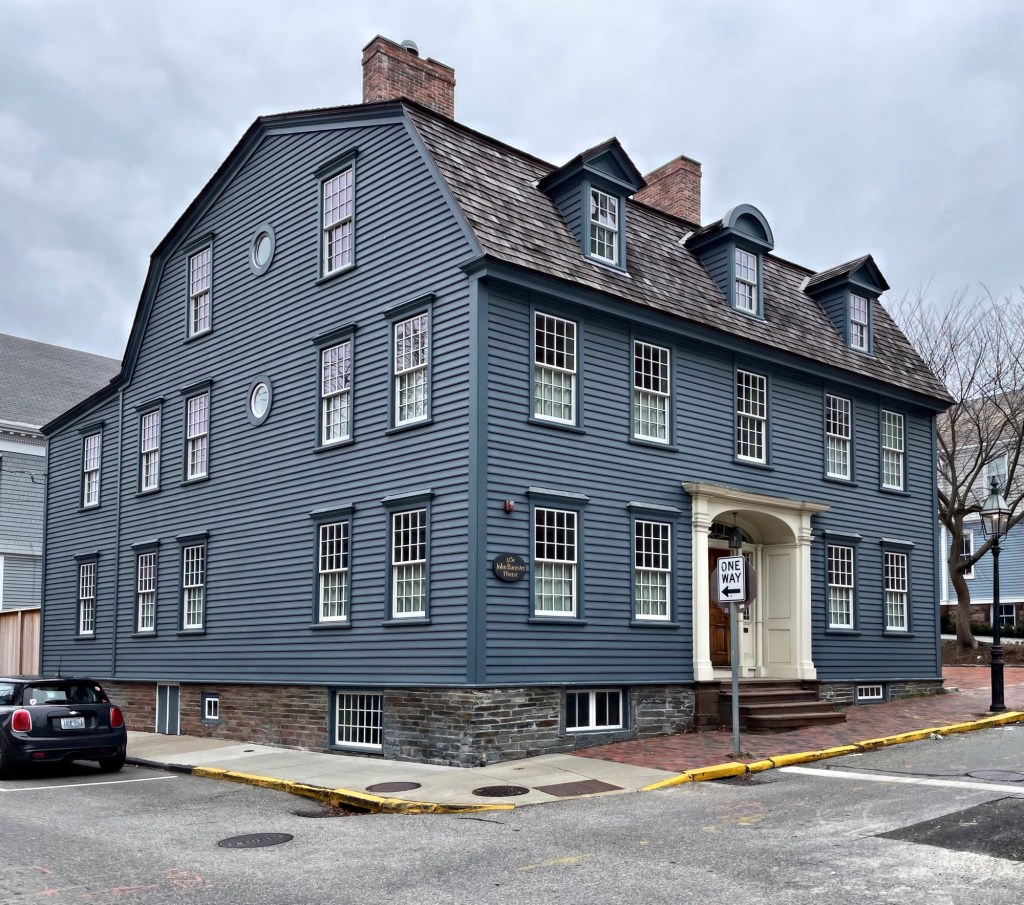
This deep, gambrel-roofed house is among my favorites in Newport. The house was built in 1751 for John Banister (1707-1767), a Boston-born merchant who moved to Newport in 1736, marrying Hermoine Pelham (1718-1765), a granddaughter of Gov. Benedict Arnold, that next year. Banister quickly established himself as a leading Newport merchant, trading with England, the West Indies, engaging in privateering and the slave trade. In 1752, he held one of the last public slave auctions in Rhode Island at his store, describing them in advertisements as “the finest cargo of slaves ever brought into New England”. The couple also built a country estate in Middletown, Rhode Island. John and Hermione had two sons, John and Thomas, who grew up in this home. John inherited the house after his father’s death in 1767, but the two brothers would soon find themselves on opposite sides of the battle for independence. Thomas was a loyalist, and even enlisted in the British army during the occupation of Newport, while John supported American independence. In retaliation for his patriot views, the occupying British forces seized this house, along with John’s farm in nearby Middletown. The house became the headquarters of General Richard Prescott during the occupation, although John later reclaimed his property following the British evacuation of Newport in 1779. The house has a later Federal entry, but otherwise is one of the best-preserved Colonial homes in Newport. It is a single-family home.
 Buildings of New England