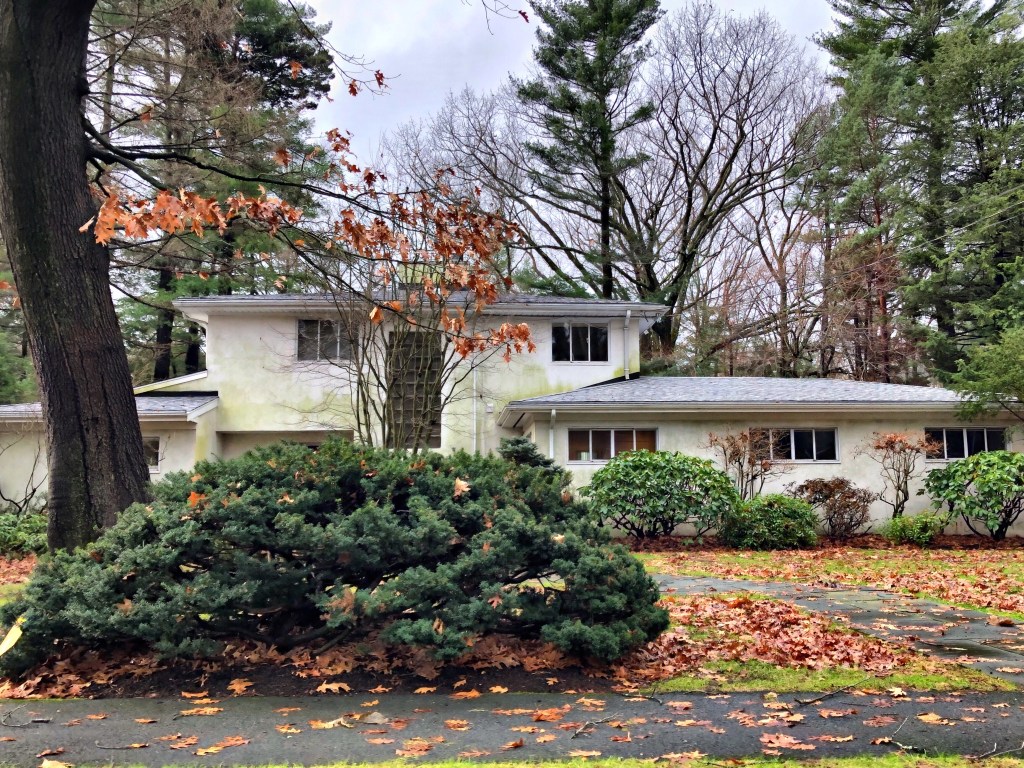
Melnick House // 1935

Built in 1935 (the same year as the Webber House in the last post), the Melnick House in South Brookline shows how the historically oriented designs of colonial New England converged with the Modern principles brought over from the Bauhaus movement from Germany. The 1930s were an interesting time for residential design around Boston as the two diverging styles were often located in the same neighborhoods. The Melnick House was designed by architect Samuel Glaser for Edward S. T. Melnick and his wife, Ethyle Melnick. Edward worked in Downtown Boston as the assistant division manager at Filene’s department store. Architect Samuel Glaser (1902-1983) was born in Riga, Latvia and at the age of four came to the United States with his family, settling in Brookline. He studied architecture at MIT and started his own practice in Boston a niche as a designer of moderately priced homes, particularly in the expanding suburbs where young Jewish families had begun living. The Melnick home combines the austere stucco walls and lack of applied ornament typical of late 1930s Modern architecture in the Boston area with a hipped-roof main block and flanking wings more commonly associated with traditional style houses of the same period. The home features a vertical glass block window which illuminates the interior stair hall.

Socony-Mobil Building // 1956

One of the unsung heroes of Modernist architecture in New York City is one of my personal favorites, the Socony-Mobil Building at 150 E 42nd Street in Manhattan. Completed in 1956 from plans by Wallace Harrison of the iconic firm of Harrison & Abramowitz, the development stands out amongst the competing masonry buildings and glass skyscrapers in the area. At the time of its completion, the Socony–Mobil Building was the first skyscraper to have its exterior wall entirely clad with stainless steel, as well as being the largest air-conditioned building in the world! The base is clad with opaque blue glass panels framed with stainless steel moldings; above, the tower and wings are clad in over 7,000 embossed stainless steel panels. The firm reviewed over 100 different designs until they settled upon the four raised relief panels: a rosette-like motif for above and below the windows; a large and small rosette to flank the windows, and two variants displaying a design of interlocking pyramids. The panels were likely designed by or inspired by Oskar Nitzchke (1900-91), a German-born designer who worked at the firm and worked on the similar style Alcoa Building (1953) in Pittsburgh. The building was developed as a speculative project, but the largest tenant, the Socony-Mobil Oil Company, later renamed Mobil, helped to give way to the naming rights. The building was landmarked by the City of New York in 2003.