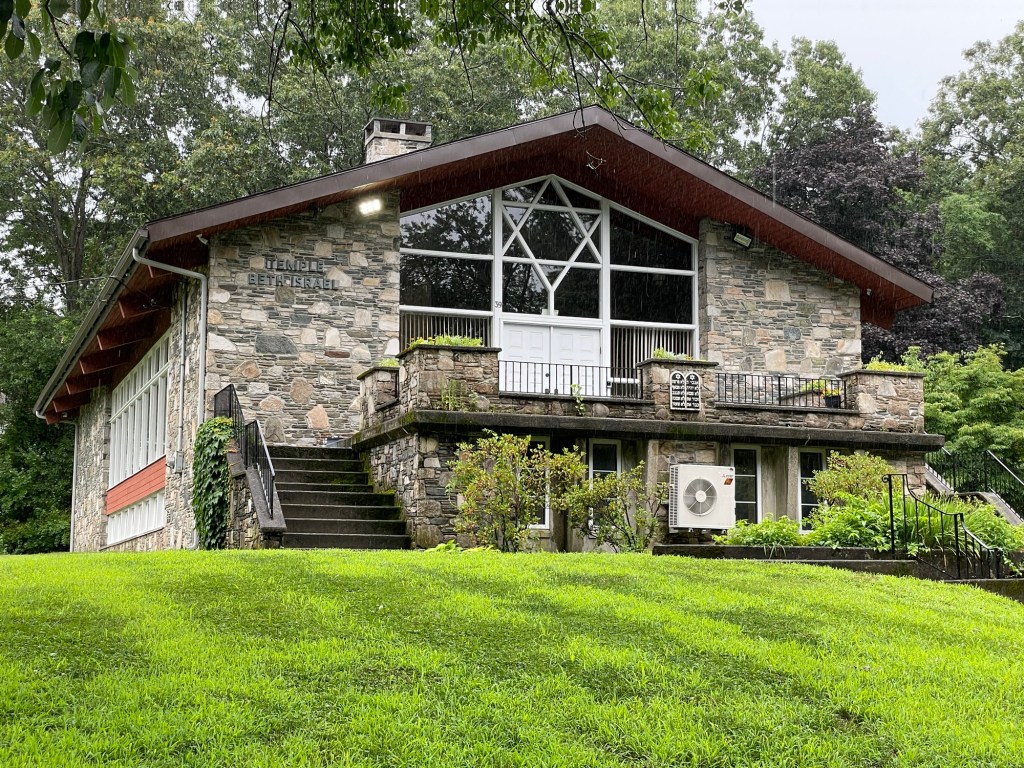
Temple Beth Israel, Danielson // 1955

Temple Beth Israel is a unique, Mid-Century Modern former synagogue, that can be found in the village of Danielson, in the town of Killingly, Connecticut. Ground was broken on the temple in 1951 and the foundation and basement were completed soon-after. Funding was tight and the building remained unfinished for years. During the first years that the congregation used the unfinished synagogue, while continually striving for additional funds to complete the building. A congregation member Mary Riseman’ s son William Riseman, an architect, designed the building and the Riseman family donated the fieldstone for the building from a quarry on their farm. The building was eventually completed in 1961, ten years after its ground-breaking ceremony, with young, recently graduated architect, Maurice Finegold as designer of the interior of the main floor sanctuary and more, completing the project. The congregation, a blend of Orthodox and Conservative adherents, was generally served by itinerant rabbis, often religious students. Dwindling membership forced the congregation to merge with another in nearby Putnam, and the building was eventually sold. A secular preservation society was organized to keep it, which has transformed it into a cultural and historical center, dedicated to preserving the history of the Jewish experience in the area.
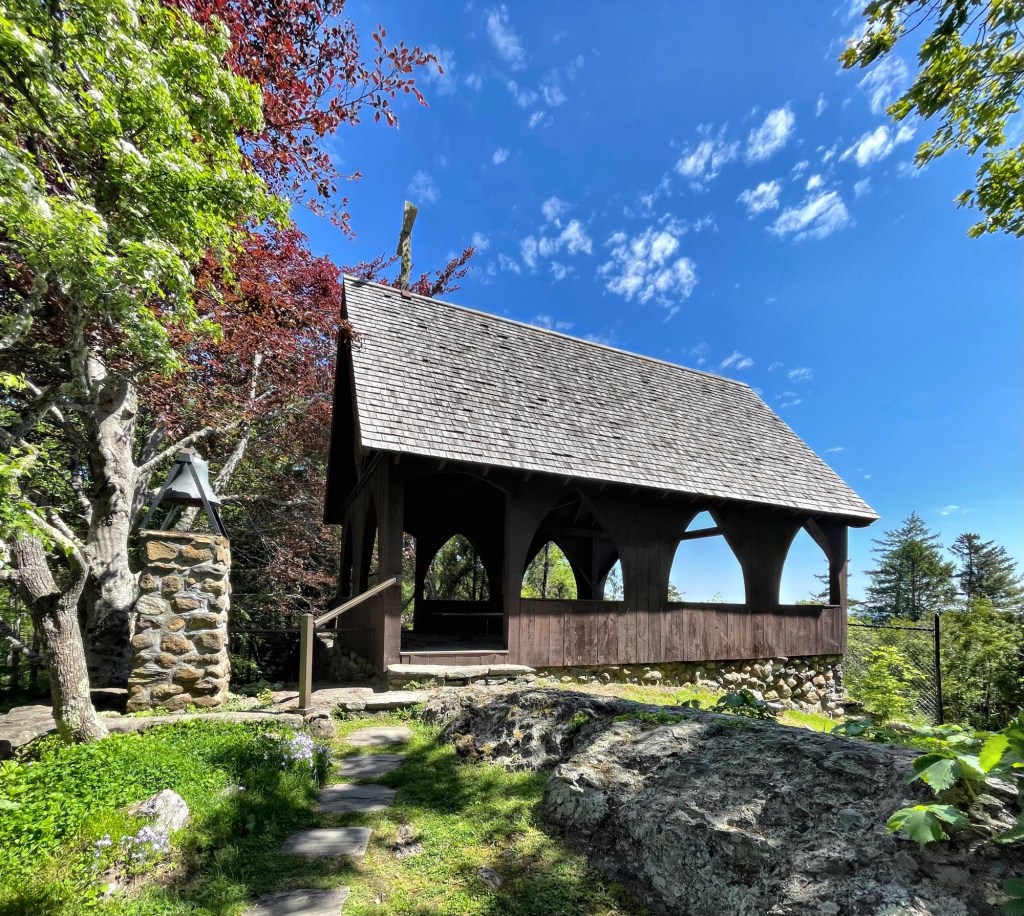
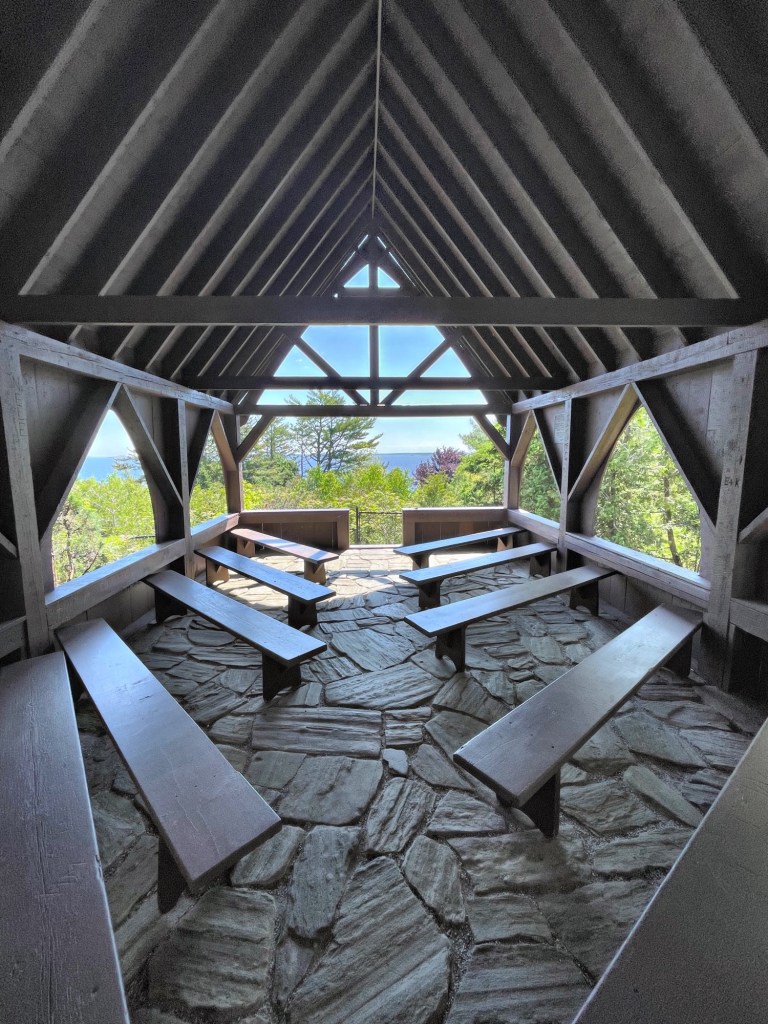
Vesper Hill Children’s Chapel // 1960

After the Tamarack Lodge hotel of Rockport, Maine, burned down in 1954, nearby resident Helene Bok began to envision what would be the best use of the charred landscape. Her project became the Vesper Hill Children’s Chapel, an absolutely stunning outdoor chapel that is open to the public. Her dream was to build a refuge that would be open for all people and “speak in and of itself of the beauty, goodness and truth of nature, life and God.” It is not clear to me who the designers were, but the structure and grounds are elegantly sited on the hill, overlooking the harbor in the distance. Helene planned the chapel to partially sit atop the rustic stone foundation of the former hotel on the site, with an open post-and-beam wooden structure above. After Helene’s death, Elmer Crockett, a designer for years on the Olmsted staff in Maine, oversaw the grounds and maintained a biblical herb garden. The chapel is today approached by a roofed stairway and surrounded by mature trees and locally harvested stones. It is truly a hidden gem in Mid-Coast Maine.

St. Anthony of Padua Catholic Church // 1956

Believe it or not, the city of North Adams, Massachusetts has long been home to a large Italian population. The first waves of Italians first arrived to this part of the Berkshires in the mid-late 19th century, many of which were hired to build the Hoosac tunnel, which when it was finished, was the second longest tunnel in the world. It took almost 25 years to build! Some Italians were experienced stone carvers and others worked in the cotton mills and other factories in the area. As the Italian population grew, Roman Catholic churches were required for these new first- and second-generation families in the mill town. The first St. Anthony of Padua Roman Catholic Church was erected in North Adams in 1906. Four years later, the 1910 census noted that roughly 16% of North Adams’ population was of Italian descent. After the first church burned down around 1950, money was raised to build the present church which is located across the street from Mass MoCA. The church was designed by architect Anthony DePace (1892–1977), an American architect who designed numerous Roman Catholic churches throughout the Northeastern United States area during the mid to late 20th century. Architecturally, the building features late-Romanesque and Art Moderne details. Eventually, the decline in the number of Catholics in North Adams in recent decades led to the consolidation of parishes in 2009. St. Anthony’s is the sole remaining Catholic church in North Adams and the church and parish are now known as St. Elizabeth of Hungary, possibly after a merging of multiple parishes.

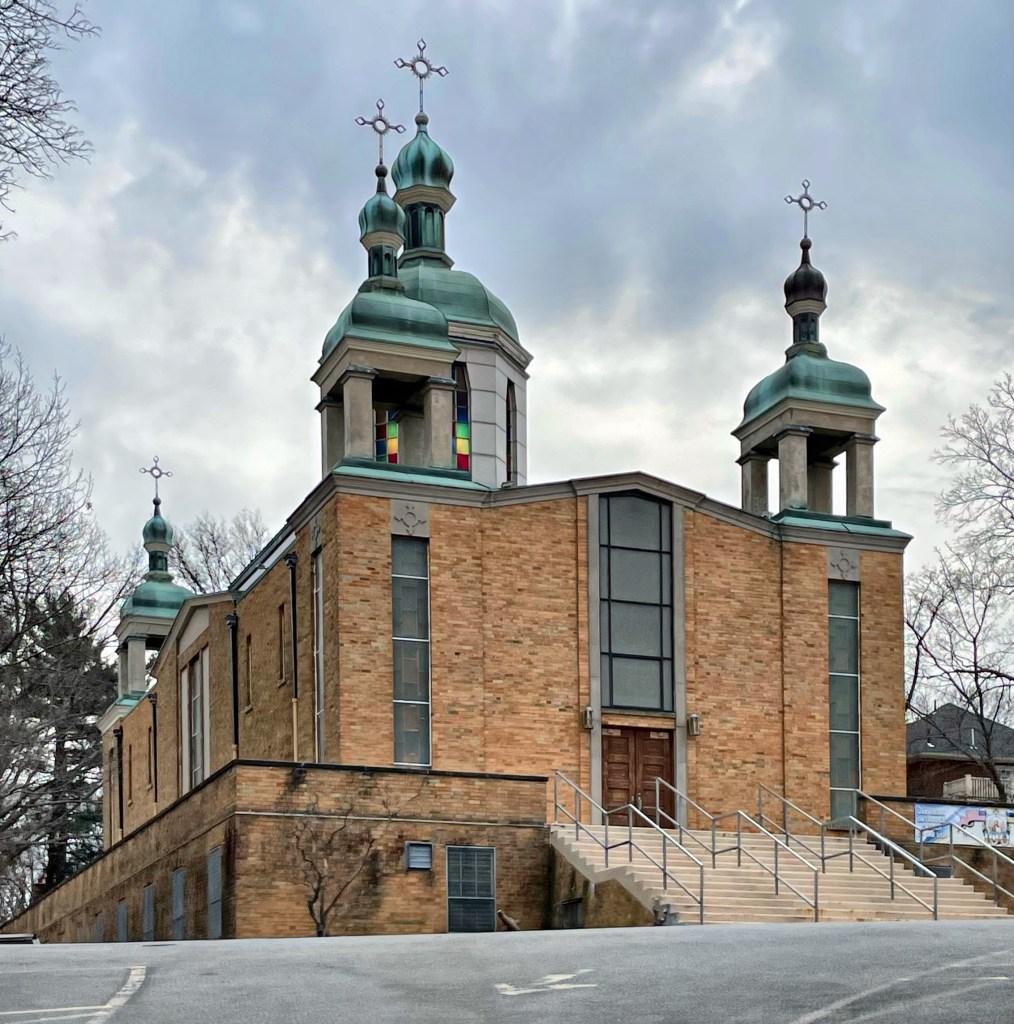
St. Andrew Ukrainian Orthodox Church // 1958

I typically do not connect my posts to current events, but I really wanted to take time to highlight the strength and fortitude of the Ukrainian people fighting to preserve their home and democracy around the globe. Closer to home, a growing Ukrainian community in Boston in 1956, decided to erect a new church in the Forest Hills section of Jamaica Plain. Land was acquired and a blessing ceremony was attended by members of the church, the architect, and Reverend John Theodorovich; the head of the Ukrainian Orthodox Church of America, who was born in Ukraine, and served at chaplain with the Army of the Ukraine National Republic in the war against Russia in 1919-20, before eventually moving to North America. The architect, John Kodak, was a Toronto-based architect of Ukrainian descent who ended up in Canada after fleeing from his home to escape communist rule from the USSR. This church is a Modernist interpretation of the iconic St. Andrew’s Church in Kiev, Ukraine, with its onion domes surmounted by crosses. The church, like many others, is holding prayers for Ukraine and is coordinating donations and aid to the Ukrainian people and related charities.