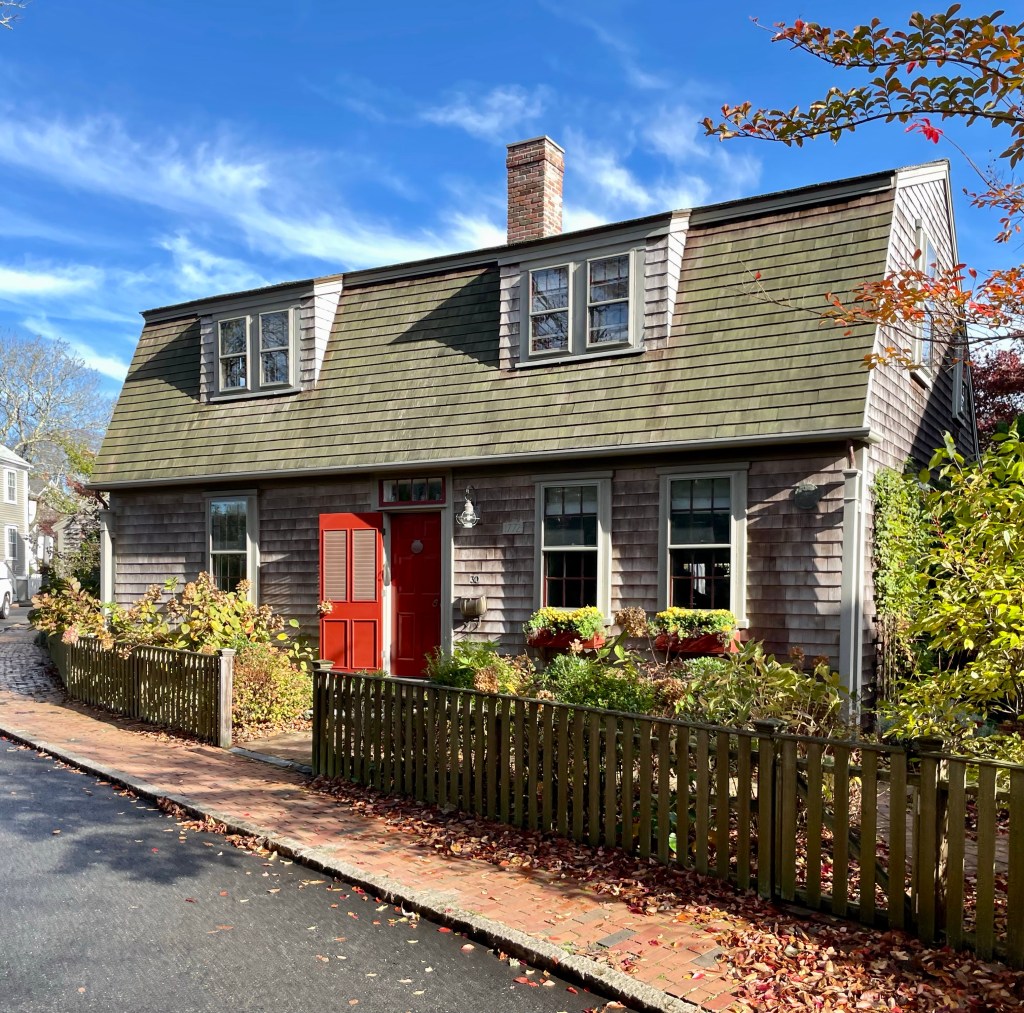
In 1772, Grindell Gardner built this Georgian gambrel-roofed house on land which was part of a large tract formerly owned by his grandfather, Abel Gardner, whose own home sits a stone’s throw away. The charming Cape house is of an unusual type, having the gambrel on the front side only which slopes to a sort of saltbox at the rear, which originally contained the summer kitchen and a water closet. The house was altered in the 1890s with the addition of dormer windows and the removal of the original large central chimney, which was removed prior to the new dormers. By the 1960s, the house had only been owned by four families.
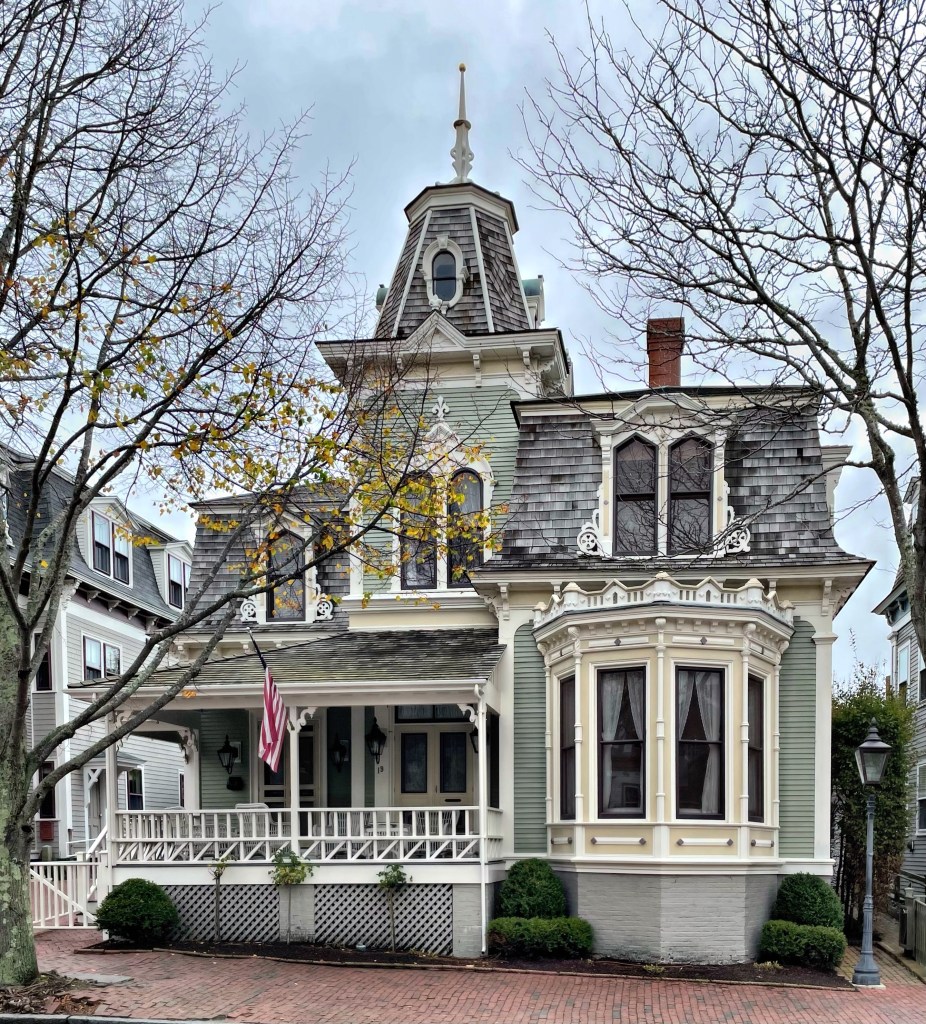
When one thinks of architecture on Nantucket, many would think of old Colonial-era capes and stately Federal and Greek Revival whaling captains mansions. There are Victorian-era houses on Nantucket, but building on the island tapered off by the mid 1800s after the mid-1700s to the late 1830s when Nantucket was the whaling capital of the world. In December of 1877, Nantucket coal dealer Andrew Hunt purchased a vacant lot on Broad Street to erect a new home for his family. Mr. Hunt hired local builder Charles H. Robinson to design and construct the Second Empire cottage, which today, remains one of the best-preserved and high-style Mansard residences on the island.
Here it is… The oldest house in Nantucket! The Jethro Coffin House dates to 1686, and when it was built, Nantucket’s English population totaled several hundred, and the native Wampanoag outnumbered them by at least three to one. The home was built seemingly as a wedding gift from twenty-three-year-old Jethro Coffin (1663–1727) to his new sixteen-year-old wife Mary Gardner (1670–1767). The marriage merged two of the old Nantucket families and was built on Gardner family land out of lumber transported to the island from Exeter, New Hampshire, where Jethro’s father, Peter Coffin, owned timberland and a saw mill. The First Period house has small windows of small panes of glass as the material was shipped from England at high cost. The large central chimney would heat the entire home on cold winter nights. Mary and Jethro sold their Nantucket dwelling to Nathaniel Paddack in 1708 and moved to Mendon, Massachusetts, when Jethro inherited property there. By the late nineteenth century, the house was abandoned (for some time it was used as a barn) and had fallen into disrepair. A Coffin family reunion held on the island in 1881 renewed interest in the property and off-island members of the family bought the old Coffin House. The Nantucket Historical Association acquired the house in 1923, and four years later, Historic New England), commenced an extensive reconstruction in an attempt to return the house to its historic appearance. It remains a location of pride for residents and visitors to the island to this day.
In around 1800, Baker Turner built this beautiful Federal period home on Nantucket. It typifies the best parts of Nantucket architecture: gray weathered shingles, charm and simplicity. Over 100 years after the house was built, the property became significant as a facility for saving lives. The Nantucket Cottage Hospital was founded in 1911, conceived by the visions of Dr. John S. Grouard (who lived nearby) and Dr. Benjamin Sharp, to provide centralized high-quality medical services to the residents on the island. There had been no hospital on the island beforehand. The duo bought the former Turner homestead in 1912 and moved in. The hospital was eventually outgrown, and the hospital relocated to a modern building on available land in the 1950s. This building was sold and now appears to be a home, full circle.
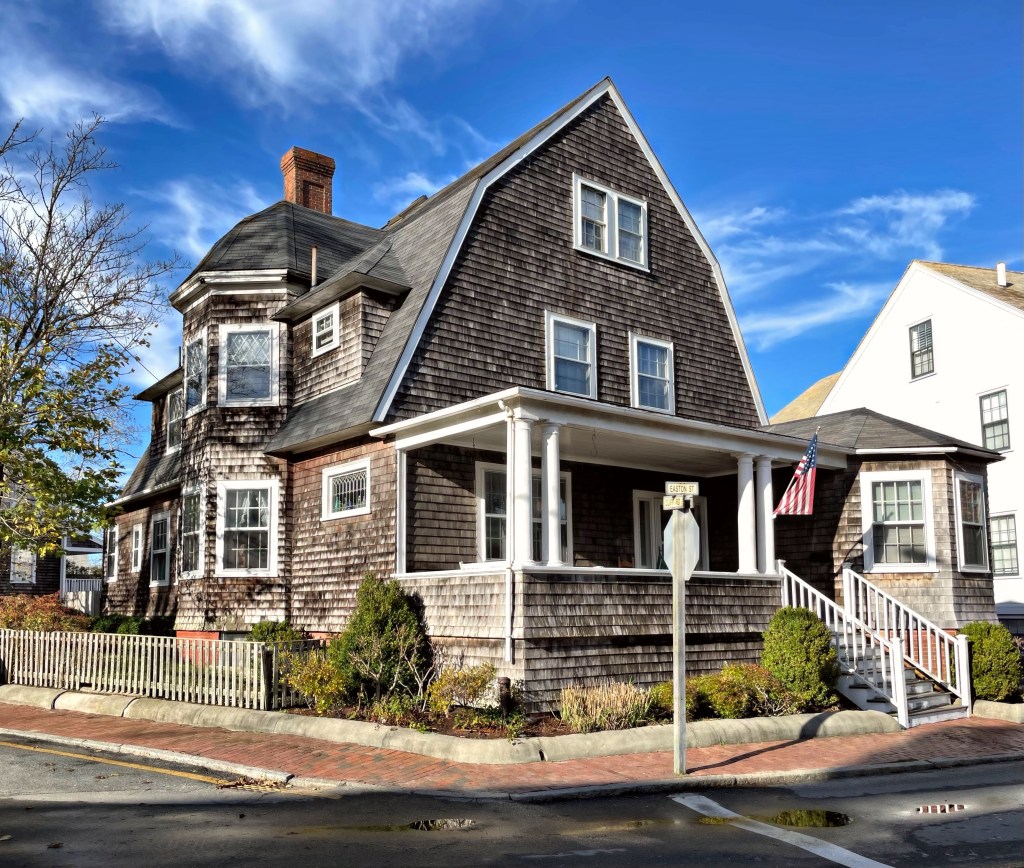
Dr. John Shackford Grouard (1867-1927) was a physician and surgeon born in Allegheny County, Penn. He attended Phillips Exeter Academy, and earned an M.D. from Harvard Medical School in 1889. In 1891, he moved to Nantucket, Massachusetts, where he established his own general medicine and surgical practice. Years after establishing his practice, he built this beautiful Shingle/Queen Anne style cottage that is dominated by a massive gambrel roof and is located adjacent to the Nantucket Hotel. He served as the Town Physician and medical examiner, on the Nantucket School Board, and as president of both the Nantucket Civic League and Citizen’s Gas, Electric, and Power Company. Dr. Grouard also co-founded the Nantucket Cottage Hospital in 1911, but more on that later. Dr. John Shackford Grouard died in Boston in 1927, one week after surgery for a gallbladder inflammation.
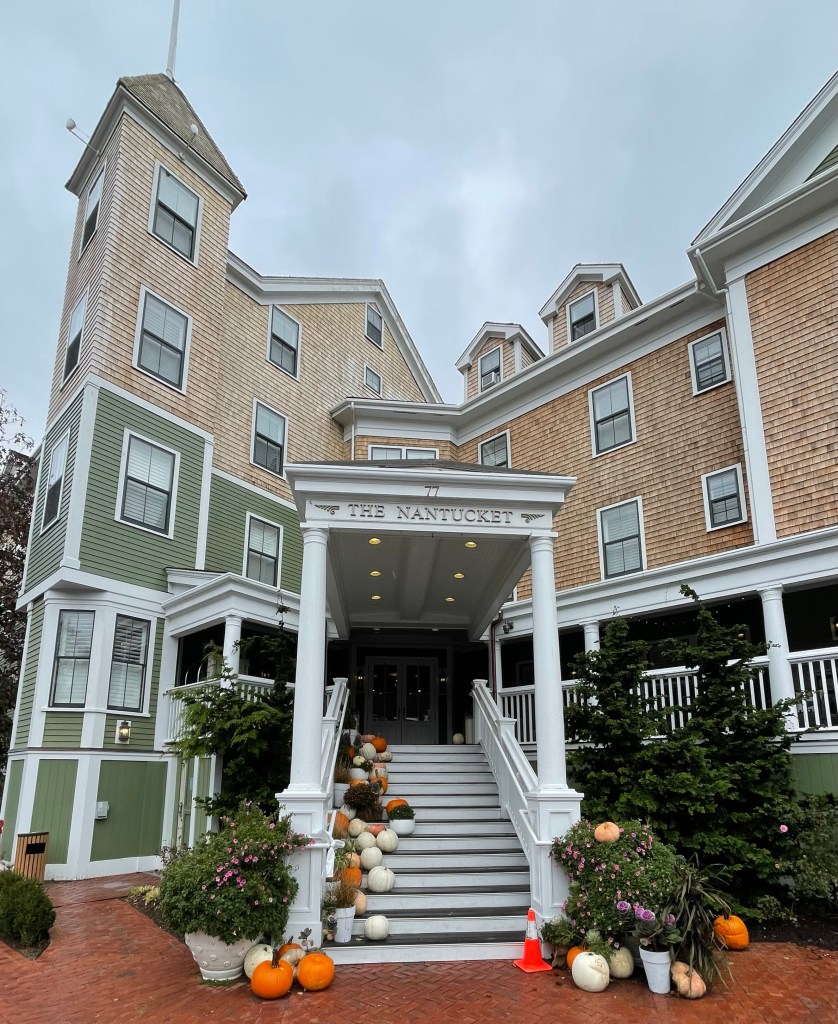
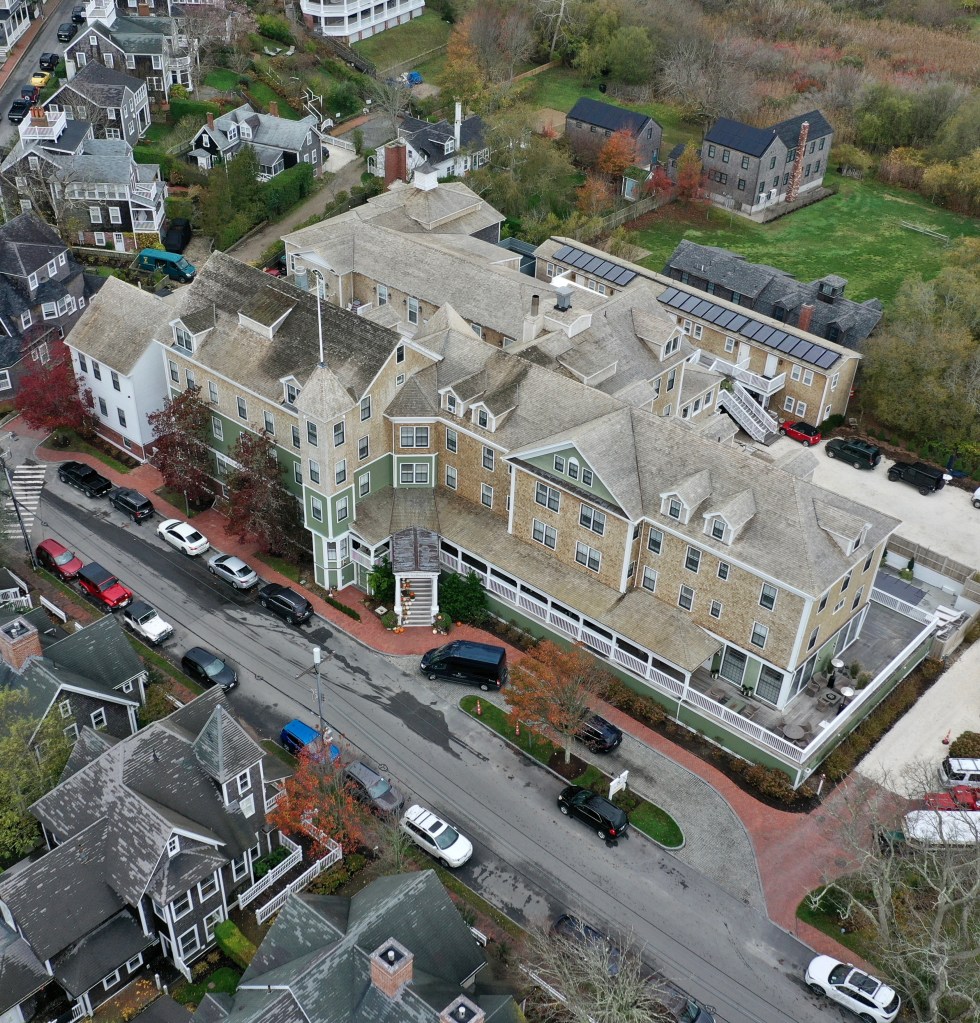
In 1888, Charles F. Folger of Philadelphia purchased the former Elijah Alley house on Easton Street, just north of the main village of Nantucket. Folger hired carpenter Edwin R. Smith to design and build a new grand hotel for summer residents of Nantucket. Originally named the Point Breeze Hotel, the grand resort opened in the summer of 1891. The Queen Anne style hotel contained forty sleeping apartments in the upper floors and was dominated by a corner tower with billiards rooms and a bowling alley in the raised brick basement. Business was booming, and by the early 20th century, Folger expanded the hotel adding the east wing in the Colonial Revival style. In 1925, a fire destroyed the original Point Breeze Hotel, leaving just the East Wing. By this time, the days of the grand, wooden hotels was coming to a close. The Nantucket Institution for Savings acquired the hotel during the Great Depression, until 1936 when Gordon Folger Jr., grandson of the Point Breeze’s original proprietor, purchased the hotel and renamed it after himself, as the Gordon Folger Hotel. By the end of the 20th century, the building sat underutilized, the early 2000s when Little Gem Resorts purchased the hotel, seeking to restore this historic property back to her former glory. The original 1891 hotel was rebuilt in 2012, even down to its iconic corner tower, and the hotel was renamed The Nantucket. The hotel is open year-round and is lavish inside and out, providing you with a sense of home even when on vacation in the middle of the Atlantic!


 Buildings of New England