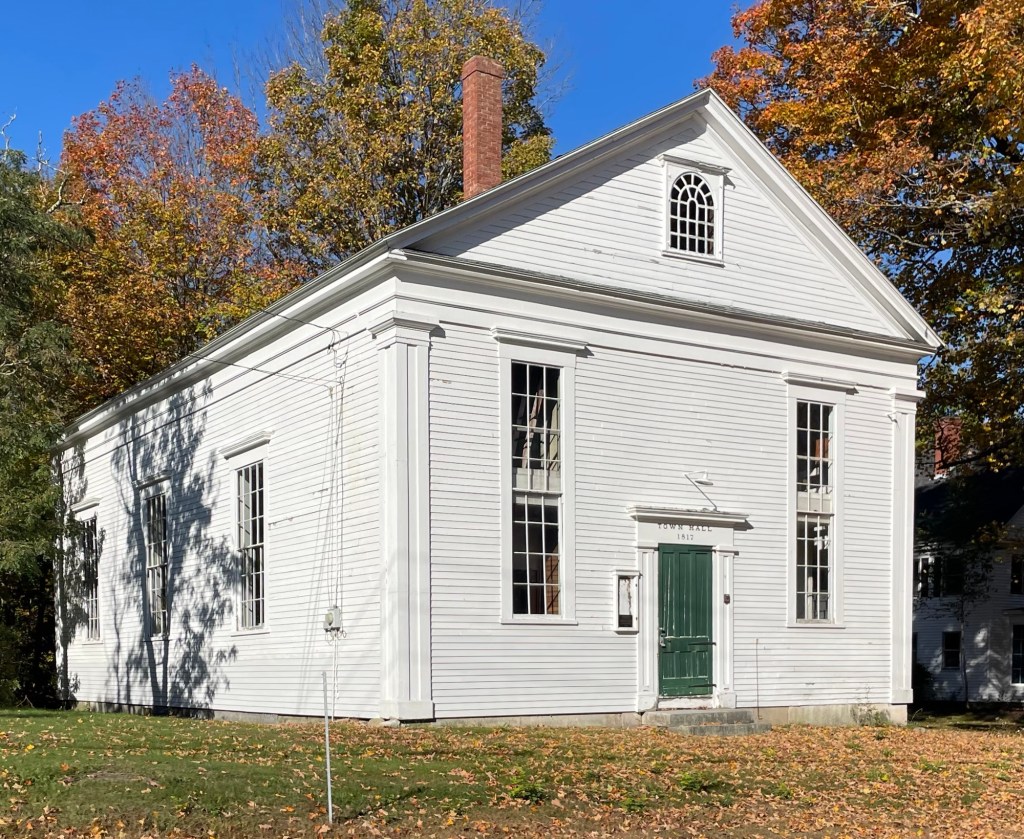
Old New Ipswich Town Hall // 1817

New Ipswich, New Hampshire, is a town that oozes New England charm! Winding back roads are lined with Colonial-era homes and buildings, lovingly maintained by stewards and neighbors to create the quintessential small town feeling. New Ipswich was granted in 1735 to 60 inhabitants of Ipswich, Massachusetts, where the name is derived, by colonial Governor Jonathan Belcher and the General Court of Massachusetts. European settlement began here in 1738, when Abijah Foster arrived to the area with his wife and infant daughter. At the center of town, a new Town Hall was built in 1817 as a combination town hall and private academy with funds provided by the town government and by the trustees of New Ipswich Academy. The building was constructed under the direction of Deacon Nathaniel Gould, using materials salvaged from a disused meetinghouse of 1770. The arched gable window is reputed to have been taken from the meeting house, as are twisted balusters on the gallery stairway inside. As completed in 1817, the building had a full second floor which provided the academy with a lecture room, a small library, and a laboratory, but that was taken over by 1869 when the Town renovated the building, removing a tower and belfry, and occupied the second floor spaces. The building is still owned by the town, and is used occasionally for civic functions, with town offices in a mundane, newer building a short distance away.

Lebowich Tenement House // 1895

One of the most photographed buildings in North End is arguably this tenement block, built in 1895 at the corner of Prince and Salem Streets. As the North End continued to redevelop into a diverse immigrant community, tenement houses were constructed by those with the means, providing housing at low cost to those who arrived to Boston in the late 19th and early 20th centuries. Max and Etta “Ethel” Lebowich, Russian Jews, immigrated to Boston, settling in the Jewish quarter of the North End and opened up a dry goods store at the corner. The business did well, and the couple redeveloped their land and hired Swedish-born architect Charles A. Halstrom, to design the prominent apartment house. The Renaissance Revival building features massive pressed metal oriels and brick and stone construction. I am unsure if the oriels are truly copper, which would have been fairly expensive for a tenement building, or if they are pressed tin. Any insight would be much appreciated.

Captain George Nowell House // 1854

Captain George W. Nowell and his wife, Frances, the daughter of the wealthy Capt. William Jefferds, built this elegant Italianate style home in 1854 that stands on Temple Street, next door to the Kennebunkport Post Office. George was a sea captain, following in his father’s footsteps and also invested in several of the ships he sailed, but had the fiscal foresight to insure his interests against loss. His prized ship was named “Tropic” and she was launched in 1855, less than a year after his house was built. On a cold December day in 1862, Nowell, captaining The Tropic left Philadelphia with a cargo of coal for the Pacific Mail Steamship Company in San Francisco. She and her crew of 20 were never heard from again. George was not yet 40 when he perished. His youngest son, Frank, never met his father and was only 8 years-old when his mother passed in 1872. Shipbuilder David Clark bought their Temple Street home and George’s brother took his children to live in Bangor.

The captain’s reputation as a prudent and charitable man was recognized by Victoria, Queen of England. She awarded Capt. George W. Nowell, of the ship Tropic, an engraved spyglass in testimony of his humanity in rescuing her subjects, the crew of the Village Belle, of Nova Scotia. The telescope and a certificate, signed by the Queen, have been proudly protected by the Kennebunkport Historical Society.

The family home features bold corner quoins, bracketed door and window hoods, and paired rounded arch windows at the top floor.