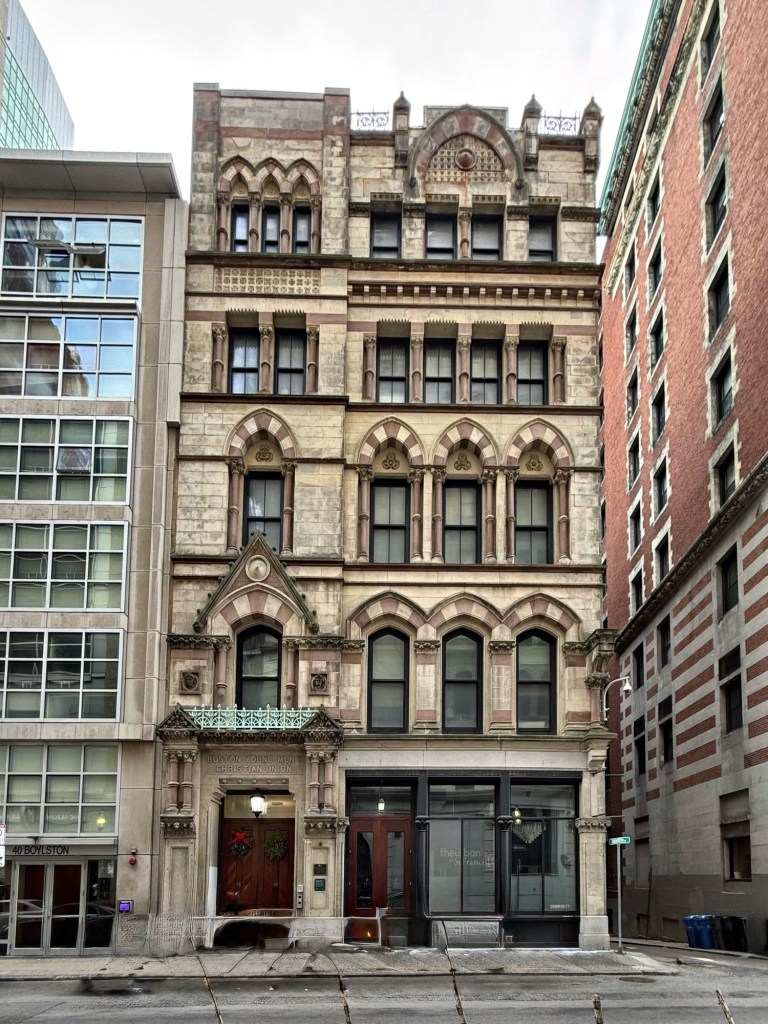
Boston Young Men’s Christian Union Building // 1875

The Boston Young Men’s Christian Union was founded in 1851 by a group of Harvard students as a biblical and christian literature discussion group, which incorporated the following year. First located on School Street, the organization’s activities were to provide a focal point for the intellectual, religious, and social life of primarily middle-class, well-educated Christians. The organization grew to the point that a new building was needed, and in 1873, a site on Boylston Street was acquired as a perfect central location for the group. Architect Nathaniel J. Bradlee of Bradlee and Winslow was hired to design the structure, principally because Mr. Bradlee by then a prominent architect and public figure, was also a life member of the Union and the brother of one of its founders. The building was completed in 1875 and included ground floor retail with an auditorium, gymnasium, library, social and game rooms, and offices for the Union above and behind. Designed in the High Victorian/Ruskinian Gothic style, derived from a mixture of English, Italian, French, and some German Gothic precedents, the style emphasized complicated, asymmetrical massing, polychromy, ornate details, and lancet or Gothic arched openings, in this building a sandstone facade was used. The building became a City of Boston Landmark in 1977. In 2016, the building was converted to an affordable housing development by The Architectural Team Inc., and called “The Union”. The development provides 46 units of affordable housing, including 25 targeted to those who have experienced homelessness. What a great rebirth of the building. Historic Preservation and Affordable Housing can work together and create great projects.

Killingly Town Hall // 1876

The economic center of the town of Killingly, Connecticut is the village of Danielson, which is located at the confluence of the Quinebaug and Five Mile rivers. The area developed as an industrial village and prospered as the town’s center through the late 19th and early 20th centuries. The present-day town hall building was originally constructed in 1876, not as a civic building, but as a multi-purpose music hall and G.A.R. Hall. The Victorian/Ruskinian Gothic style building was constructed of brick with stone trim. The building was later acquired by the town in 1906 and has served as the town offices ever since. Besides the unfortunate replacement windows, the building is well-preserved by the town.

Yale University – Street Hall // 1866

Closing out this series on Yale’s Old Campus, I present one of the finest Victorian Gothic collegiate buildings in the United States, Street Hall. Street Hall was designed by Peter B. Wight (who had just completed the Venetian Gothic style National Academy of Design in New York City) and opened in 1866. The building opened as the Yale School of the Fine Arts, which was the first art school on an American college campus. The building was named after Augustus Russell Street (1791–1866), a Yale graduate and New Haven businessman who donated the funds for the building’s construction on the condition that all residents of the city could enroll in the school, wanting a bridge between citizens of New Haven (“Town”) and the college “Gown”). Augustus Street and his wife, Caroline Leffingwell had seven daughters together, all of whom predeceased them. It was likely the fact he was around so many women in his life that he also required the Yale School of the Fine Arts to admit both male and female students (Yale would become co-educational and admit women to all programs in 1969.) Street Hall is a landmark example of the Victorian/Venetian Gothic style with lancet arches, polychromatic stone, and trefoil and quatrefoil stone medallions. Street Hall is now connected to, and is a part of the Yale University Art Gallery.

Yale University – Durfee Hall // 1871

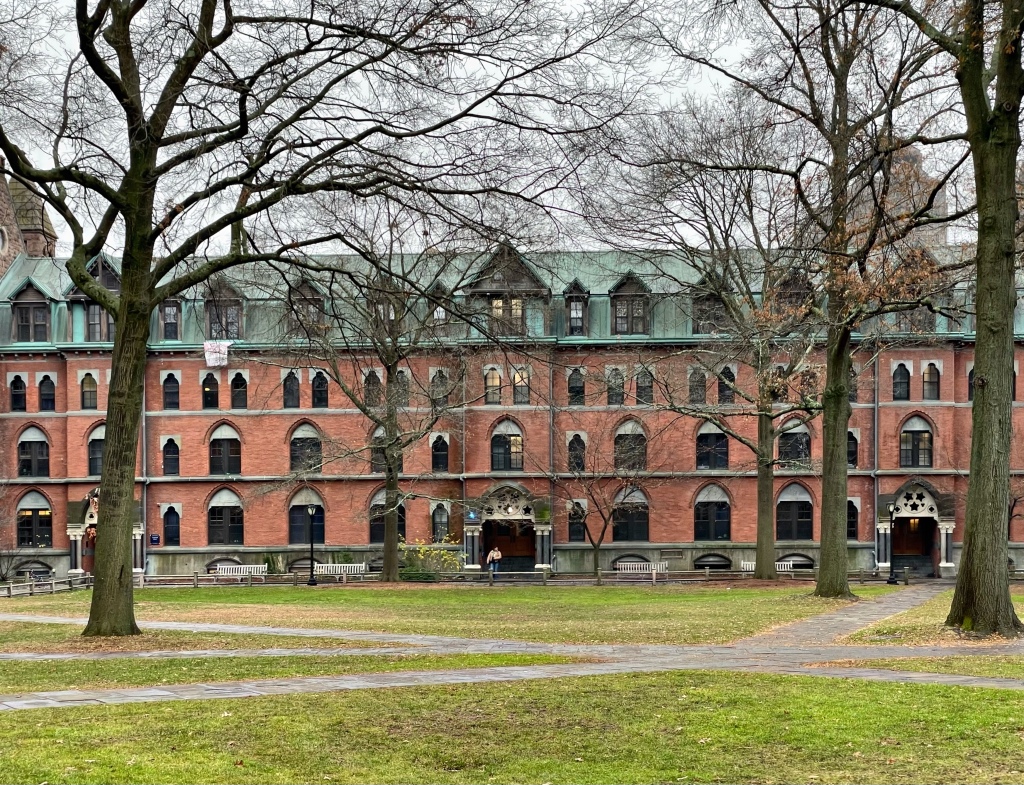
Following his success of designing Farnam Hall at Yale, architect Russell Sturgis was again commissioned to design Durfee Hall, the residence hall built to enclose the northern edge of the Old Campus Yard. The elongated dormitory was the largest and most imposing building on the Old Campus when it was completed and was named for its benefactor, Bradford M. C. Durfee of Fall River, Massachusetts. The exterior of Durfee is covered in a combination of sandstone and bluestone, and is accentuated with gables, ornate turrets, and large brick chimneys. Upon its completion, it was considered a “high point in Victorian Gothic Style architecture,” and critics from American Architect and Building News commented that “It will be a long time before the quiet dignity of its roof and chimneys will be surpassed anywhere.” The exterior was renovated by Wiss, Janney, Elstner Associates Inc.

Yale University – Farnam Hall // 1870

Farnam Hall is Yale University’s oldest dormitory still in use. Designed by New York architect Russell Sturgis in a Ruskinian High Victorian Gothic style, Farnam Hall is considered Sturgis’s most important work and was completed in 1871, marking a new direction toward an enclosed campus, shielded off from the surrounding downtown district of New Haven. Named for Henry Farnam, its construction required the removal of the Second President’s House and a section of the Yale Fence, which was met with some trepidation. The red brick, four-story building originally consisted of twenty suites and ten common rooms on each floor. Sturgis, who was influenced by John Ruskin’s ideals put forward in his Seven Lamps of Architecture, used a variety of brick and stone on the facade all with hand carved detailing. Farnam Hall was renovated in 1977 by architect Edward Larrabee Barnes and today serves as a dormitory for first-year students belonging to Yale’s Jonathan Edwards College.

Nott Memorial Hall // 1858

The 16-sided Nott Memorial Hall is one of America’s most dramatic High Victorian buildings, is the centerpiece of the Union College campus (and a major reason for my stop in Schenectady when driving through New York). Union was the first non-denominational institution of higher education in the United States, and the second college established in the State of New York. Eliphalet Nott became college president in 1804, and envisioned an expanding campus to accommodate a growing school. In 1806 a large tract of land was acquired to the east of the Downtown Schenectady, on a gentle slope up from the Mohawk River. In 1812 French architect Joseph-Jacques Ramée, equally skilled in landscapes and structures, was then hired to draw up a comprehensive plan for the new campus. Ramée worked on drawings for about a year, and construction of two of the college buildings proceeded quickly enough to permit occupation in 1814. The Union College campus thus became the first comprehensively planned college campus in the United States! As part of Remee’s plan for the campus, a round, Neo-Classic “pantheon” building was proposed at the center of campus (a prescendent for Thomas Jefferson’s plans for the University of Virginia just four years later). The building never materialized in Unions early days. Construction finally began on the building in 1858, based on designs by Edward Tuckerman Potter, grandson of President Nott, but apparently took nearly 20 years to complete due to the Civil War and funding issues. The Nott Memorial as completed, is 89 feet in diameter and capped with a ribbed dome. The dome is sprinkled with 709 small colored glass windows, making it one of the finest buildings on a college campus in the United States!