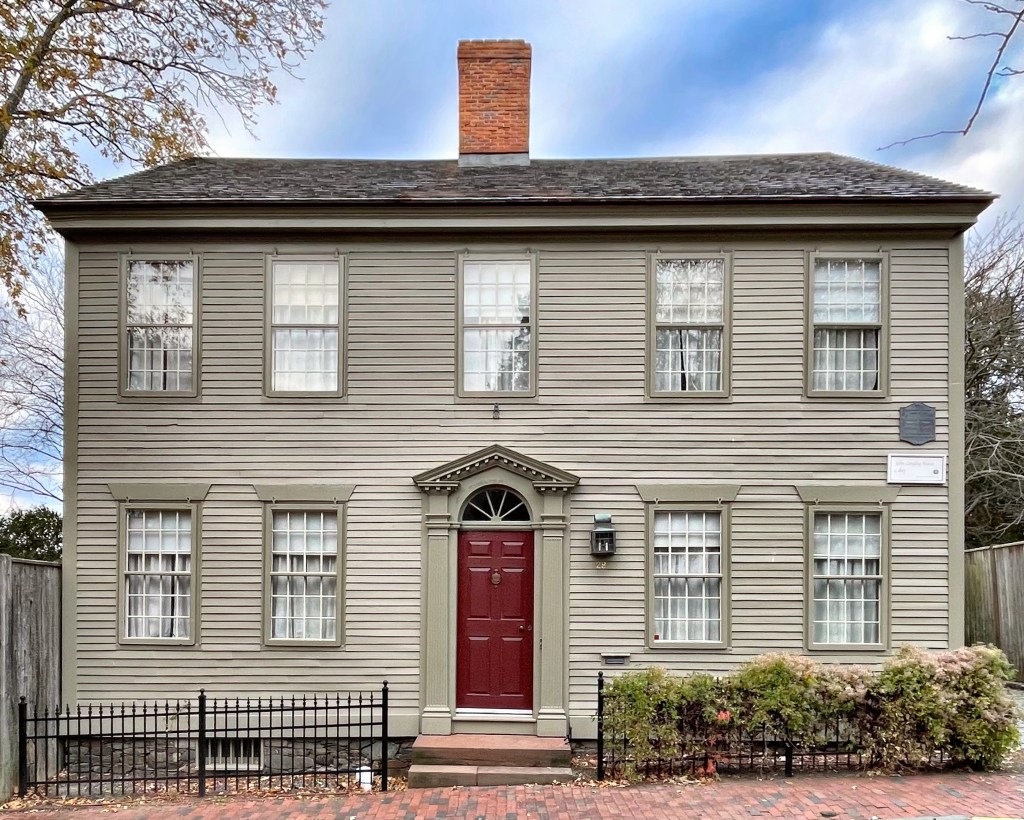
Billings Coggeshall Double House // c.1784

This unique double-house on Mill Street is stopped me in my tracks when strolling around Newport. The two-family house was built around 1784 by Billings Coggeshall (1733-1810) and is unique architecturally as it is comprised of two houses, each with its own separate pedimented entry, into a single lengthy block. Both houses have interior chimneys and are just one-room deep! When urban renewal hit Newport in the second half of the 20th century, traffic patterns and revitalization of the waterfront were top of mind (not necessarily slum clearance and wholesale redevelopment of neighborhoods like in Boston). To bring traffic into the downtown shopping area, Memorial Boulevard was laid out by 1969, and the Newport Restoration Foundation was integral to saving this building from the wrecking ball, as it was in the path of the new road. As luck would have it, an area around Trinity Church was cleared to establish Queen Anne Square, a town common-like park in the center of town. To provide the quintessential “New England charm”, many historic buildings were relocated to line the square, including this house. When the Billings Coggeshall House was moved here, it replaced a gas station, and it was given an even longer side addition with breezeway, providing screened parking and a rear addition for offices. Here’s to preservation!
Langley House // 1807

Smack-dab in the middle of Newport, Rhode Island’s dense network of downtown streets, you’ll find Queen Anne Square, a rare bit of open space in a web of alleys and ways. Did you know that this park is only 50 years old? It’s true! In the late 1960s and early 1970s, Newport (and many cities all over New England) were grappling with suburbanization and dwindling tax revenue with people and businesses moving out. Their solution was “urban renewal”, which entailed the razing of buildings and sometimes, neighborhoods which were deemed “blight”. Historic buildings and communities were destroyed with modern planning (high capacity roads and high-rises connected by open space) to take its place. In Newport, this saw the form of America’s Cup Avenue and Memorial Boulevard, which cut through the city to allow for more cars and less-congested side-streets. Years later, planners realized that Newport was without a traditional town common like many New England towns, so they cleared buildings in front of Trinity Church to provide that traditional feeling. At the time, preservationists were trying to save significant buildings, with the Langley House being one of them. This house was set for the wrecking-ball, from Memorial Boulevard’s construction but moved and restored by Newport Restoration in the last hour to the south side of Church Street. Seven years later when Queen Anne Square was built, this house was moved to the north side, saving it once again. This house is a survivor!