Lewis-Zukowski Farm // 1781

On the rural back roads of Suffield, CT, it is amazing how many historic farmhouses you can stumble upon. This is the Lewis-Zukowski Farmhouse, built in 1781, as one of the earliest brick homes built in this part of the state. When Hezekiah Lewis (?-1805) built his house in 1781, he was a farmer of modest prosperity. By the time of his death in 1805, he was somewhat wealthier, perhaps because of his second marriage in 1794 to widow Ruth Phelps, as his 91-acre farm. His estate indicates he was a traditional farmer of the period: he had a yoke of oxen, 2 horses, 2 cows, and 2 pigs, suggesting that he was primarily raising sustenance for his family, not products for market. Michael Zukowski arrived in Suffield in 1888 with his family as an immigrant from Poland. Zukowski worked on a farm in town for $8.00 a month plus board for local tobacco farmer Calvin Spencer. He had saved enough by 1905 to pay Hiram Knox (then the owner of the former Lewis Farm) $2,800 in cash, purchasing the property. Zukowski worked the farm until the 1920s, when his son took it over and he moved to another farm nearby. The house remained in the family one more generation until it was sold out of the family. It remains as an architecturally and culturally significant farm in Suffield.

John Fuller House // 1823

This home was built for John and Mary Fuller in rural Suffield, CT in 1823 and operated as a farm by the family for over fifty years. The town of Suffield purchased the house and farmland before the 1880s for use as a poor farm. Poor farms (also known as almshouses) were often rural houses where paupers (mainly elderly and disabled people) were supported at public expense. The land was available for the elderly and workers to harvest crops for sale and sustenance. According to an 1886 article, a former slave from Stamford, CT died in the poorhouse. “Old Cato” was a slave owned by Maj. John Davenport, a lawyer and politician of Stamford. Davenport offered Old Cato his freedom in 1812 if he enlisted to serve in the War of 1812, which he did. By the 1820s, he moved to Suffield CT, and worked at the West Suffield Congregational Church, paid to ring the bell at the church, likely also maintaining the property. He eventually ended up at the poorhouse and died, estimated to be over 100 years old. Back to the house… It was sold by the town at private auction in 1952 and purchased as a single family home, which it remains to this day. The house is a great example of a vernacular brick Federal style home with fanlights.

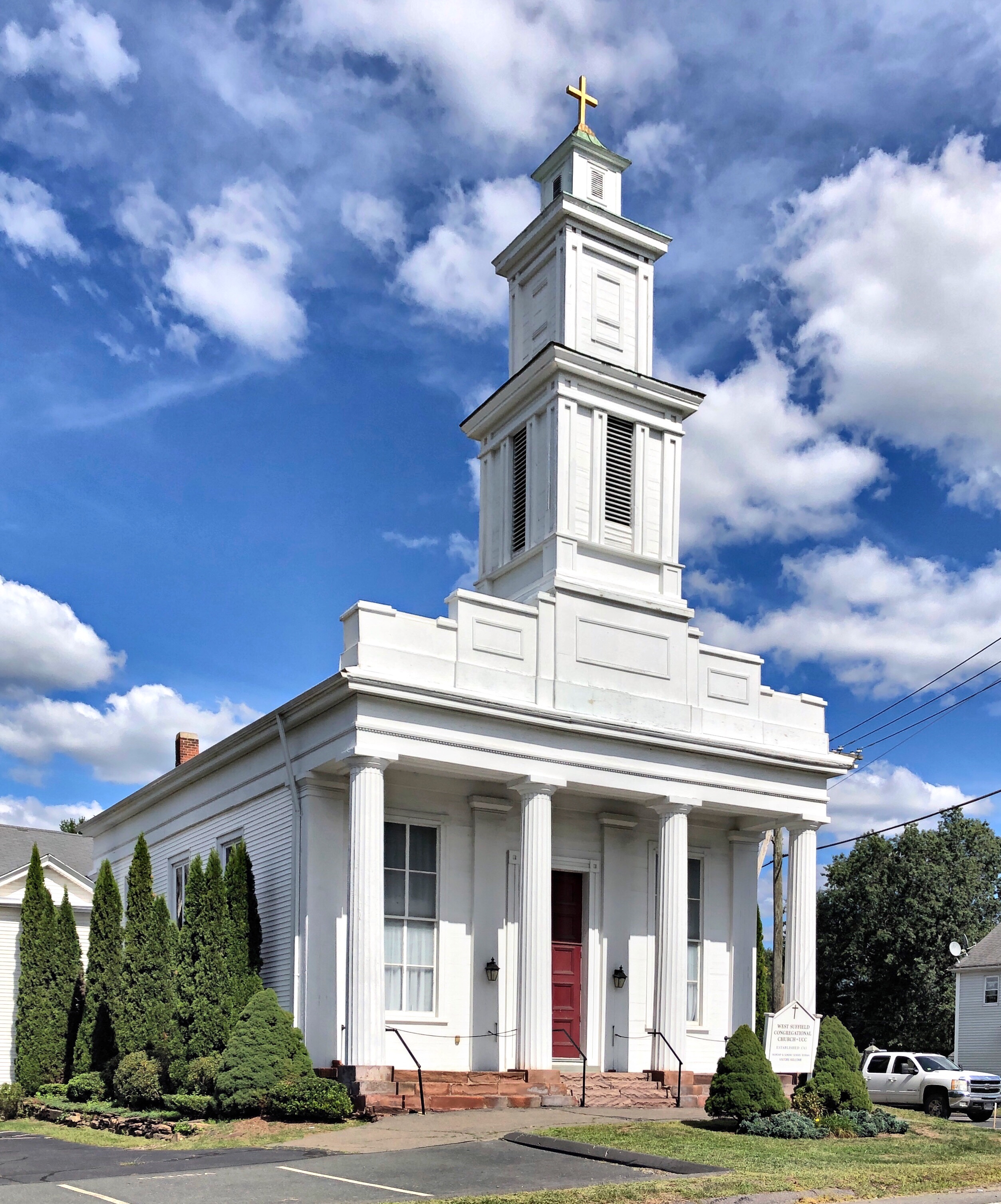
West Suffield Congregational Church // 1839

Suffield (originally Southfield) Connecticut, was once a part of Massachusetts, incorporated as a town in 1682. After having to travel to downtown Suffield to worship at the church there, the families in the west part of town established the Second Ecclesiastical Society in 1743. The first meeting house was built in 1744 on what was known as “Ireland Plain”, now the southwestern corner of the West Suffield Cemetery. In 1775, a second meeting house was erected on the site of the present building. It was rebuilt in 1839 using the earlier foundation. The Greek Revival church building is very charming with its columned portico and belfry surmounted above a stepped parapet. The church is very well preserved and a lasting remnant of West Suffield’s early days.