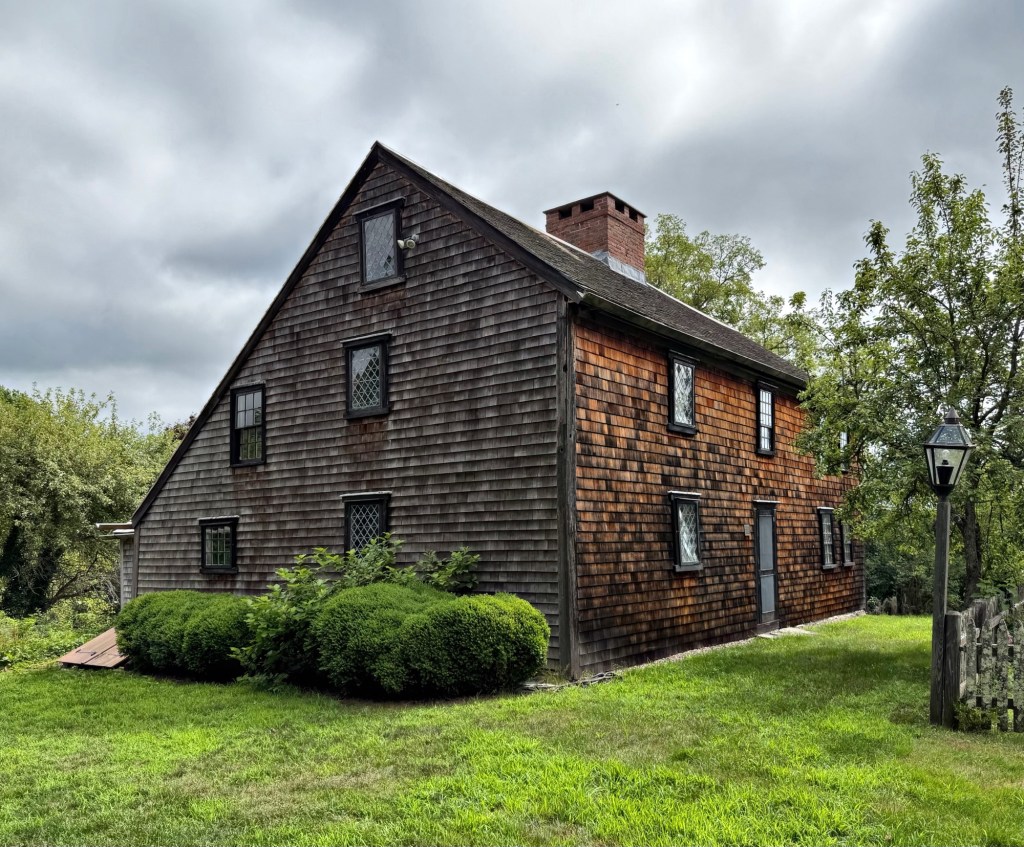
The Major John Bradford Homestead (also known as the Bradford House) is a stellar and well-preserved example of a First Period house in Kingston, Massachusetts. The house was reportedly built by Major William Bradford (1624-1704), the son of Governor William Bradford who arrived to Plymouth via the Mayflower in 1620 and served as Governor of the Plymouth Colony between 1621 and 1657, purportedly built the west (left) half of the house in 1674 for his eldest son John Bradford and his bride, Mercy Warren. John Bradford (1653-1736) served as selectman, a deputy from Plymouth, and as a representative in the Boston General Court, who in 1717, led in the establishment of Kingston as a new town by donating land for the meeting house, school house, burial ground, training green, and minister’s house. In around 1715, John Bradford expanded this house which was not sufficient to house his wife and seven children. After centuries, the house began to show its age, and in 1921, coinciding with the tercentenary of the Pilgrims arriving to Plymouth, the Bradford House was thoroughly documented and restored by Frank Chouteau Brown and George Francis Dow. Since 1921, the property (including a historic barn moved here from a nearby site) has been owned and preserved by the Jones River Village Historical Society, who operate the property as house museum.
 Buildings of New England