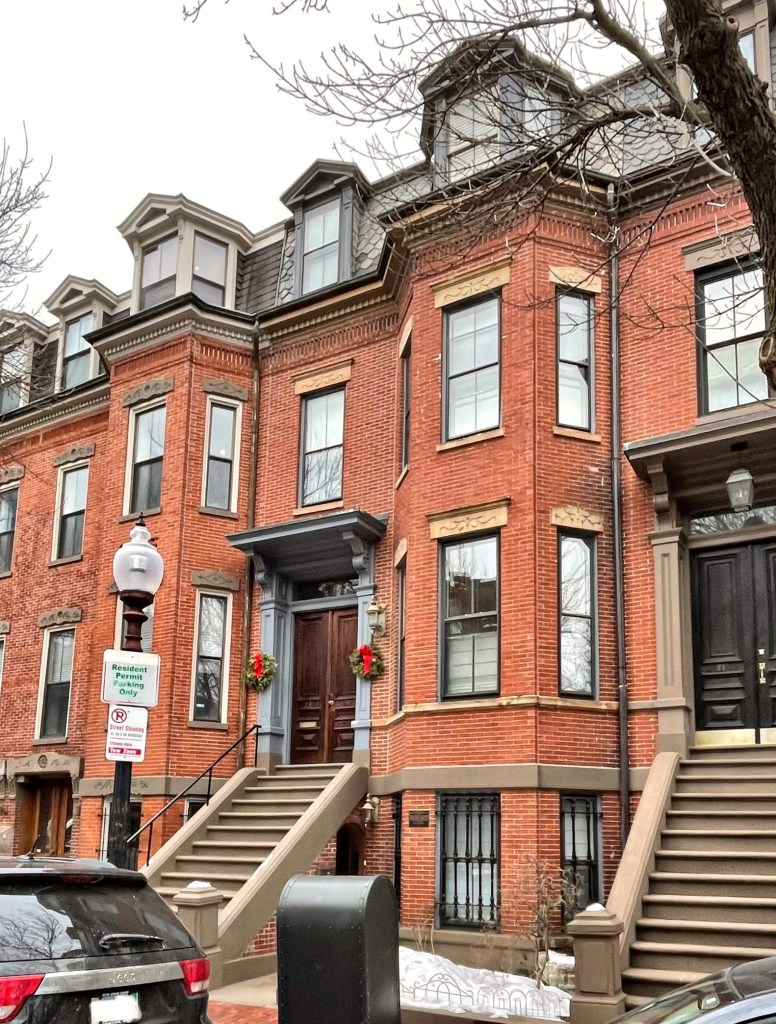
The rowhouse at 23 Holyoke Street in the South End neighborhood of Boston is an excellent architectural specimen, but is best known for one of its residents, Susie King Taylor. Susie King Taylor (1848-1912) was born into slavery near Savannah, Georgia; and despite Georgia’s harsh laws against the formal education the enslaved, she attended two secret schools taught by black women. She became free at the age of 14 when she escaped onto a Union-owned boat off the coast of the then Confederate occupied Fort Pulaski on the islands off the coast of South Carolina. She soon attached herself to the First South Carolina Volunteers, the first black regiment in the US Army. She served under the Union Army in various capacities: officially as a “laundress” but in reality a nurse, caretaker, educator, and showcased such strength and courage as a young woman. Eventually, Taylor married Sergeant Edward King in 1862, and together they remained with the unit until it was mustered out of service in 1866. It is likely at that time that she met Harriet Tubman, who served as a nurse, scout, and spy for the 1st South Carolina Volunteers. Postwar, the Kings moved to Savannah, Georgia. She hoped to continue her teaching career and opened a private school for the children of freedmen. Unfortunately, her husband died the same year, and a public school opening caused her private school to fail. By 1868, Taylor was forced to find work as a domestic servant. She moved to Boston in 1872 where she married Russell Taylor in 1879. She devoted much of the rest of her life to work with the Woman’s Relief Corps, a national organization for female Civil War veterans. She lived at this home on Holyoke for much of her time in Boston, likely re-connecting with her old friend Harriet Tubman when she lived on the street.
 Buildings of New England