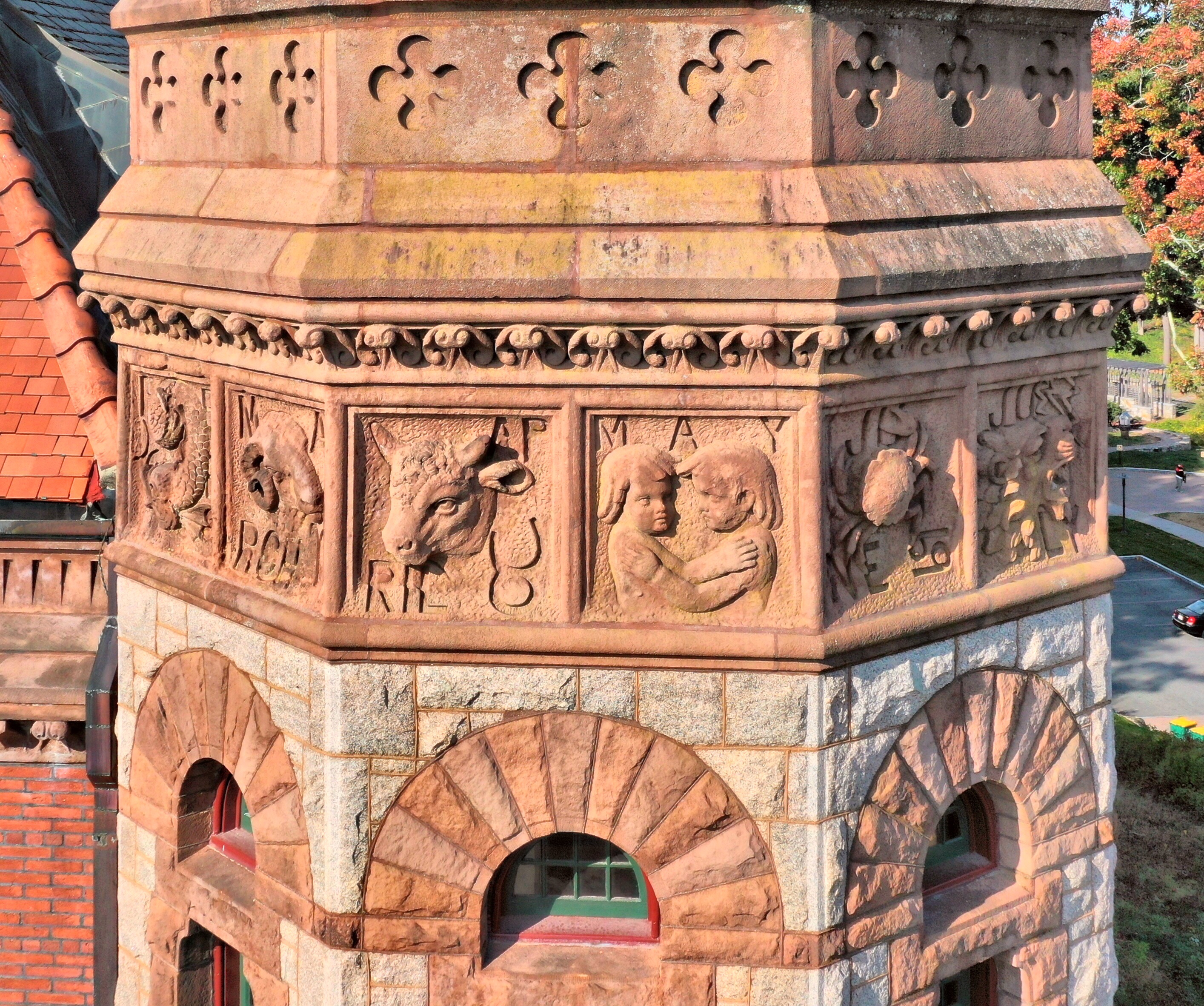
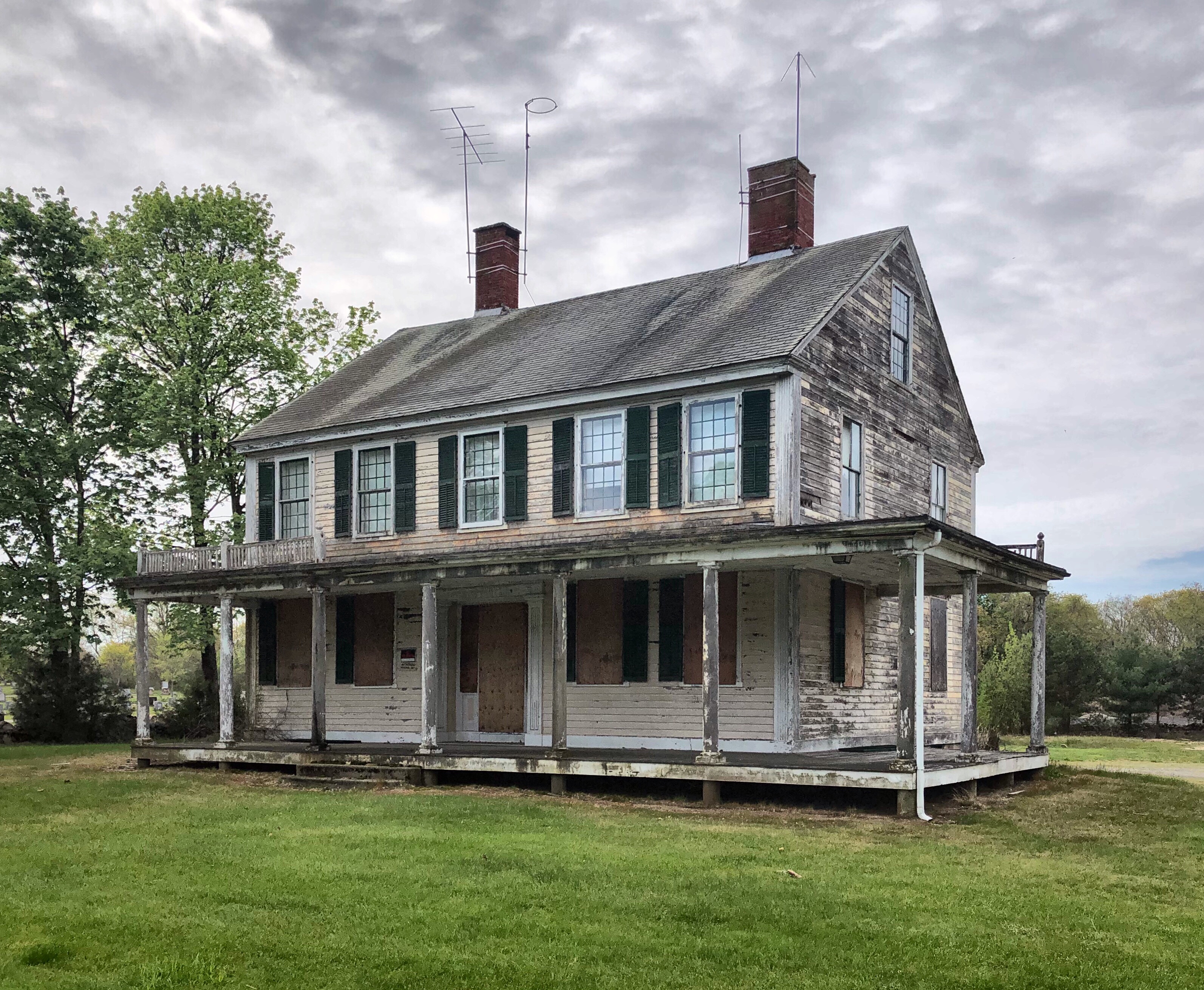
Nichols Homestead // c.1815

At the end of the War of 1812, Captain John Nichols settled in Assonet and appears to have had this Federal style house built soon after. The house remained in the family for at least two successive generations, seeing little exterior modifications during that time. After John’s death in 1848, the property was inherited by his second-born son, Thomas. Dr. Thomas Nichols left town as a young man and studied medicine at Jefferson Medical College in Philadelphia, and returned to Freetown to begin the practice of medicine in 1847, likely to assist his ailing father. In Freetown, Thomas was involved with the local church, politics, medicine, and worked for a local gun manufacturer. After Dr. Nichols died with paralysis, his son, Gilbert inherited the family home. The family home is a great example of the Federal style with a symmetrical facade, low hip roof, twin interior chimneys, and central doorway with sidelights and blind, elliptical fan above. The side porch was likely added in the early 20th century.

Briggs House // c.1790

The village of Assonet in Freetown, MA, has a great collection of late 18th and early 19th century homes built along the riverfront. This home is a great example of a late-Georgian cape house, built in the late 1700s or early 1800s. The home was constructed when Assonet was developing into a prominent, inland commercial fishing port. From this, a shipyard was constructed nearby, where shipbuilders constructed vessels along the river. By the 1850s, the house was owned by Charles Briggs, who worked in the village as a nailer (maker and seller of nails) and his wife Bathsheba. The cottage features a high pitched roof, boxed-eave cornice, and windows standing out from the plane of the house. They really don’t make them like they used to!

Freetown Town Hall // 1888

Welcome to Freetown, Massachusetts, a town I had not really heard about until recently (don’t come after me)! The land here was originally occupied by the Wampanoag Tribe, who lived off the earth well before colonization. In 1659, twenty-six Plymouth Bay settlers bought from the local native leaders the large tract of upland meadow thereafter called the Freeman’s Purchase, which includes much of Freetown and parts of adjacent towns. The land was divided into lots the following year, but settlement did not occur in earnest until the 1680s. Fall River used to once be a part of Freetown until it separated in the early 19th century, believe it or not! Freetown today is divided into two villages, which historically developed almost entirely independent from one another: Assonet and East Freetown. Assonet became the major “downtown” or populated area of the town and it is named after the River upon which is straddles. East Freetown was always more rural and today retains that charm. Due to Assonet’s location, a new town hall building was proposed in the last decades of the 19th century there. This structure was built and designed in 1888 by Charles C. Marble from Fall River, who combined the Queen Anne style with elements of the Colonial Revival style. The building contained the town offices as well as the fire station. Its wide double doors originally opened onto North Main Street have been replaced with windows, with flared eaves.

Unity Church Parsonage // 1878

Architects William Robert Ware and Henry Van Brunt designed this parsonage in Easton, Massachusetts for the Unity Church in town (featured previously). The Victorian Gothic house is constructed of polychromatic stone, wood trim, slate and copper roof surfaces, and terracotta finials. The architecture is very well-developed and stands toe-to-toe with the other architectural landmarks in town, just a short walk away.

Queset House // 1854

Tucked away behind the Ames Free Library in Easton, you will find one of the most stately examples of Gothic Revival architecture in a house in New England. The house is known as Queset House. Queset was commissioned to be built in 1853 and it was completed the following year for Oakes Angier Ames, of the wealthy Ames Family, who ran a shovelworks in town, and built some of the most handsome structures in the state. The house’s front portion design was drawn from a plan by noted architect Andrew Jackson Downing (who died in 1852). Downing collaborated with Alexander Jackson Davis who provided architectural drawings. The two architects created pattern books which greatly influenced Gothic Revival and Italian Villa style architecture for the next decades, with many wealthy people hiring builders to complete homes in their designs. Queset House is different than most in that the house is constructed of local stone. Oakes would later hire Harvard-educated architect John Ames Mitchell, (a first cousin of Oakes Angier and architect of the nearby Unity Church in Easton) designed the rear addition in 1873, adding the copper-clad chimneys. In the later years of his life, Oakes wanted to help further-improve his town and worked with his family to consult with starchitect H. H. Richardson and landscape starchitect Frederick Law Olmsted on projects in town (the Library, Town Hall, Rockery). After his death in 1899, the home was occupied by his son, famous theatrical producer Winthrop Ames, and his wife. The family would eventually gift the property to the Town of Easton, who today occupy it as an extension of the Public Library, open to the public!

Side view.

Ames Gate Lodge // 1880

In 1880, twenty years after Frederick L. Ames built his rural estate “Langwater”, he felt the need to give the property more rural character, especially given the close proximity to the Ames Shovel Works. Emulating old European estates with gatehouses, Ames hired star-chitect Henry Hobson Richardson, to design a gate lodge at the entrance to his property, fitting of one of the richest men in Massachusetts. Richardson’s design for the gate lodge was oriented longitudinally and is bisected by the arched entry to the estate. The large room on the left was intended to serve as a storeroom for flowering plants, and the two-story portion had a caretaker’s residence on the lower floor and a “bachelor hall” for men’s socializing and spill-over bedroom. The building uses glacial boulders found on the expansive grounds and older stone walls, with trim of Longmeadow brownstone. The bright red terracotta roof contrasts boldly with the rough stone walls. The building is one of the most beautiful structures I have seen, but can be difficult to photograph without trespassing. Ugh!

Langwater // 1859

The country estate of Frederick Lothrop Ames (1835-1893), “Langwater” sits in North Easton amongst a collection of some of America’s greatest architectural treasures, all thanks to the Ames Family. The Ames family was a wealthy family which had lived in Easton for many generations. Frederick’s grandfather Oliver Ames Sr. founded the Ames Shovel Works in Easton, Massachusetts. The Shovel Works earned the family a huge fortune, during a time when aggressive canal and railroad expansion was built by the hands of thousands of men using shovels. Frederick’s father Oliver Jr. was president of the Union Pacific Railroad during the building of the transcontinental railroad. Frederick’s cousin Oliver Ames was governor of Massachusetts 1887–1890. Frederick himself was Vice President of the Old Colony Railroad and director of the Union Pacific railroad. At the time of his death, Ames was reported to be the wealthiest person in Massachusetts. With this immense wealth, Frederick built a castle where he would spend most of the year, overseeing his various businesses, in his hometown of Easton, Massachusetts. The mansion was designed by architect George Snell and built around 1860, with a couple additions and updates until Frederick’s death. A few years before his death, Frederick hired famed architect Henry Hobson Richardson, who he already worked with in designing the Oakes Ames Memorial Hall(Easton’s Town Hall), to design a gate house leading to Langwater (more on that later).

Oakes Ames Shooting Lodge // c.1905

Located near the banks of Leach Pond in Borderlands State Park, this handsome stone structure set the style for one of the most iconic and beautiful buildings in Easton, the Ames Mansion. The one-story concrete and stone structure was designed and constructed under the supervision of Blanche Ames, and may have been a prototype for the construction technique used in the Ames Mansion, built just years later. Blanche was an amazing woman. She was an artist, political activist, inventor, writer, and prominent supporter of women’s suffrage and birth control. In 1900, she married Harvard University botany professor Oakes Ames (no relation). She took the married name Blanche Ames Ames. She illustrated her husband’s botanical research on orchids, and later got involved in designing the family’s country retreat. Originally designed as a warming hut during hunting season, this lodge was originally minimally designed with exposed stone walls. In the 1930s, the lodge was renovated to contain a living space, a kitchen, and a bedroom. When the Commonwealth of Massachusetts acquired the Ames Estate in the 1970s for a state park, the Lodge was restored to its original condition. The hunting lodge is open to the elements and the public, who can warm themselves in one of the two six-foot fireplaces.

Ames Mansion-Borderland // 1910

One of the more stunning homes and parks in Massachusetts is located in Easton, known as the Borderland State Park. Borderland was the 1,200-acre estate of Blanche Ames Ames, an artist, political activist, inventor, writer, and prominent supporter of women’s suffrage and birth control. Blanche Ames’ husband, Oakes Ames (of the Ames Family of Easton), came from a wealthy Massachusetts family that owned the Ames Shovel Works. Marrying in 1900, Blanche and Oakes (who were not related even though they had the same last name) constructed their stone mansion in 1910 and created a system of ponds and dams on their property. Blanche and Oakes, who wanted a fireproof house, became displeased with the work of their architect because of the challenges he faced with their design and engineering requirements. Dismissing the architect, Blanche took over the design and construction management of the mansion and hired the Concrete Engineering Company to draw plans according to her specifications. Also on the grounds is a hunting lodge with fireplace, overlooking the large pond on the estate.

Once the mansion was completed, Blanche set up a studio on in the house and developed a scientific color system for mixing paints. She became the sole illustrator of her husband’s botanical books (Oakes was a renowned authority on orchids and taught botany at Harvard from 1900 until his retirement in 1941). Later in life, Blanche became the co-founder of the Birth Control League of Massachusetts and the Treasurer of the League of Women Voters from 1915 to 1918. She also gained notoriety for her political cartoons depicting the struggle for women’s suffrage. In addition to these many accomplishments, Blanche was an inventor who, in 1939, designed a hexagonal lumber cutter. During World War II she designed, tested and patented a method for ensnaring enemy airplanes in wires hung from balloons. Remaining active her entire life, Blanche received a patent for a water anti-pollution device in 1969, a year before her death.

The estate remained in the Ames family for 65 years, until 1971, when the Commonwealth of Massachusetts was gifted the Borderland Estate and all furnishings inside for use as a State Park.

North Easton Savings Bank and Post Office // 1904

Located across the street from the Oakes Ames Memorial Hall and the Ames Free Library, the North Easton Savings Bank and Post Office building perfectly compliments the Romanesque Revival motif seen in the village. The building was constructed in 1904 in a Richardsonian Romanesque design with rough-faced granite ashlar walls with brownstone trim. The three-bay front façade contains centered entrances recessed behind a wide brownstone arch in the signature Richardsonian manner. The building was designed by Shepley, Rutan and Coolidge, a Boston-based architectural firm which grew out of Henry Hobson Richardson’s office, where they completed many of Richardson’s unfinished works after his death.