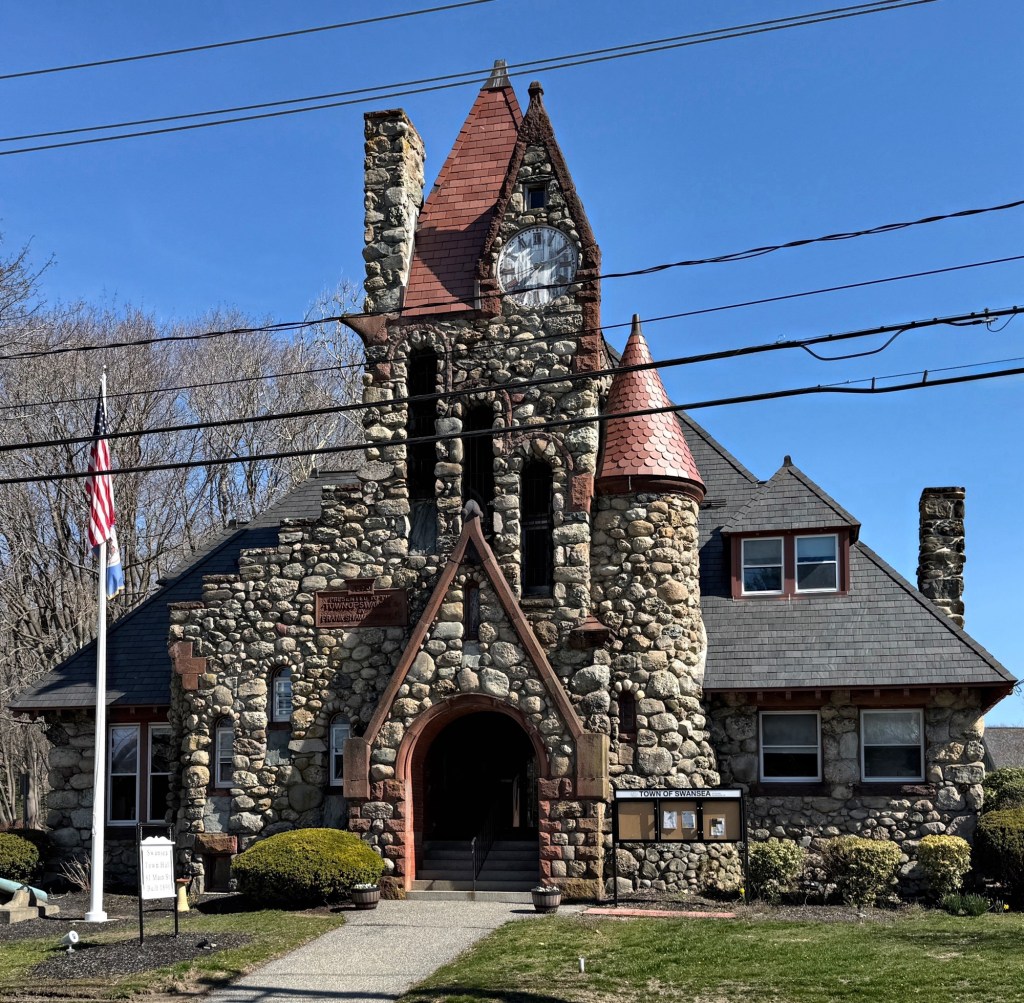
The Swansea Town Hall in Swansea, Massachusetts, is one of the most unusual and architecturally eclectic town hall buildings in New England, and was a gift to the community from a wealthy resident. Built in 1891 from plans by Boston architect, James Merrill Brown, the building is constructed of randomly laid rubblestone with brownstone trim with a massive pyrammidal slate roof and offset turret and tower containing a historic clock. The building was the gift of benefactors, Frank Shaw Stevens and Elizabeth Case Stevens, who lived down the street in the town’s largest mansion. The Stevens’ donated the building with the stipulation that the building was to be available to every and any religious society desiring to hold funeral services there and to also provide space for a public library. The town obliged. The space was outgrown and the Stevens’ would later donate the town’s public library next door and a church, that also held funeral services for the community. The building has been home to the Town Hall since 1891.
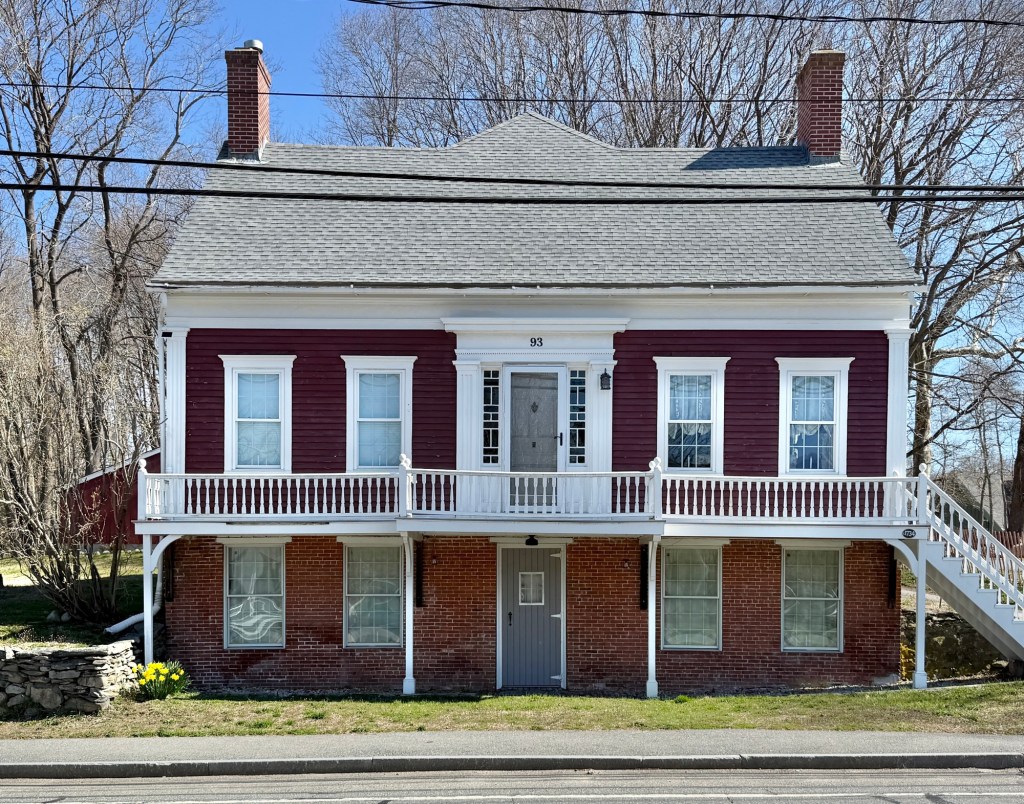
This unique two-story house on Main Street in Swansea, Massachusetts, is said to date to about 1734 but for the most part, its appearance dates to 100 years later. It is possible this was once a one-story, brick house, but by 1836, the property was owned by Samuel Sherman Hull (1788-1862) and Sarah Waite Hull (1799-1863) who married in 1835. It was during their ownership, that the house was expanded and “modernized” in the Greek Revival style in the 1830s or 1840s, when the wooden upper floor was added with elaborate central entrance with sidelights and pilasters at the corners and entry. The property was farmed by Mr. Hull and by the end of the 19th century, was owned by Mrs. Caroline A. Chace. It is possible that the brick floor operated as a store with a residence above but now is a single-family home.
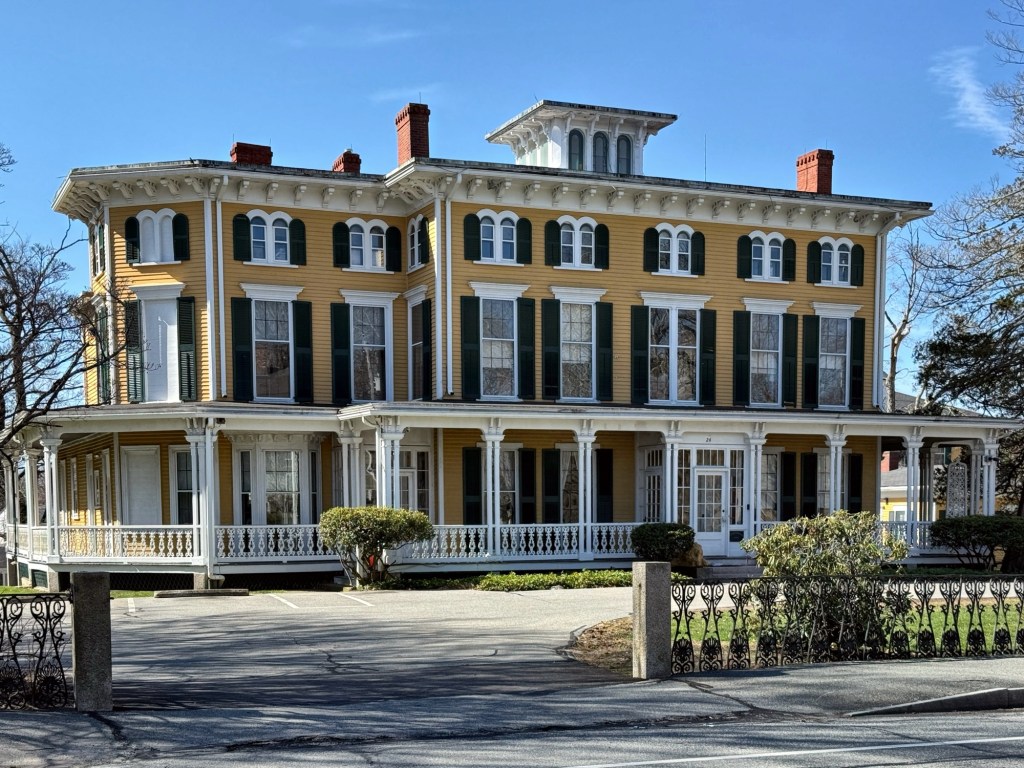
Built in 1855, the Birch-Stevens Mansion of Swansea, Massachusetts, is a grand Italianate style residence distinguished by its low hipped roof with belvedere, broad overhanging eaves with brackets, paired arched windows, and expansive wrap-around porch, all of a scale not commonly found in such a small community. The residence was built for James Birch and overseen by his new bride, Julia Chace. Before construction on the home, James Birch (1828-1857), not a wealthy man, worked as a stagecoach driver in Providence. His bride-to-be desired a large mansion in her native Swansea, equipped with servants and all the finer things of life. Since this dream was not attainable in his present circumstances, Birch, an enterprising 21 year old, decided to join the Gold Rush in California to make his fortune. In California, James became a stagecoach line entrepreneur and founder of the California Stage Company, the largest stage line in California in the 1850s. James made a fortune and returned to his wife in Swansea bringing money for her to begin constructing their grand mansion. James left again, this time establishing the San Antonio -San Diego Mail Line, the first transcontinental mail route in the United States. In 1857, while heading home, James sailed from San Francisco to Panama, took a train across the Isthmus, and sailed for New York on the steamer SS Central America. During the voyage, his ship was struck by a hurricane and later sunk. Many survivors clung to pieces of the ship’s wreckage for days with many dying to exposure or were swept away to their deaths, like James. He was just 28 years old. Back in Swansea, Julia was heartbroken but remarried her late-husband’s business partner, Frank Shaw Stevens, an equally successful businessman. Julia died in 1871, and Frank married a younger Elizabeth Case. The couple resided in this mansion for decades and donated substantially to their community, including funding the Town Hall, Public Library, Episcopal Church, and local public schools. In her will, Elizabeth Case Stevens bequeathed the large mansion in 1837 to the Frank S. Stevens Home for Boys which began as a boy’s orphanage. The organization remains to this day with an expanded mission, and maintain the sprawling estate and its various outbuildings, including the historic stable and farm structures.
Cemetery chapels are fairly uncommon, but always a must-see when exploring a new place. These small charming buildings help bridge the gap between life and death and are often adorned with a permanence not seen in our lifetimes. This is the Card Memorial Chapel in the Spring Brook Cemetery of Mansfield, Massachusetts. The chapel was erected in 1898 as a memorial to 31-year-old Mary Lewis Card, who died in 1896. Mary’s parents, Simon W. Card and Mary J. Card, founded S.W. Card Manufacturing Company in 1874. The Mansfield-based company did very well and manufactured tap and die tools locally, shipping them all over the country. Before her abrupt death, Mary Lewis Card was set to marry architect Charles Eastman, who is credited with designing the memorial to his late-fiance. The chapel borrows from the Romanesque and Victorian Gothic styles, and is constructed of red brick laid with a tinted mortar atop a foundation of Quincy granite. The various roof sections are sheathed in green slate. The building displays a cross plan with a central tower rising forty-two feet from the ground to the apex, topped by a steeply pitched pyramidal roof. The building was restored years ago and still looks great!
Arguably the most beautiful building in Mansfield, Massachusetts is the Soldier’s Memorial Library in the center of town. Constructed in 1901, the Soldiers’ Memorial Library is a well-preserved example of 19th century High Victorian architecture with Shingle style elements, designed by the prominent Boston architectural firm of Peabody & Stearns. In as early as 1896, the idea of constructing a building as a memorial to the soldiers who died in the Civil War had prominent local members of the community. In 1898, a relatively new resident in town, Mrs. Elizabeth Noble, donated a parcel of land for the building with the stipulation that the first floor was to be used as a library and the second floor as an “audience room”, banquet room, and kitchen for the use of the G.A.R. The architects created one of their most significant civic buildings with an interesting juxtaposition of Gothic elements with Shingle style details. The Gothic lancet window and door surround blends surprisingly well with the use of rubblestone on the first story with buttresses and shingle siding above which give the building a fortress-like appearance.
This charming Federal period dwelling in Mansfield, Massachusetts, was built around 1830 by Solomon Pratt and his brother-in-law, Elkanah Bates as a boarding house for the workers at their nearby cotton mill. The duplex was historically split down the middle with a unit on each side, accessed by the shared center stairhall. Local lore states that the Irish immigrant families who lived in this property reported that there were “supernatural” noises in the house, which frightened the occupants, they would tell friends it was “thundering in the castle”, giving the property the nickname, Thunder Castle.
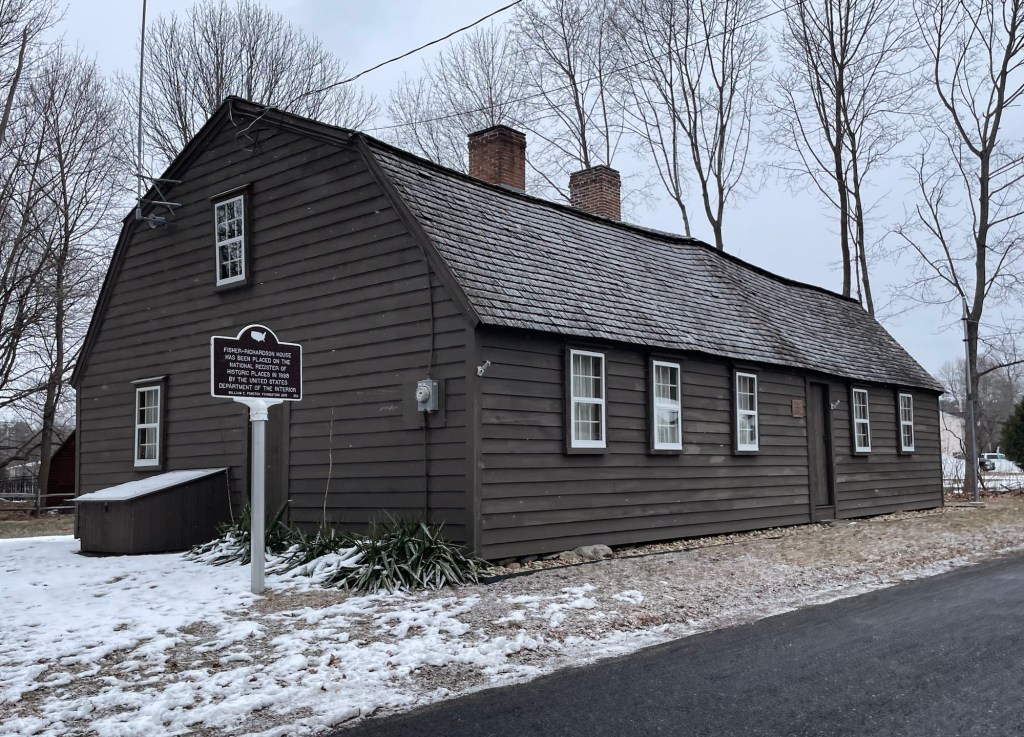
The Fisher-Richardson House in Mansfield, Massachusetts is considered to be one of the oldest buildings in the suburban town. The home dates to sometime between 1743 and 1751 and was built for its original owner Ebenezer Wellman (1720-1776). The property was eventually owned by Lemuel Fisher, who in about 1800, doubled the size of the house adding its western half. When Lemuel died in 1820, the property was inherited by his youngest son, Daniel, a farmer and blacksmith who also built a gristmill nearby. The home was later inherited by Daniel’s daughter, Evelina and her husband, Captain Ira Richardson. By 1930, the gambrel-roofed Georgian house was in disrepair, and the owner at the time contacted SPNEA (now Historic New England) who drafted an agreement to acquire and restore the house. However, as local interest in the property increased, the owner deeded the property to the town, and the town took on the costs of restoration. The property is now managed by the Mansfield Historical Society.
Tucked away on a side street in Mansfield, I was pleasantly surprised to stumble upon this charming example of a Craftsman bungalow, a style and form not too common in New England. The style, synonymous with the western United States’ population growth in the early 20th century, never took off the same way here as Yankee homeowners and builders often stayed true to the Colonial Revival style (even today). This building is said to date from the early 1800s and was built as a Federal style cape. It was owned by a Margaret Lane in the late 19th century. By the 1930s, the house was significantly altered with a full-length porch supported by tapered shingled columns atop fieldstone bases and new dormers at the roof with flared eaves. The building has been home to a local chapter of the Daughters of the American Revolution (DAR). What a charmer!
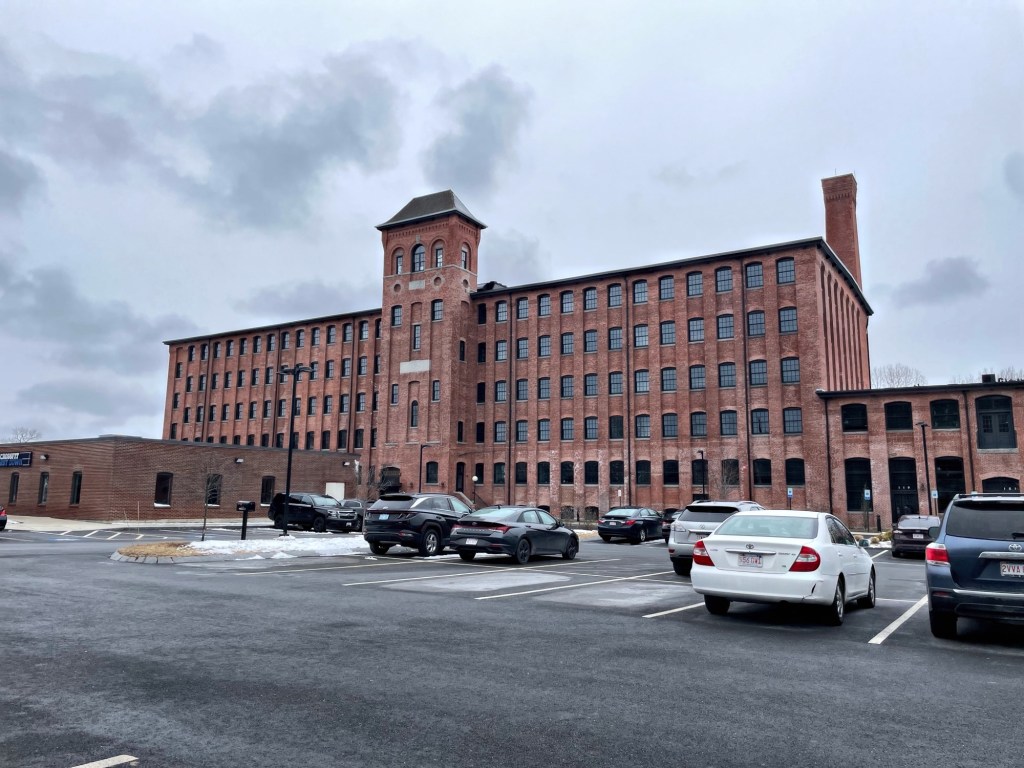
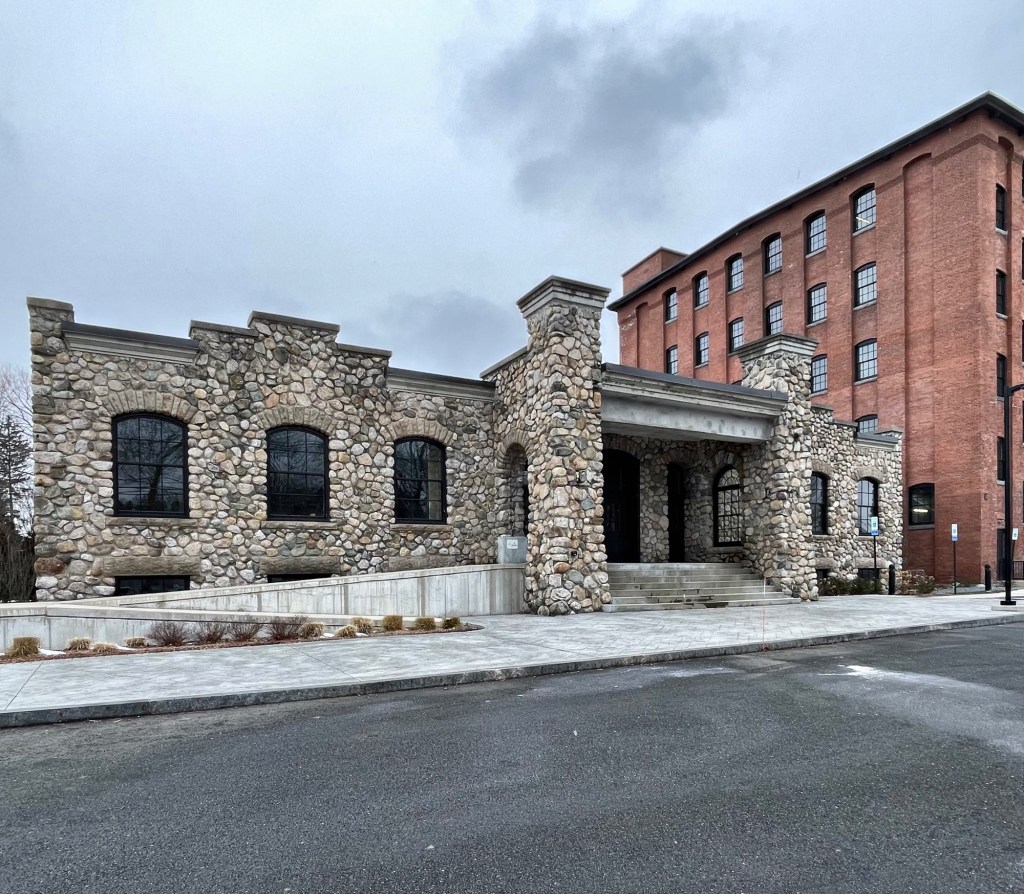
The Lowney Chocolate Factory is a historic industrial complex in Mansfield, Massachusetts and was established there after town officials took advantage of rail access provided by the Boston and Providence Railroad and enticed businesses to establish themselves in Mansfield. The Walter M. Lowney Company was a chocolate and candy business founded in Boston in the early 1880s by Walter M. Lowney, who started his business by manufacturing chocolate bonbons. The company built offices and factories in Boston, Montreal and here in Mansfield, where they would ship out boxed sweets to stores all over the country. The Mansfield factory was designed by the architectural and engineering firm of Dean & Main in 1903. The firm was comprised of partners Francis W. Dean and Charles T. Main, who had offices in Boston and specialized in mill design and engineering from 1893 to 1907, originally designing Lowney’s Boston factory in the North End. A later fieldstone addition was added in 1910 and housed the company’s office and shipping facilities. After Walter Lowney died in 1921, the Walter M. Lowney Company continued to operate under the ownership of Lowney’s wife. In the 1930s the factory property was wholly purchased by the Rexall Drug Company, who renamed the Lowney company, United Chocolate Refiners. The Mansfield factory was later owned by Nabisco to make chocolate for oreo cookies for a number of years until it again changed hands. The factory had been largely empty since 2010 until it was recently converted to mixed-income housing (the best kind of redevelopment)! Who doesn’t love a happy ending?
Welcome to Mansfield, Massachusetts! Located in the southeastern part of the state, this very suburban town is often overlooked in terms of architecture, but there are definitely some great buildings to discover. This is the Orthodox Congregational Church of Mansfield, an 1839 edifice at the town’s South Common. The congregation was established in the 1730s and followed strict Congregationalist beliefs, which were at odds with the growing tide of Unitarianism which was becoming a dominant belief in the Commonwealth by the early 1800s. The differences came to a head when the Anti-Slavery Riot of 1836 occured. Factions of local pro- and anti-slavery residents fought when Charles C. Burleigh, Secretary of the American Anti-Slavery Society, was invited, with the consent of the parish committee, to lecture in the meeting-house. This difference of theological taste as well as a difference of opinion on the idea of slavery led, in 1838, to the forming of a new society, the Orthodox Congregational Society, who built this church soon-after. While the split-off congregationalists were “behind the times”, among the separatists were Hermon Hall and Deacon Otis Allen, secretary and president of the Mansfield Anti-Slavery Society. This church was completed in 1839, and was altered and enlarged in the 1850s and 1870s.
Architects William Robert Ware and Henry Van Brunt designed this parsonage in Easton, Massachusetts for the Unity Church in town (featured previously). The Victorian Gothic house is constructed of polychromatic stone, wood trim, slate and copper roof surfaces, and terracotta finials. The architecture is very well-developed and stands toe-to-toe with the other architectural landmarks in town, just a short walk away.
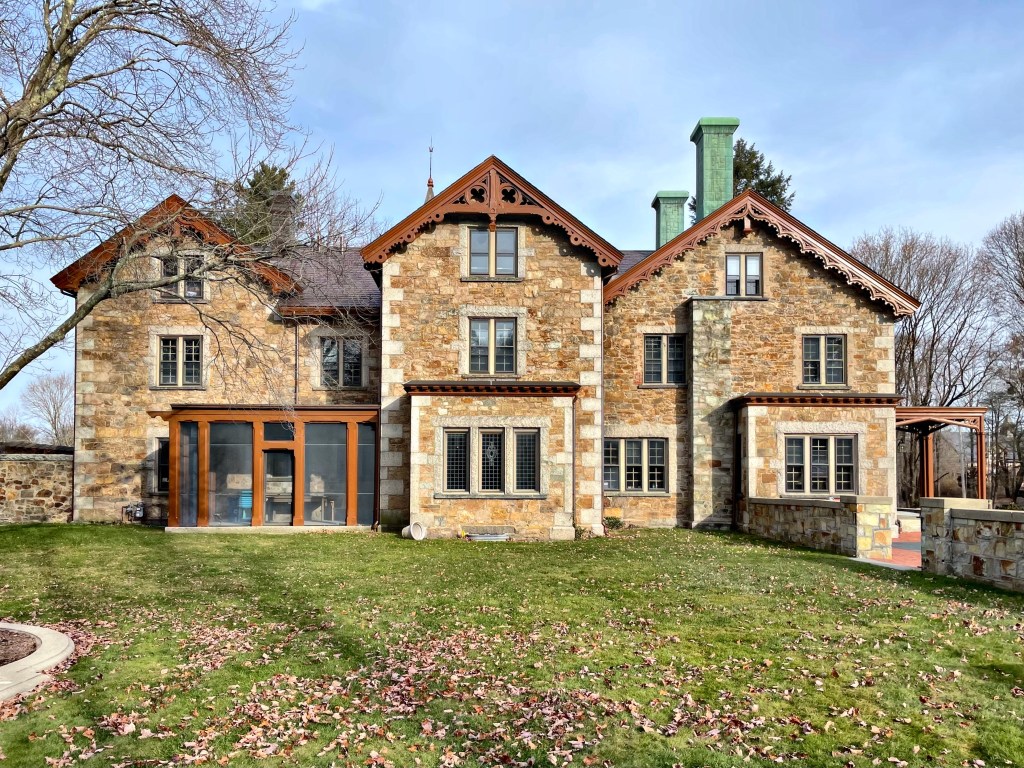
Tucked away behind the Ames Free Library in Easton, you will find one of the most stately examples of Gothic Revival architecture in a house in New England. The house is known as Queset House. Queset was commissioned to be built in 1853 and it was completed the following year for Oakes Angier Ames, of the wealthy Ames Family, who ran a shovelworks in town, and built some of the most handsome structures in the state. The house’s front portion design was drawn from a plan by noted architect Andrew Jackson Downing (who died in 1852). Downing collaborated with Alexander Jackson Davis who provided architectural drawings. The two architects created pattern books which greatly influenced Gothic Revival and Italian Villa style architecture for the next decades, with many wealthy people hiring builders to complete homes in their designs. Queset House is different than most in that the house is constructed of local stone. Oakes would later hire Harvard-educated architect John Ames Mitchell, (a first cousin of Oakes Angier and architect of the nearby Unity Church in Easton) designed the rear addition in 1873, adding the copper-clad chimneys. In the later years of his life, Oakes wanted to help further-improve his town and worked with his family to consult with starchitect H. H. Richardson and landscape starchitect Frederick Law Olmsted on projects in town (the Library, Town Hall, Rockery). After his death in 1899, the home was occupied by his son, famous theatrical producer Winthrop Ames, and his wife. The family would eventually gift the property to the Town of Easton, who today occupy it as an extension of the Public Library, open to the public!
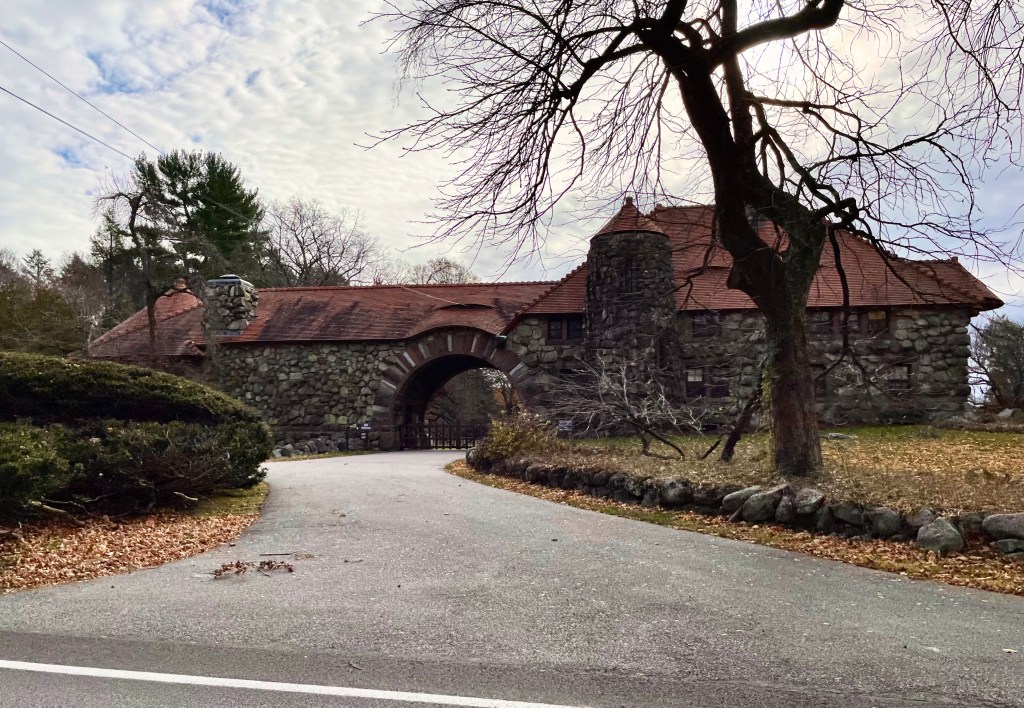
In 1880, twenty years after Frederick L. Ames built his rural estate “Langwater”, he felt the need to give the property more rural character, especially given the close proximity to the Ames Shovel Works. Emulating old European estates with gatehouses, Ames hired star-chitect Henry Hobson Richardson, to design a gate lodge at the entrance to his property, fitting of one of the richest men in Massachusetts. Richardson’s design for the gate lodge was oriented longitudinally and is bisected by the arched entry to the estate. The large room on the left was intended to serve as a storeroom for flowering plants, and the two-story portion had a caretaker’s residence on the lower floor and a “bachelor hall” for men’s socializing and spill-over bedroom. The building uses glacial boulders found on the expansive grounds and older stone walls, with trim of Longmeadow brownstone. The bright red terracotta roof contrasts boldly with the rough stone walls. The building is one of the most beautiful structures I have seen, but can be difficult to photograph without trespassing. Ugh!
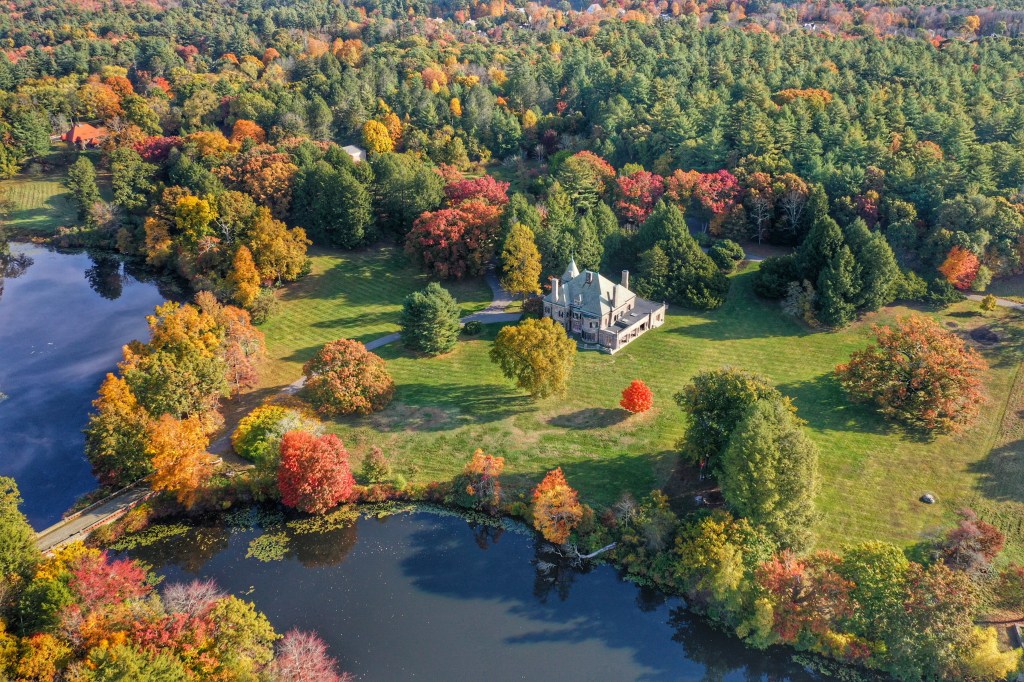
The country estate of Frederick Lothrop Ames (1835-1893), “Langwater” sits in North Easton amongst a collection of some of America’s greatest architectural treasures, all thanks to the Ames Family. The Ames family was a wealthy family which had lived in Easton for many generations. Frederick’s grandfather Oliver Ames Sr. founded the Ames Shovel Works in Easton, Massachusetts. The Shovel Works earned the family a huge fortune, during a time when aggressive canal and railroad expansion was built by the hands of thousands of men using shovels. Frederick’s father Oliver Jr. was president of the Union Pacific Railroad during the building of the transcontinental railroad. Frederick’s cousin Oliver Ames was governor of Massachusetts 1887–1890. Frederick himself was Vice President of the Old Colony Railroad and director of the Union Pacific railroad. At the time of his death, Ames was reported to be the wealthiest person in Massachusetts. With this immense wealth, Frederick built a castle where he would spend most of the year, overseeing his various businesses, in his hometown of Easton, Massachusetts. The mansion was designed by architect George Snell and built around 1860, with a couple additions and updates until Frederick’s death. A few years before his death, Frederick hired famed architect Henry Hobson Richardson, who he already worked with in designing the Oakes Ames Memorial Hall(Easton’s Town Hall), to design a gate house leading to Langwater (more on that later).
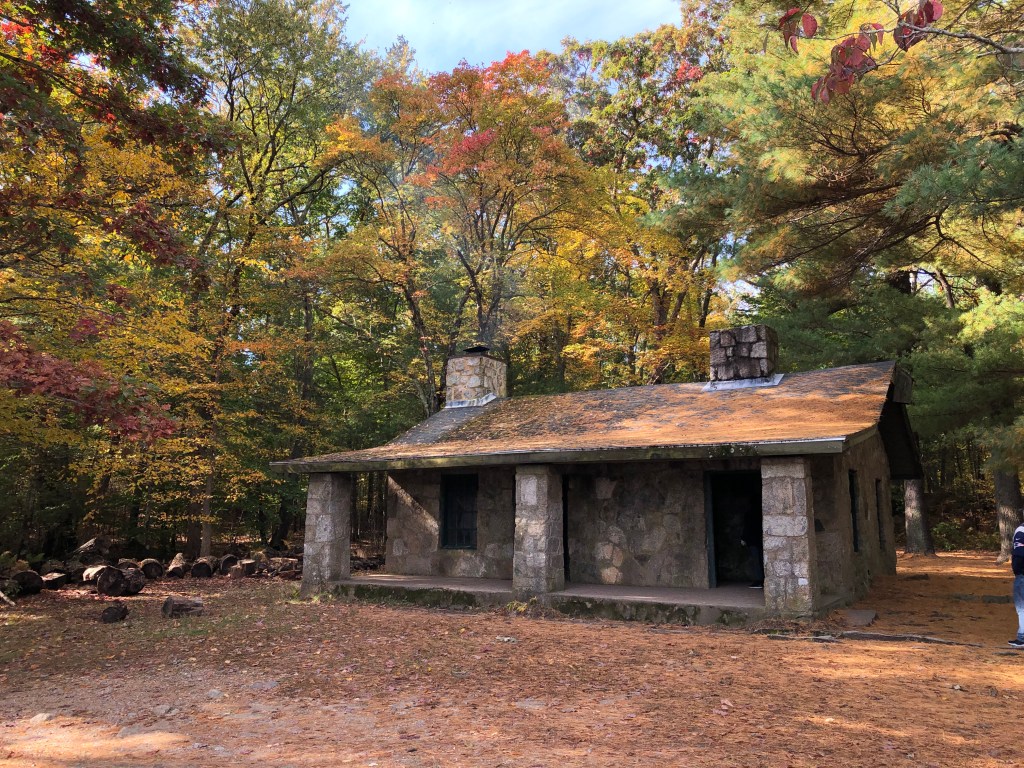
Located near the banks of Leach Pond in Borderlands State Park, this handsome stone structure set the style for one of the most iconic and beautiful buildings in Easton, the Ames Mansion. The one-story concrete and stone structure was designed and constructed under the supervision of Blanche Ames, and may have been a prototype for the construction technique used in the Ames Mansion, built just years later. Blanche was an amazing woman. She was an artist, political activist, inventor, writer, and prominent supporter of women’s suffrage and birth control. In 1900, she married Harvard University botany professor Oakes Ames (no relation). She took the married name Blanche Ames Ames. She illustrated her husband’s botanical research on orchids, and later got involved in designing the family’s country retreat. Originally designed as a warming hut during hunting season, this lodge was originally minimally designed with exposed stone walls. In the 1930s, the lodge was renovated to contain a living space, a kitchen, and a bedroom. When the Commonwealth of Massachusetts acquired the Ames Estate in the 1970s for a state park, the Lodge was restored to its original condition. The hunting lodge is open to the elements and the public, who can warm themselves in one of the two six-foot fireplaces.